

Healthcare professionals rarely stay in one position during a working shift. Nurses walk between patient rooms, doctors bend and reach, physical therapists demonstrate movements, and medical staff may spend hours standing, sitting, lifting, or moving quickly.
For medical uniform brands, this creates an important fabric challenge: how can scrub fabric provide enough stretch for movement without sacrificing structure, durability, or professional appearance?
This is where 4-way stretch scrub fabric becomes increasingly relevant.
Today, stretch is no longer simply a specification listed on a fabric datasheet. When properly engineered, it can become part of the overall performance of a medical uniform—from bending and reaching to pocket loading, garment fit, and long-term appearance.
Why 4-Way Stretch Matters in Medical Uniforms
The term “4-way stretch” generally refers to fabric that can stretch in both the horizontal and vertical directions and recover after movement. This is different from a fabric designed primarily for one-directional stretch.
For medical uniforms, multidirectional stretch can be useful because healthcare work involves movements in several directions.
A nurse may need to:
- Bend down to assist a patient
- Reach forward or overhead
- Sit and stand repeatedly
- Walk quickly between departments
- Carry equipment or supplies
- Move the arms freely during clinical procedures
Spandex or elastane is commonly incorporated into woven fabric blends to provide elasticity and flexibility. Fabric guides from Uniform Advantage also identify spandex as a fiber that adds stretch and flexibility, while polyester contributes durability and shape retention.
This combination makes poly rayon spandex medical fabric particularly interesting for brands looking for a balance between softness, structure, stretch, and everyday wear.
From “Stretch” to Long-Shift Productivity
For a scrub manufacturer, simply stating that a fabric has 4-way stretch does not fully explain its value.
The more useful question is:
How does the fabric perform when the wearer is moving for an entire shift?
Consider a pair of scrub joggers.
During a typical workday, the wearer may repeatedly bend at the knees, sit down, stand up, walk quickly, and stretch the legs. If the fabric has insufficient flexibility, tension can build around the knees, hips, and seat.
A well-designed stretch woven fabric can provide additional movement allowance while maintaining the intended garment silhouette.
This is one reason modern scrub collections increasingly combine stretch fabrics with contemporary silhouettes such as joggers, tapered pants, and athletic-inspired fits. Current product offerings from major uniform retailers include both jogger styles and stretch fabric constructions, demonstrating how movement-oriented design has become part of the medical uniform product landscape.
For B2B buyers, however, the goal should not simply be to maximize stretch.
The goal is to find the right balance between stretch, recovery, structure, and durability.
Poly Rayon Spandex: A Practical Fabric Combination
Different fiber combinations create different performance profiles.
For example, polyester can contribute durability, dimensional stability, wrinkle resistance, and easy-care characteristics. Rayon is often incorporated to provide a softer hand feel, while spandex contributes elasticity.
Commercial medical uniform products currently use a range of polyester/rayon/spandex constructions. For example, Uniform Advantage lists medical uniform products using blends such as 71% polyester/24% rayon/5% spandex and 74% polyester/23% rayon/3% spandex.
Other products use higher-spandex polyester constructions. One current 4-way stretch scrub collection, for example, uses a 93% polyester/7% spandex fabric.
This illustrates an important point for fabric buyers:
There is no single “correct” stretch ratio for every scrub application.
The appropriate construction depends on the garment design, target market, desired hand feel, weight, recovery requirements, and cost structure.
Stretch Must Work with Garment Structure
More stretch does not automatically mean a better medical uniform.
If a fabric is too soft or lacks sufficient structure, a garment may not deliver the professional appearance expected by hospitals, clinics, or uniform brands.
This is especially important around functional areas such as:
- Cargo pockets
- Hip and seat areas
- Knee areas
- Waistbands
- Shoulder seams
- Pocket openings
- High-movement sleeve areas
For example, a cargo scrub pant may need enough flexibility around the hips and knees while still maintaining sufficient fabric stability around heavily used pockets.
This is why 4-way stretch scrub fabric should be evaluated as part of the complete garment system rather than as an isolated fabric parameter.
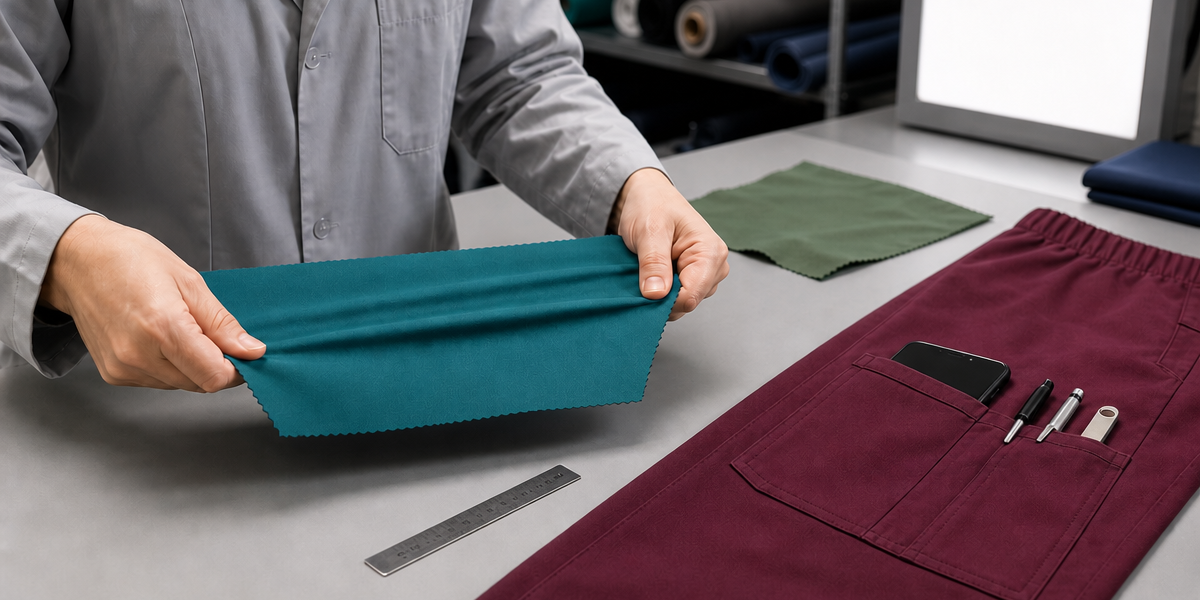
Don’t Forget Pocket Loading
Pocket performance is an often-overlooked consideration when evaluating stretch medical uniform fabrics.
Healthcare uniforms frequently include multiple pockets for pens, phones, medical tools, identification cards, and other daily-use items.
When a pocket is loaded, the surrounding fabric experiences additional tension.
If the fabric construction and garment engineering are not properly matched, repeated loading may affect the appearance of the pocket area.
For buyers developing new scrub collections, it can therefore be useful to test:
Stretch + recovery + pocket loading + repeated movement
rather than testing stretch alone.
This approach provides a more realistic picture of how the fabric may perform in an actual uniform.
Fabric Recovery Is Just as Important as Stretch
Stretch describes how much a fabric can extend.
Recovery describes how well it returns toward its original dimensions after being stretched.
These are not the same thing.
A fabric can feel very elastic during a hand test but still require further evaluation for recovery after repeated use.
For medical uniform development, buyers should consider testing:
- Stretch percentage
- Stretch recovery
- Dimensional stability after washing
- Fabric appearance after repeated movement
- Pilling resistance
- Colorfastness
- Seam performance
- Hand feel after laundering
This is especially important because medical uniforms are frequently washed.
The objective is not to promise that a fabric will “never deform.” Instead, buyers should establish measurable performance requirements based on their garment design and intended use.
Washing and Dimensional Stability Matter
A stretch fabric can perform well during the first fitting but behave differently after repeated laundering.
For this reason, wash testing should be part of fabric evaluation.
Depending on the product specification, buyers may evaluate:
- Length change
- Width change
- Appearance after washing
- Stretch recovery after washing
- Colorfastness
- Pilling
- Hand feel
- Surface appearance
Polyester is commonly valued for its ability to maintain shape and resist shrinking, while spandex provides elasticity in blended scrub fabrics.
However, actual performance depends on the complete fabric construction and finishing process. Therefore, buyers should rely on test results for the specific fabric rather than assuming that fiber composition alone guarantees a particular result.
How Should Medical Uniform Brands Select Stretch Fabric?
When sourcing stretch nursing uniform fabric or developing a new scrub collection, consider these questions before placing a bulk order:
1. What movement does the garment require?
Jogger pants, fitted scrub tops, jackets, and relaxed-fit uniforms may require different levels of stretch and recovery.
2. How important is structure?
A fashion-forward scrub may prioritize softness and flexibility, while a more traditional medical uniform may require a firmer and more structured appearance.
3. What is the target GSM?
Fabric weight influences drape, opacity, durability, hand feel, and garment appearance. The appropriate GSM should be selected according to the garment and market rather than choosing the highest or lowest number.
4. What will happen after repeated washing?
Ask for dimensional stability and colorfastness test data where applicable, and conduct your own sample washing when developing a new product.
5. Can the fabric support the garment construction?
Evaluate pocket areas, seams, waistbands, knee areas, and other high-stress points together with the fabric.
The Future of Stretch Scrub Fabric Is About Balance
The development of medical uniforms is moving beyond the simple question of whether a fabric stretches.
For modern scrub brands, the more useful question is:
Can the fabric provide the right combination of flexibility, recovery, comfort, structure, durability, and easy care for real healthcare work?
Current scrub collections show that stretch fabrics are being used across contemporary designs, including joggers, tapered pants, athletic-inspired fits, and 4-way stretch constructions.
For fabric manufacturers and B2B buyers, this creates an opportunity to develop more application-focused materials.
At YunAi Textile, we believe fabric development should begin with the actual requirements of the finished uniform—not simply a list of fiber percentages.
Whether the project requires 4-way stretch scrub fabric, poly rayon spandex medical fabric, or stretch nursing uniform fabric, the fabric should be evaluated through the complete process: fiber composition → weaving → finishing → stretch and recovery → garment construction → washing → final application.
Because in a long healthcare shift, stretch is not just a number on a specification sheet.
It is part of how the uniform performs.

Yunai Textile
Post time: Sep-16-2026