
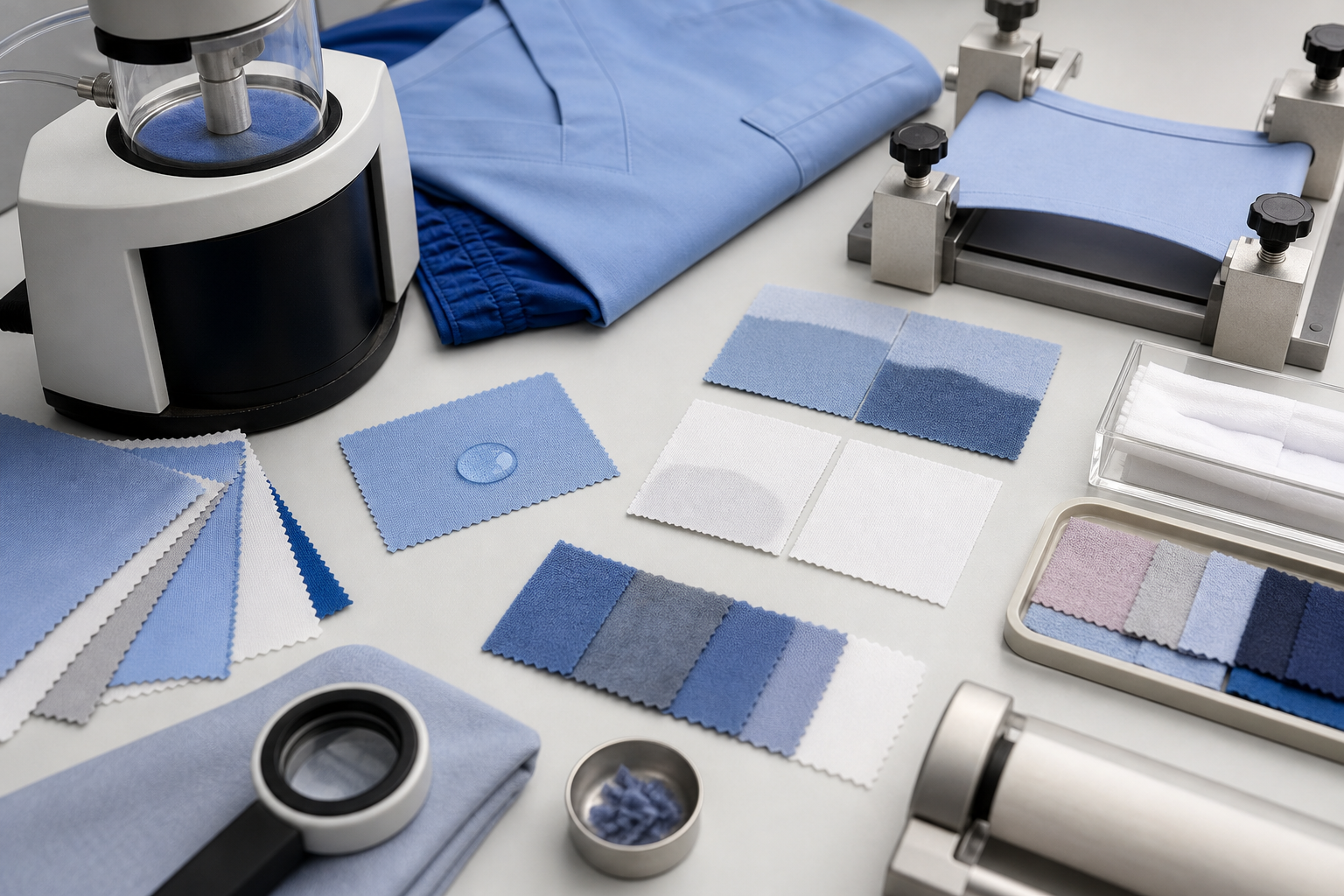
Choosing medical uniform fabric for hot and humid climates requires more than comparing fiber composition and GSM. Healthcare uniform buyers need to understand how the fabric behaves in actual use, especially when uniforms are exposed to heat, perspiration, frequent washing, stretching, and changing indoor and outdoor environments.
For medical uniform brands, wholesalers, hospital suppliers, and procurement teams, requesting relevant test data can provide a more objective basis for comparing fabrics and suppliers.
This article explains five important categories of fabric performance that buyers can consider when developing medical uniforms for hot and humid climates.
1. Air Permeability: How Easily Can Air Pass Through the Fabric?
Air permeability is one of the most useful characteristics to consider when developing breathable medical uniforms.
It describes how easily air passes through a fabric under specified test conditions.
This can be relevant for medical uniforms used in:
- · Hot climates
- · Humid environments
- · Outdoor healthcare work
- · Warm hospital areas
- · Tropical regions
However, air permeability should not be assumed from GSM alone.
Two fabrics with similar GSM can have different air permeability because of differences in:
- · Yarn characteristics
- · Weave structure
- · Fabric density
- · Thickness
- · Fiber composition
- · Finishing
For this reason, buyers can request air permeability data when comparing breathable scrub fabrics.
What buyers should compare
Rather than asking only:
“Is this fabric breathable?”
buyers can request:
- · Air permeability test result
- · Test method
- · Test conditions
- · Fabric construction
- · GSM
This creates a clearer basis for comparison.
2. Moisture Management: How Does the Fabric Handle Perspiration?
Hot and humid climates can increase perspiration, making moisture management an important consideration for medical uniforms.
However, moisture management is more complex than simply asking whether a fabric absorbs moisture.
A useful way to understand the process is:
Moisture → spreading → movement → evaporation
A fabric may absorb moisture but not necessarily move or release it efficiently.
Therefore, buyers can consider moisture-related performance from several perspectives.
Moisture management can include:
- · Moisture spreading
- · Moisture movement
- · Absorption behavior
- · Drying behavior
- · Interaction with fabric construction
The exact test selected should depend on the product requirements.
For tropical medical uniforms, comparing candidate fabrics under consistent testing conditions can help buyers understand their relative moisture behavior.
3. Quick-Drying Performance: How Fast Does Moisture Leave the Fabric?
Quick drying is related to moisture management but is not exactly the same thing.
A fabric may spread moisture effectively but still require suitable environmental conditions for evaporation.
Drying can be influenced by:
- · Fiber composition
- · Fabric construction
- · Fabric thickness
- · Moisture distribution
- · Airflow
- · Temperature
- · Humidity
This is particularly relevant in Southeast Asian and other humid climates, where the surrounding air may already contain significant moisture.
For buyers, it is therefore useful to distinguish between:
Moisture wicking
and
Quick drying
When evaluating a supplier’s claim, ask for the specific test method and result rather than relying on general marketing descriptions.
4. Opacity: Does the Fabric Provide Suitable Coverage?
Opacity can be especially important for white and light-colored medical uniforms.
A fabric may appear sufficiently covered under normal conditions but look different when:
- · The fabric is stretched
- · The fabric becomes damp
- · It is viewed under strong lighting
- · It is made into a fitted garment
This is why opacity should be considered during fabric development rather than after bulk production.
A practical comparison can include:
Dry sample
vs.
Damp sample
vs.
Stretched sample
vs.
Actual garment
This type of evaluation can provide useful information about real-world appearance.
For white, light blue, pale gray, and other light-colored medical uniforms, buyers should pay particular attention to wet-state appearance and show-through.
5. Colorfastness: Can the Color Maintain Its Required Performance?
Medical uniforms are frequently washed and handled, so colorfastness can be an important part of fabric evaluation.
Depending on the end use, buyers may consider:
- · Washing colorfastness
- · Rubbing colorfastness
- · Perspiration colorfastness
- · Light-related colorfastness where relevant
Different tests measure different aspects of color performance.
For example, dry and wet rubbing can provide different information.
This is why a general statement such as “good colorfastness” is not enough for a detailed procurement specification.
Buyers should request the relevant test results and confirm that the test conditions match their intended requirements.
6. Pilling Resistance Should Also Be Considered
Although pilling is not specific to hot climates, it can affect the long-term appearance of medical uniforms.
Frequent wear, washing, friction, and garment movement can contribute to surface changes.
For professional medical uniforms, excessive pilling may affect the perceived appearance of the garment.
Buyers can therefore include pilling resistance in their fabric evaluation.
This can be particularly useful when comparing different:
- · Fiber blends
- · Yarn constructions
- · Fabric structures
- · Finishing processes
The appropriate performance level should be defined according to the garment and customer requirements.
7. Dimensional Stability: Does the Fabric Maintain Its Size?
Medical uniforms need to maintain their intended garment dimensions after washing.
Changes in fabric dimensions can affect:
- · Garment fit
- · Sleeve length
- · Trouser length
- · Overall appearance
- · Pattern matching
- · Production consistency
Therefore, dimensional stability can be an important part of fabric testing.
Buyers should consider the actual washing and drying conditions used for the finished garment.
A laboratory test should ideally reflect the intended care process as closely as practical.
8. GSM and Width Should Be Verified
GSM remains an important basic specification.
However, buyers should treat GSM as one part of a complete specification rather than the only performance indicator.
Fabric width is also important because it can influence:
- · Cutting efficiency
- · Garment consumption
- · Production planning
- · Final garment cost
During bulk production, buyers may want to verify:
- · GSM
- · Usable width
- · Construction
- · Composition
These measurements can help confirm that the production fabric remains within the approved specification.

9. Stretch and Recovery for Stretch Medical Fabrics
Modern medical uniforms increasingly use stretch woven fabrics.
For these fabrics, simply stating “4-way stretch” may not provide enough technical information.
Buyers may also want to understand:
- · Stretch percentage
- · Recovery
- · Fabric stability
- · Dimensional changes after washing
Stretch performance can influence garment comfort and fit, but excessive or unstable stretch may create different garment-production challenges.
Therefore, stretch should be evaluated together with recovery and dimensional stability.
10. Test the Fabric Under Relevant Conditions
One of the most important principles in fabric testing is that the test should relate to the actual product.
For example, a fabric intended for:
Hot + humid + frequent washing
may require a different testing focus from fabric intended for:
Cool + dry + occasional washing
Similarly, a white medical uniform may require different appearance evaluations from a dark-colored uniform.
The buyer should therefore establish the intended end-use conditions before finalizing the testing program.
11. Ask for the Test Method, Not Just the Result
When a supplier provides a test result, buyers should also understand:
- · What was tested?
- · Which test method was used?
- · Under what conditions?
- · What was the sample condition?
- · Was the result from laboratory testing or internal evaluation?
This is particularly important when comparing results from different suppliers.
Two numbers may not be directly comparable if they were obtained using different methods or conditions.
A professional procurement process should therefore consider both the result and the testing context.
12. Build a Medical Uniform Fabric Test Sheet
For repeated purchasing, buyers can create a standard specification sheet.
For example:
|
Category |
Items to Check |
| Basic | Fiber composition, GSM, width |
| Construction | Weave, density, thickness |
| Breathability | Air permeability |
| Moisture | Moisture management, drying |
| Appearance | Opacity, wet-state appearance |
| Color | Washing, rubbing, perspiration |
| Durability | Pilling, dimensional stability |
| Stretch | Stretch percentage, recovery |
| Production | Shade consistency, bulk stability |
This makes it easier to compare suppliers and maintain consistent requirements across different orders.
13. Test the Bulk Fabric, Not Only the Sample
A sample may meet expectations, but the final production fabric still needs quality control.
For B2B medical uniform programs, buyers can establish a process such as:
Development sample → Approved sample → Bulk production → Bulk inspection → Shipment
Before shipment, the production lot can be checked against the approved specifications.
Depending on the project, this may include:
- · GSM
- · Width
- · Color
- · Appearance
- · Fabric defects
- · Stretch
- · Hand feel
- · Relevant performance requirements
This helps reduce the risk of differences between the development sample and the final production.
14. Do Not Use One Test to Define the Entire Fabric
A common mistake is to select a fabric based on one impressive performance number.
For example:
- · High air permeability does not automatically mean excellent durability.
- · High moisture absorption does not automatically mean quick drying.
- · Low GSM does not automatically mean better comfort.
- · High stretch does not automatically mean better garment performance.
Medical uniform fabric is a system of characteristics.
The most useful approach is to evaluate the combination of properties according to the final application.
15. A Practical Buyer Checklist
Before approving medical uniform fabric for a hot or humid market, buyers can ask:
Comfort
- · Is the fabric sufficiently breathable?
- · How does it manage moisture?
- · How does it dry?
- · Is the fabric sufficiently opaque?
- · How does it look when damp?
- · Does the color remain consistent?
- · How does it perform after washing?
- · Is pilling controlled?
- · Is dimensional stability suitable?
- · Is GSM within specification?
- · Is width stable?
- · Is the stretch and recovery suitable?
- · Can the supplier reproduce the approved fabric consistently?
- · Can bulk samples be checked before shipment?
- · Are relevant test reports available?
Appearance
Durability
Construction
Production
These questions can make the sourcing process more systematic.
Conclusion
Selecting medical uniform fabric for hot and humid climates requires more than looking at GSM, composition, or a single performance claim.
Air permeability, moisture management, quick drying, opacity, colorfastness, pilling, dimensional stability, stretch, and bulk consistency can all contribute to the final performance of a medical uniform fabric.
For healthcare uniform buyers, the most practical approach is to establish a clear specification sheet, compare samples under relevant conditions, review appropriate test results, and verify bulk production against the approved standard.
The goal is not to find a fabric with the highest number in one category.
The goal is to identify a balanced fabric specification that matches the actual climate, garment, washing process, and purchasing requirements.

Yunai Textile
Post time: Oct-20-2026