
Introduction
Choosing between TR and TC fabric affects more than the look of a school uniform: it shapes comfort, durability, maintenance, and overall cost across the school year. Although both blends are widely used, they perform differently in daily wear, washing, wrinkle resistance, breathability, and appearance. This comparison explains how polyester-rayon and polyester-cotton fabrics differ in practical terms, where each one performs best, and what schools, suppliers, and buyers should consider before placing an order. By the end, readers will have a clearer basis for matching fabric choice to budget, student needs, and the expected standard of uniform presentation.
Why School Uniform Fabric Selection Matters
When educational institutions and apparel brands develop school uniform programs, the choice of fabric dictates both student comfort and long-term budget viability. We recognize that school uniforms endure rigorous daily wear, requiring materials that can withstand frequent laundering while maintaining a crisp, professional appearance throughout the academic year.
Selecting the right foundation is not merely an aesthetic choice; it is a critical operational decision that impacts parent satisfaction and the school’s overall brand identity. Proper fabric selection minimizes the need for mid-year replacements and ensures consistency across different production batches.
Commercial Trade-Offs Between TR and TC
In our experience, procurement managers constantly navigate the commercial trade-offs between TR and TC blends. Cost is a primary driver, but it must be carefully weighed against garment longevity and lifecycle value. Typically, industrial fabric orders require Minimum Order Quantities (MOQs) ranging from 1,500 to 3,000 meters per color, representing a significant upfront capital commitment.
While TC (Polyester-Cotton) often presents a lower initial procurement cost, making it highly attractive for tight district budgets, TR (Polyester-Rayon) offers a premium drape and superior anti-wrinkle properties that can drastically reduce replacement rates. Balancing these financial factors ensures that schools do not sacrifice structural integrity for short-term savings, ultimately providing a better return on investment over a standard two-to-three-year uniform lifecycle.
Key Performance Priorities for Uniform Fabrics
Evaluating the best school uniform fabric manufacturer requires looking beyond the surface texture to strict, quantifiable performance metrics. We prioritize fabrics that achieve a minimum colorfastness of Grade 4 to both washing and dry rubbing, ensuring that vibrant school colors do not fade or bleed after a single semester.
Additionally, pilling resistance must meet Grade 3-4 standards to prevent the premature degradation of the garment’s surface, which is a common issue in high-friction areas. Breathability, tear strength (requiring a minimum warp/weft tear strength of 15N), and moisture management are equally crucial. In warmer climates, a student’s focus and comfort directly correlate with the thermal regulation provided by their uniform.
TR vs TC Fabric for School Uniforms

To make an informed procurement decision, buyers must understand the fundamental differences between TR and TC. Both are dominant players in the global textile market, but their distinct fiber compositions yield entirely different behavioral profiles in finished garments. Understanding these technical nuances allows brands to allocate the right fabric to the right garment type.
Technical Definitions of TR and TC Fabrics
The acronyms TR and TC refer to highly specific fiber blends used extensively in the apparel industry. TC stands for Tetoron (a widely recognized brand name for polyester) and Cotton. A standard TC fabric for school uniform typically features a 65% polyester and 35% cotton ratio. This engineered blend combines the high tensile strength and color retention of synthetic polyester fibers with the breathable, hypoallergenic softness of natural cotton.
Conversely, TR stands for Tetoron and Rayon (also known as viscose). High-quality TR fabric for school uniform also frequently utilizes a 65/35 or 70/30 blend. The inclusion of rayon—a semi-synthetic fiber derived from natural cellulose—imparts a distinctively silkier hand-feel, a subtle luster, and a much more structured drape compared to traditional cotton blends.
Comparison of Performance and Cost
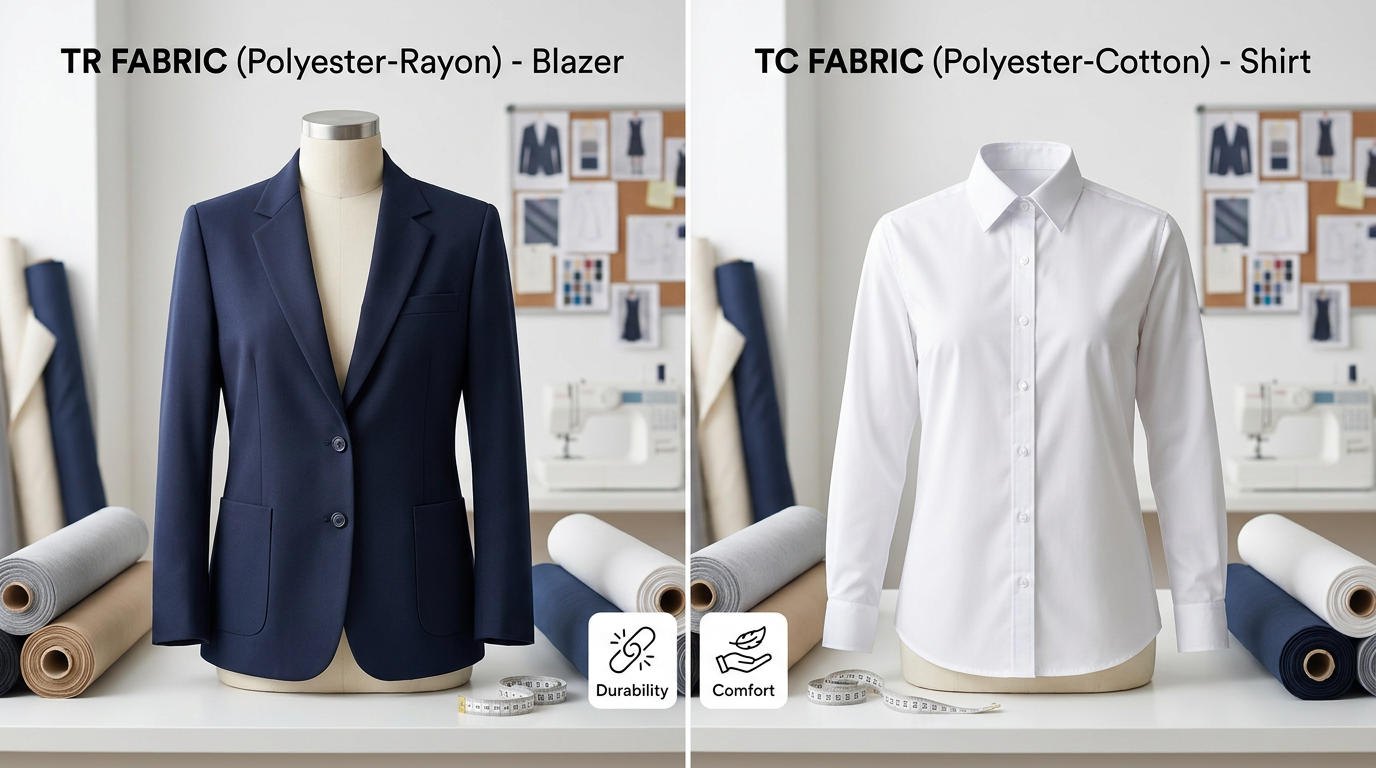
When comparing these two materials, the specific garment application and target price point often dictate the choice. TC is highly breathable, absorbs moisture well, and is exceptionally durable against repeated high-temperature washing, making it the industry-standard choice for lightweight shirting and summer blouses (typically woven between 110-150 gsm).
TR, however, excels in formal wear construction, such as pleated skirts, tailored trousers, and structured blazers. This is due to its excellent wrinkle recovery, smooth finish, and heavier weight profiles (usually ranging from 200-300 gsm).
| Feature | TC (Polyester/Cotton) | TR (Polyester/Rayon) |
|---|---|---|
| Primary Application | Shirts, blouses, summer activewear | Trousers, skirts, blazers, suits |
| Typical Weight Range | 110 – 150 GSM | 200 – 300 GSM |
| Cost Profile | Generally lower | Moderate to premium |
| Key Advantages | High breathability, durability, easy care | Superior drape, soft hand-feel, anti-pilling |
| Wrinkle Resistance | Moderate | Excellent |
| Washing Shrinkage | 3% – 5% | 1% – 3% |
How to Choose Between TR and TC Fabric
Transitioning from technical specifications to actual procurement requires a structured, data-driven evaluation process. We recommend a systematic approach to ensure the chosen fabric aligns with the specific environmental, financial, and demographic needs of the student body, while also meeting international compliance standards.
Practical Evaluation Steps
The first critical step in evaluation is securing physical sample yardage to conduct localized, independent testing. Buyers should verify dimensional stability, ensuring that fabric shrinkage remains strictly below 3% after three standard washing and drying cycles.
It is also vital to partner with a capable, integrated supplier who intimately understands these rigorous parameters. As a trusted manufacturer, we at Yun Ai bring over 20 years of dedicated experience to the textile industry. With robust ODM/OEM capabilities and an extensive global export capacity, we are well-equipped to deliver high-quality, standardized materials at scale. Sourcing and testing a specialized viscose polyester fabric for school uniform from a highly experienced supplier guarantees that your bulk production will perfectly mirror the approved sample’s performance.
Decision Guide for Uniform Fabric Selection
The final decision ultimately relies on aligning fabric properties with garment function and the regional climate of the school district. For tropical or highly humid regions, TC is almost always preferred for upper-body garments to maximize airflow and sweat absorption. For temperate climates or institutions requiring a formal, tailored aesthetic, TR is unmatched for lower-body garments and outerwear due to its sharp crease retention.
When you are ready to finalize your technical specifications, choosing to customize your school uniform fabric ensures the best possible outcome for your institution’s apparel program.
Key Takeaways
- The most important conclusions and rationale for school uniform fabric
- Specs, compliance, and risk checks worth validating before you commit
- Practical next steps and caveats readers can apply immediately
Frequently Asked Questions
What is the main difference between TR and TC fabric for school uniforms?
TR is polyester-rayon, giving a smoother drape and better wrinkle resistance. TC is polyester-cotton, offering better breathability, durability, and a lower cost for everyday schoolwear.
Which fabric is better for school shirts and blouses?
TC fabric is usually better for shirts and blouses because it is lighter, more breathable, and handles frequent washing well, especially in warm climates.
Which fabric is better for skirts, trousers, and blazers?
TR fabric is often the better choice for skirts, trousers, and blazers because it holds shape well, looks more formal, and wrinkles less during daily wear.
How can buyers judge school uniform fabric quality before ordering?
Check key specs like colorfastness Grade 4, pilling resistance Grade 3-4, and tear strength around 15N. These help uniforms last through frequent washing and daily use.
Can I contact IYUNAI Textile for custom school uniform fabric inquiries?
Yes. You can submit fabric questions, customization needs, and bulk order requests through the contact page at iyunaitextile.com/contact-us/.
Post time: May-11-2026