

For healthcare workers in hot and humid climates, wearing a medical uniform for an entire shift can be challenging. High temperatures, humidity, physical movement, and long working hours can all influence how comfortable a garment feels.
When buyers search for medical uniform fabric for hot weather, breathability is often one of the first requirements they mention.
But what exactly makes a fabric breathable?
Is a lower GSM always more breathable?
Does a high polyester content automatically make a fabric less breathable?
And how can buyers compare different fabrics objectively?
The answer is more complicated than simply choosing a lightweight fabric.
For medical uniforms, breathability is influenced by a combination of fiber composition, yarn characteristics, fabric construction, fabric density, GSM, finishing, and garment design.
Understanding these factors can help healthcare uniform brands make better fabric decisions for hot and humid markets.
What Does Fabric Breathability Mean?
In simple terms, breathability describes how easily air can move through or around a fabric.
For woven medical uniform fabrics, air permeability is one measurable property that can be used to evaluate how readily air passes through the fabric under specified testing conditions.
This is different from simply touching a fabric and deciding that it “feels cool.”
A fabric may feel soft or lightweight but still have different air permeability from another fabric with a similar appearance.
Therefore, professional buyers should distinguish between:
Subjective comfort: how a fabric feels when worn.
Measured air permeability: how air passes through the fabric under a defined test method.
Both can be useful, but they answer different questions.
Why Breathability Matters in Hot Climates
In hot environments, healthcare workers may experience increased heat and perspiration during long shifts.
A medical uniform with suitable air permeability can support air exchange between the body and the surrounding environment.
However, fabric breathability should not be viewed as a standalone solution.
Overall comfort also depends on:
- · Temperature
- · Relative humidity
- · Physical activity
- · Garment fit
- · Fabric weight
- · Fabric construction
- · Moisture management
- · Air movement
- · Indoor or outdoor environment
This means that the most breathable fabric on a laboratory test does not automatically become the most comfortable uniform in every real-world situation.
The fabric needs to be matched to the application.
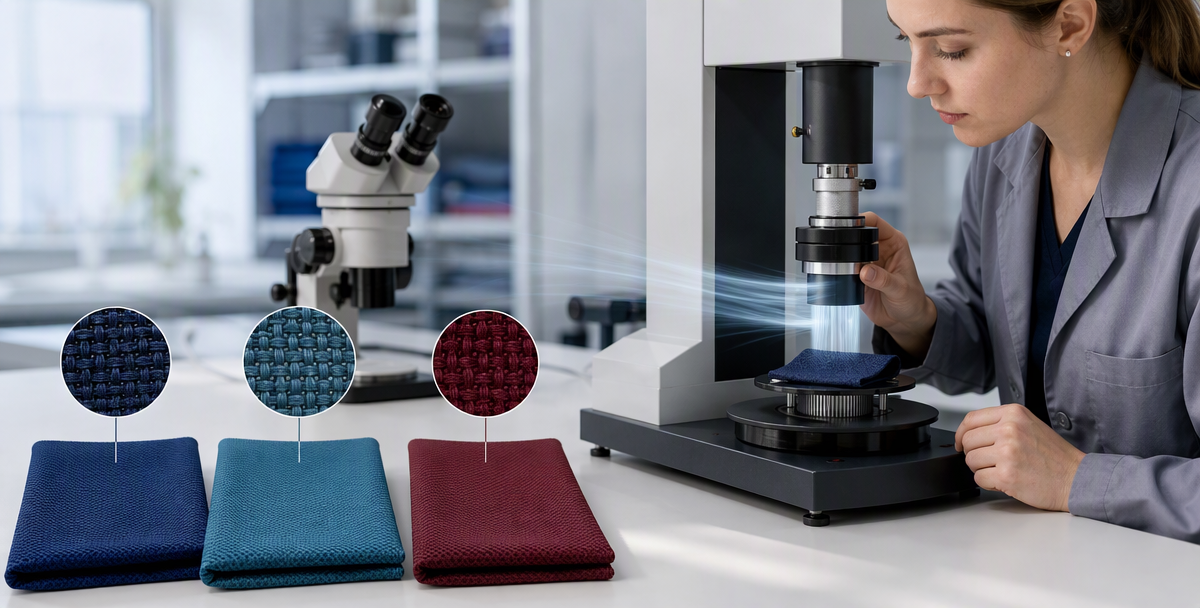
Is Lower GSM Always More Breathable?
This is one of the most common misunderstandings in medical uniform fabric purchasing.
A lower GSM means that the fabric weighs less per square meter.
It does not directly mean that the fabric has higher air permeability.
For example, two fabrics may both be around the same GSM but have different:
- · Yarn structures
- · Fabric constructions
- · Thread densities
- · Thickness
- · Finishing treatments
As a result, their air permeability can differ.
Likewise, a slightly heavier fabric can sometimes provide a useful balance of breathability, coverage, durability, and professional appearance.
This is particularly important for white and light-colored medical uniforms, where excessive reduction in fabric weight may affect coverage.
Therefore:
GSM should be treated as one specification—not a complete measurement of breathability.
How Fabric Construction Influences Air Permeability
The structure of a woven fabric creates pathways through which air can move.
Important factors can include:
Yarn Characteristics
Yarn count, yarn structure, and hairiness can influence the spaces within the fabric.
Fabric Density
Warp and weft density influence how tightly the fabric is constructed.
A tighter structure may provide greater coverage but can also influence air movement.
Fabric Thickness
Thickness can affect how air travels through the fabric.
Weave Structure
Different weave structures create different fabric geometries and can therefore influence air permeability and overall fabric behavior.
Finishing
Processes applied after weaving and dyeing can alter the final character of the fabric.
This is why simply knowing the fiber composition is not enough to predict final breathability.
Fiber Composition Still Matters
Although construction is important, fiber composition remains a useful starting point.
Medical uniform fabrics can be developed using different combinations of polyester, rayon, spandex, and other fibers.
Each fiber can contribute different characteristics.
Polyester is commonly valued for durability, dimensional stability, and ease of care.
Rayon can contribute to softness and a comfortable hand feel.
Spandex provides stretch and supports freedom of movement.
However, fiber content alone does not tell buyers how breathable the final fabric will be.
For example, two polyester-rayon-spandex fabrics can have the same nominal composition but different GSM, construction, density, finishing, and air permeability.
Therefore, buyers should compare the finished fabric, not only the fiber percentage.
Breathability vs. Moisture Management
Breathability and moisture management are closely connected, but they should not be treated as identical.
Air permeability describes air movement through the fabric.
Moisture management considers how liquid moisture interacts with the fabric, including spreading and transport.
A fabric may have good air permeability but different moisture behavior.
Likewise, a fabric may manage moisture effectively but have different air permeability depending on its construction.
For hot and humid medical uniforms, buyers should ideally consider both.
A useful evaluation framework is:
Air Permeability + Moisture Management + Drying Performance
rather than relying on a single “breathable” label.
Why Fabric Weight Still Has a Role
Although GSM does not directly determine breathability, it remains an important specification.
Fabric weight influences the overall garment weight and can also affect how the fabric feels during extended wear.
For example:
Lower GSM
Potential advantages:
- · Lighter garment
- · Reduced material weight
- · Potentially suitable for very hot conditions
Potential considerations:
- · Coverage
- · Durability
- · Fabric hand
- · Wet-state appearance
Moderate GSM
Potential advantages:
- · Better balance of coverage and durability
- · More structured appearance
- · Suitable for a wider range of healthcare applications
Potential considerations:
- · May feel warmer than ultra-lightweight fabrics depending on construction
The appropriate GSM therefore depends on the actual application rather than a universal number.
White and Light-Colored Scrubs Need Special Attention
Breathability is not the only consideration when developing light-colored medical uniforms.
White, pale blue, light green, and similar colors can make fabric coverage more visible.
If buyers reduce GSM aggressively to increase lightness, they may unintentionally create a fabric that does not provide the desired visual coverage.
This is why fabric development should consider:
Breathability + GSM + Construction + Opacity + Wet Appearance
For important medical uniform projects, buyers can evaluate both dry and wet fabric appearance, especially when the final garment will be white or another light color.
Breathability for Air-Conditioned Hospitals
Hot-climate medical uniforms are not always worn outdoors.
Many healthcare workers in the Middle East, Southeast Asia, Latin America, and Africa work inside air-conditioned hospitals and clinics.
This creates a unique situation.
A worker may experience:
High outdoor temperature → Air-conditioned hospital → Long indoor shift → High outdoor temperature again
A fabric designed solely for maximum outdoor ventilation may not necessarily be the preferred choice for every indoor application.
This is another reason why fabric weight, hand feel, coverage, and breathability should be evaluated together.
For healthcare brands, the target environment should be clearly defined before finalizing the fabric specification.
How Can Buyers Evaluate Breathability?
A professional purchasing process can include both laboratory data and physical evaluation.
1. Ask for Air Permeability Data
If breathability is an important requirement, ask the supplier whether air permeability testing is available.
The test result should be interpreted together with the relevant test method and conditions.
2. Compare Fabrics at Similar GSM
This can help demonstrate that GSM alone does not determine air permeability.
3. Check Fabric Construction
Ask about the fabric structure, density, and other relevant specifications.
4. Evaluate the Actual Fabric Sample
Touch, drape, stretch, and appearance still matter.
5. Test the Finished Garment When Possible
A fabric’s performance as a flat textile does not necessarily represent the complete wearing experience.
Garment fit, construction, lining, pockets, seams, and other design elements can affect air circulation.
What Should Be Included in a Fabric Specification Sheet?
For buyers developing medical uniforms for hot climates, a useful specification sheet can include:
|
Specification |
Why It Matters |
| Fiber composition | Defines the material blend |
| GSM | Controls fabric weight |
| Fabric width | Important for garment production |
| Fabric construction | Helps understand fabric structure |
| Air permeability | Provides measurable breathability data |
| Moisture management | Evaluates moisture movement |
| Drying performance | Helps assess moisture release |
| Colorfastness | Important for repeated washing |
| Pilling resistance | Supports long-term appearance |
| Dimensional stability | Important after washing |
| Stretch and recovery | Important for movement and fit |
This creates a more complete technical profile than simply describing a fabric as “breathable.”
A Balanced Approach to Breathable Medical Uniform Fabric
There is no single fabric characteristic that determines whether a medical uniform will be comfortable.
A practical approach is to consider the complete system:
Fiber
↓
Yarn
↓
Fabric Construction
↓
GSM & Density
↓
Air Permeability
↓
Moisture Management
↓
Garment Construction
↓
Actual Working Environment
This is particularly important when developing fabrics for demanding hot and humid markets.
A medical uniform used in a tropical outdoor clinic may have different requirements from one used in a heavily air-conditioned private hospital.
What Should Medical Uniform Buyers Ask Suppliers?
Before selecting a breathable medical uniform fabric, buyers can ask:
1. What is the fabric’s GSM?
2. What is the fiber composition?
3. What is the fabric construction?
4. What is the air permeability result?
5. Is moisture-management testing available?
6. What is the drying performance?
7. How does the fabric perform in white and light colors?
8. What are the colorfastness results?
9. How stable is the fabric after washing?
10. Can the supplier develop different GSM or construction options?
These questions allow buyers to compare fabrics based on measurable requirements rather than general marketing descriptions.
Conclusion
Breathability is an important consideration when developing medical uniforms for hot and humid climates, but it should not be reduced to one simple rule such as “lower GSM means better breathability.”
Air permeability is influenced by fiber composition, yarn characteristics, fabric construction, density, thickness, finishing, and garment design.
For healthcare uniform brands and fabric buyers, the goal should be to find the right balance between:
Breathability + Moisture Management + Appropriate GSM + Coverage + Durability + Professional Appearance
The best medical uniform fabric is not necessarily the lightest or most breathable fabric available.
It is the fabric whose overall performance matches the climate, working environment, garment design, and expectations of the end user.

Yunai Textile
Post time: Oct-06-2026