

For healthcare workers in hot climates, choosing medical uniform fabric is not simply about finding the lightest or most breathable material. Many hospitals create a unique environment: employees may travel through hot outdoor conditions before entering strongly air-conditioned buildings. This temperature difference means medical uniforms need to provide comfort in both warm and cool environments.
For medical uniform brands and healthcare apparel buyers, fabric selection should therefore consider breathability, moisture management, fabric weight, coverage, stretch, durability, and overall wearing comfort.
1. Why Outdoor and Indoor Conditions Matter
Hospitals in regions such as the Middle East, Southeast Asia, tropical Latin America, and parts of Africa can have high outdoor temperatures for much of the year.
However, indoor hospital environments are often air-conditioned.
A healthcare worker may experience several different conditions during one working day:
- · Hot and humid outdoor conditions
- · Warm transportation environments
- · Air-conditioned hospital corridors
- · Cold examination rooms
- · Temperature changes between indoor and outdoor areas
A fabric designed only for outdoor heat may not always provide the most comfortable experience indoors.
This is why medical uniform fabric development should consider the complete working environment rather than a single temperature condition.
2. Lightweight Does Not Automatically Mean More Comfortable
Lower GSM can reduce fabric weight, but fabric weight alone does not determine comfort.
A medical uniform fabric also depends on:
- · Fiber composition
- · Yarn characteristics
- · Fabric construction
- · Fabric density
- · Air permeability
- · Moisture management
- · Stretch performance
- · Finishing
- · Opacity
For example, two fabrics with similar GSM may have noticeably different hand feel, airflow, moisture behavior, and appearance.
Conversely, an extremely lightweight fabric may improve the feeling of lightness but create concerns about coverage, durability, or professional appearance.
For this reason, buyers should evaluate the complete fabric specification rather than selecting purely by GSM.
3. Breathability Is Important Outdoors
When healthcare workers move through hot environments, breathable fabric can help support wearing comfort.
Air permeability is influenced by fabric construction and structure. It should therefore be evaluated separately rather than assumed from GSM.
A fabric development program for hot-climate medical uniforms may consider:
GSM + construction + air permeability + moisture management + coverage
This combination provides a more complete picture than GSM alone.
For buyers, requesting air permeability data or conducting comparative testing can help identify differences between fabrics with similar weights.
4. Moisture Management Matters in Hot Weather
High temperatures can increase perspiration during commuting, outdoor movement, or work in less-controlled environments.
However, moisture absorption and quick drying are not exactly the same.
A fabric may interact with moisture through several stages:
Moisture → spreading → movement → evaporation
Medical uniform buyers should therefore consider both moisture management and drying performance.
Fabric construction, fiber composition, finishing, ambient humidity, and airflow can all influence the final result.
Rather than using broad claims such as “always dry,” buyers should request specific performance information and compare fabrics under relevant testing conditions.
5. What Happens When the Worker Enters an Air-Conditioned Hospital?
The environment changes once the wearer enters an air-conditioned building.
A fabric that feels appropriate in outdoor heat may feel different after the wearer moves into a cooler environment, particularly if the garment is damp from perspiration.
This is one reason moisture management can be important.
If moisture remains in the fabric for a longer period, the garment may feel different as the wearer moves between temperatures.
For hospitals with strong air conditioning, buyers may want to consider a balanced fabric rather than simply choosing the lightest available option.
6. Coverage Still Matters for Medical Uniforms
Medical uniforms need to maintain a professional appearance.
Very lightweight fabrics can sometimes create challenges with:
- · Opacity
- · Show-through
- · Wet-state appearance
- · Color coverage
- · Garment structure
This can be particularly important for white, light blue, pale gray, and other light-colored uniforms.
A suitable fabric should therefore balance:
Lightness + Breathability + Coverage
For light-colored medical uniforms, buyers can compare samples under normal lighting and evaluate them again when damp or stretched.
This can provide more useful information than looking at GSM alone.
7. Stretch Can Improve Garment Mobility
Stretch is another consideration when developing modern medical uniforms.
Healthcare workers may frequently:
- · Bend
- · Reach
- · Walk
- · Sit
- · Lift equipment
- · Move between departments
A stretch woven fabric can provide additional garment flexibility when the construction and composition are appropriately developed.
However, stretch performance should also be evaluated together with recovery, appearance, durability, and dimensional stability.
For medical uniform brands, the goal is not simply to maximize stretch, but to find a suitable balance between mobility and long-term garment performance.
8. Consider Different GSM Options for Different Markets
There is no single GSM that is automatically suitable for every hot-climate medical uniform.
For example, a buyer may develop:
- · A lighter option for very hot outdoor environments
- · A medium-weight option for general hospital use
- · A slightly heavier option for cooler indoor environments or specific garment designs
These ranges should be treated as development starting points rather than universal industry standards.
The final selection should depend on the target market, garment construction, color, end use, and required performance.
Offering several fabric options can also allow medical uniform brands to develop different product lines for different climates.
9. What Should Medical Uniform Buyers Test?
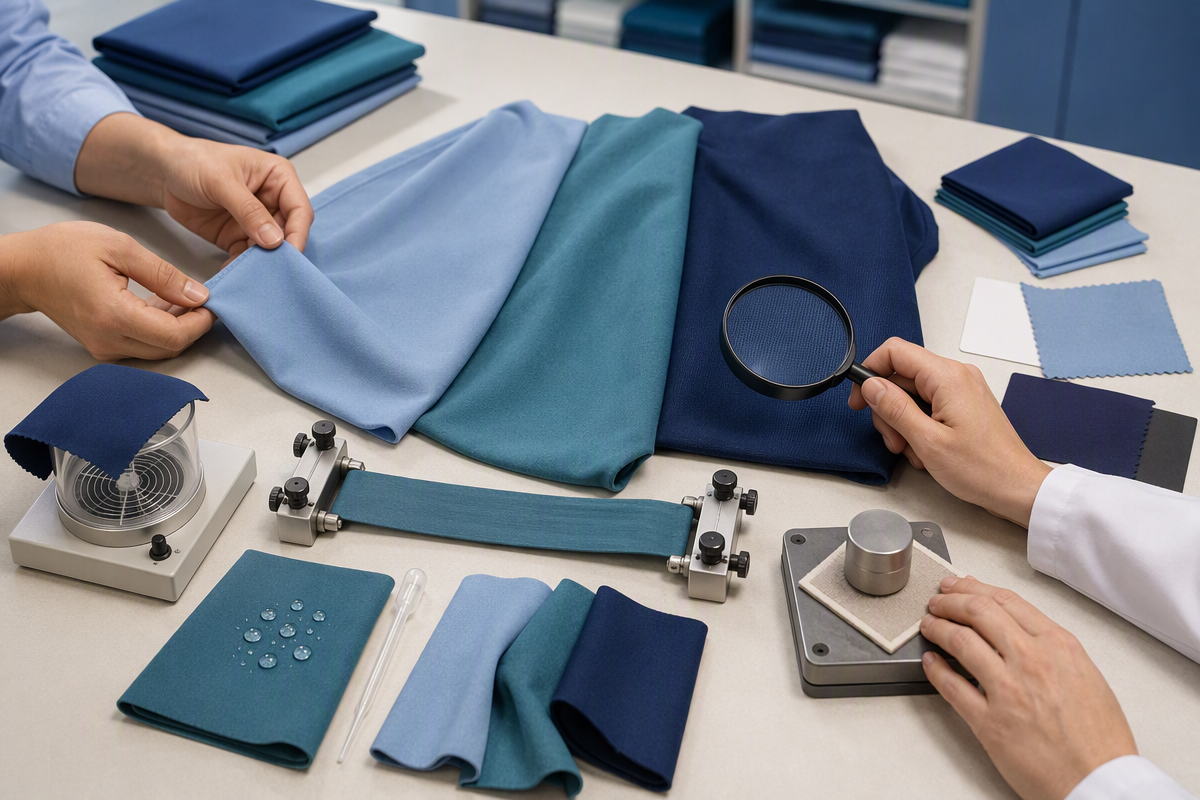
Before approving a fabric for bulk production, buyers can compare samples using a practical specification sheet.
Important items may include:
Basic specifications
- · Fiber composition
- · GSM
- · Fabric width
- · Weave/construction
- · Stretch percentage
- · Air permeability
- · Moisture management
- · Drying performance
- · Hand feel
- · Opacity
- · Color consistency
- · Wet-state appearance
- · Wrinkle appearance
- · Pilling resistance
- · Colorfastness
- · Dimensional stability
- · Other performance requirements relevant to the intended care process
Comfort-related performance
Appearance-related performance
Durability-related performance
The exact testing program should be selected according to the fabric, garment, market, and customer requirements.
10. A Better Way to Develop Hot-Climate Medical Uniform Fabric
Instead of asking:
“What is the lightest scrub fabric you have?”
buyers can ask:
“What fabric provides the right balance of breathability, moisture management, coverage, durability, and comfort for our target climate?”
This question creates a more practical development process.
For medical uniform manufacturers, the ideal solution may be a fabric package with different GSM options, colors, stretch levels, and finishing choices.
The objective is not simply to make fabric lighter.
It is to create a medical uniform fabric that performs appropriately throughout the wearer’s working environment.
Buyer Checklist
Before selecting medical uniform fabric for a hot-climate market, consider:
1. What are the typical outdoor temperatures?
2. How strongly are hospitals air-conditioned?
3. Is the working environment humid or relatively dry?
4. Does the fabric provide suitable air permeability?
5. How does it manage and release moisture?
6. Is the fabric sufficiently opaque in light colors?
7. How does it look when damp or stretched?
8. Is the GSM appropriate for the garment?
9. Does the fabric provide suitable stretch and recovery?
10. Can the supplier provide relevant test data and samples?
Conclusion
Medical uniform fabric for hot climates needs to perform across more than one environment.
Outdoor heat may increase the importance of breathability and moisture management, while strong indoor air conditioning can make fabric weight, moisture retention, and overall wearing comfort more important.
For medical uniform brands and procurement teams, the most practical approach is to evaluate GSM together with air permeability, moisture management, opacity, stretch, durability, and fabric construction.
A balanced specification can help create medical uniforms that are suitable for the real working conditions of healthcare professionals—not just one part of their day.

Yunai Textile
Post time: Oct-10-2026