
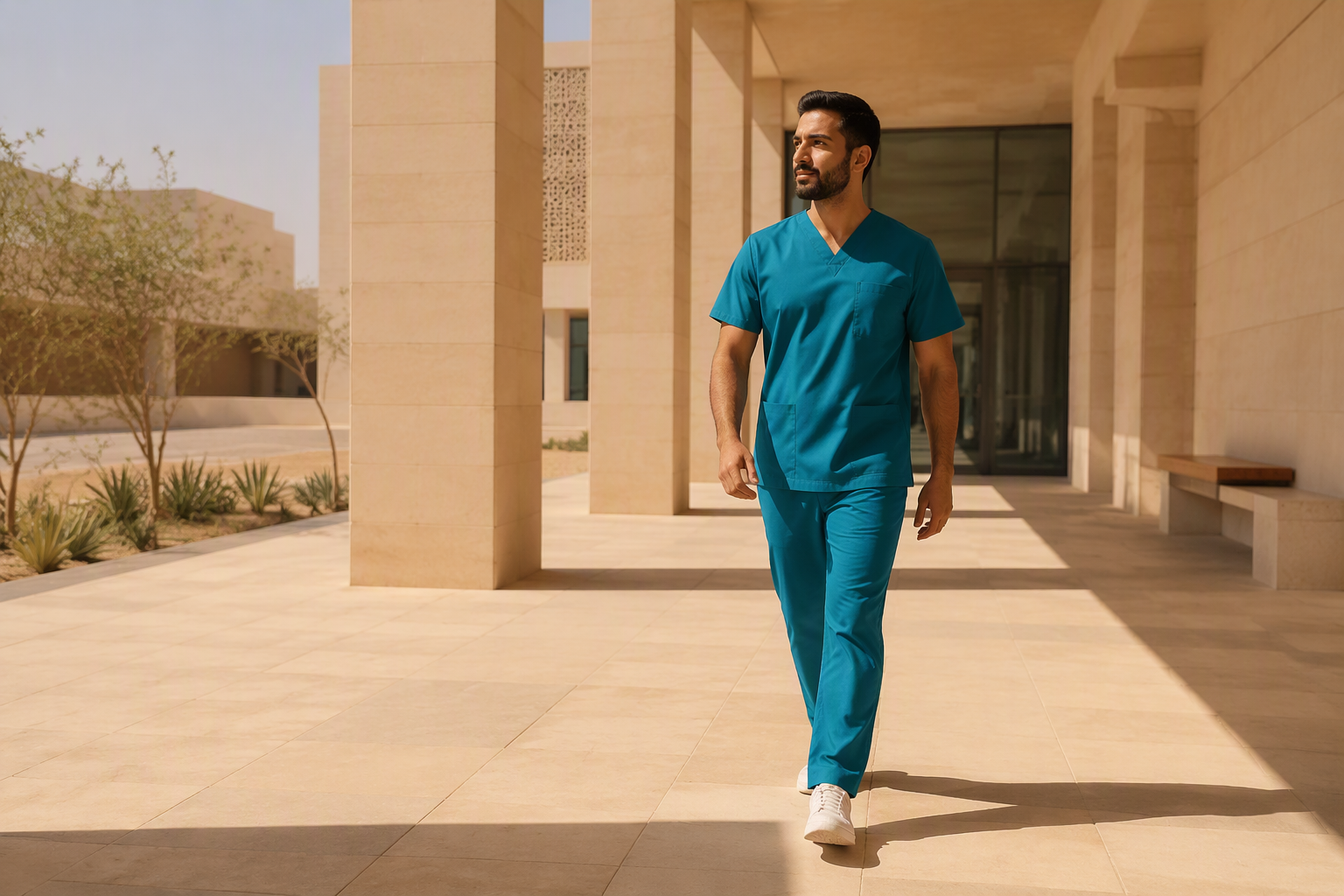
The Middle East presents specific challenges for medical uniform fabric development. High outdoor temperatures, strong sunlight, dry conditions, dust, and heavily air-conditioned indoor environments can all affect how a medical uniform feels and performs.
For healthcare uniform brands, hospital suppliers, and procurement teams serving Middle Eastern markets, choosing fabric based only on low GSM or lightweight construction may not provide a complete solution.
A more practical approach is to balance breathability, moisture management, opacity, colorfastness, durability, stretch, and comfort according to the actual working environment.
1. Why Middle Eastern Medical Uniforms Need a Different Fabric Approach
Many Middle Eastern markets experience very high outdoor temperatures, while hospitals, clinics, medical centers, and commercial buildings commonly use air conditioning.
This creates a significant temperature difference between outdoor and indoor environments.
Healthcare professionals may move between:
- · Hot outdoor environments
- · Air-conditioned hospitals
- · Clinical treatment rooms
- · Hospital corridors
- · Parking areas and transportation
- · Indoor and outdoor work areas
Therefore, medical uniform fabric should be evaluated based on the complete working environment rather than outdoor temperature alone.
2. Lightweight Fabric Is Not Always the Answer
When developing uniforms for hot climates, lightweight fabric is naturally attractive.
A lower GSM can reduce garment weight and may contribute to a lighter wearing experience.
However, GSM does not independently determine:
- · Breathability
- · Air permeability
- · Moisture management
- · Opacity
- · Durability
- · Hand feel
- · Stretch performance
A very lightweight fabric may also create concerns about coverage, especially for white or other light-colored medical uniforms.
For this reason, buyers should compare complete fabric specifications rather than choosing the lowest GSM available.
3. Breathability Still Matters in Dry Heat
Hot and dry conditions can make breathability an important consideration.
However, breathable fabric is not simply synonymous with lightweight fabric.
Air permeability can be affected by:
- · Yarn characteristics
- · Fabric construction
- · Fabric density
- · Fiber composition
- · Fabric thickness
- · Finishing
Two fabrics with similar GSM can therefore have different airflow characteristics.
For Middle Eastern medical uniform development, buyers can request air permeability data or conduct comparative testing between candidate fabrics.
This provides a more objective basis for evaluating breathable performance.
4. Moisture Management Is Still Relevant
Hot and dry climates are different from tropical humid climates, but moisture management can still be relevant.
Healthcare workers may perspire when moving outdoors, commuting, or working in areas where temperature control is limited.
The important question is not simply whether a fabric “absorbs sweat.”
Buyers can consider the complete moisture process:
Moisture generation → spreading → movement → evaporation
A fabric that allows moisture to spread and release efficiently may provide a different wearing experience from one that simply absorbs moisture.
Therefore, moisture management and drying performance can both be included in fabric development and comparison.
5. Air Conditioning Creates Another Comfort Requirement
One distinctive feature of many Middle Eastern workplaces is the transition from very hot outdoor conditions to cool indoor environments.
A uniform fabric selected purely for extreme outdoor heat may not necessarily be ideal for an air-conditioned hospital.
If a garment becomes damp from perspiration and the wearer then enters a cold indoor environment, the fabric’s moisture behavior can become particularly relevant.
This is why a balanced fabric can be more practical than simply selecting the thinnest possible construction.
Medical uniform buyers should consider both sides of the temperature transition.
6. Opacity Is Important for White and Light-Colored Uniforms
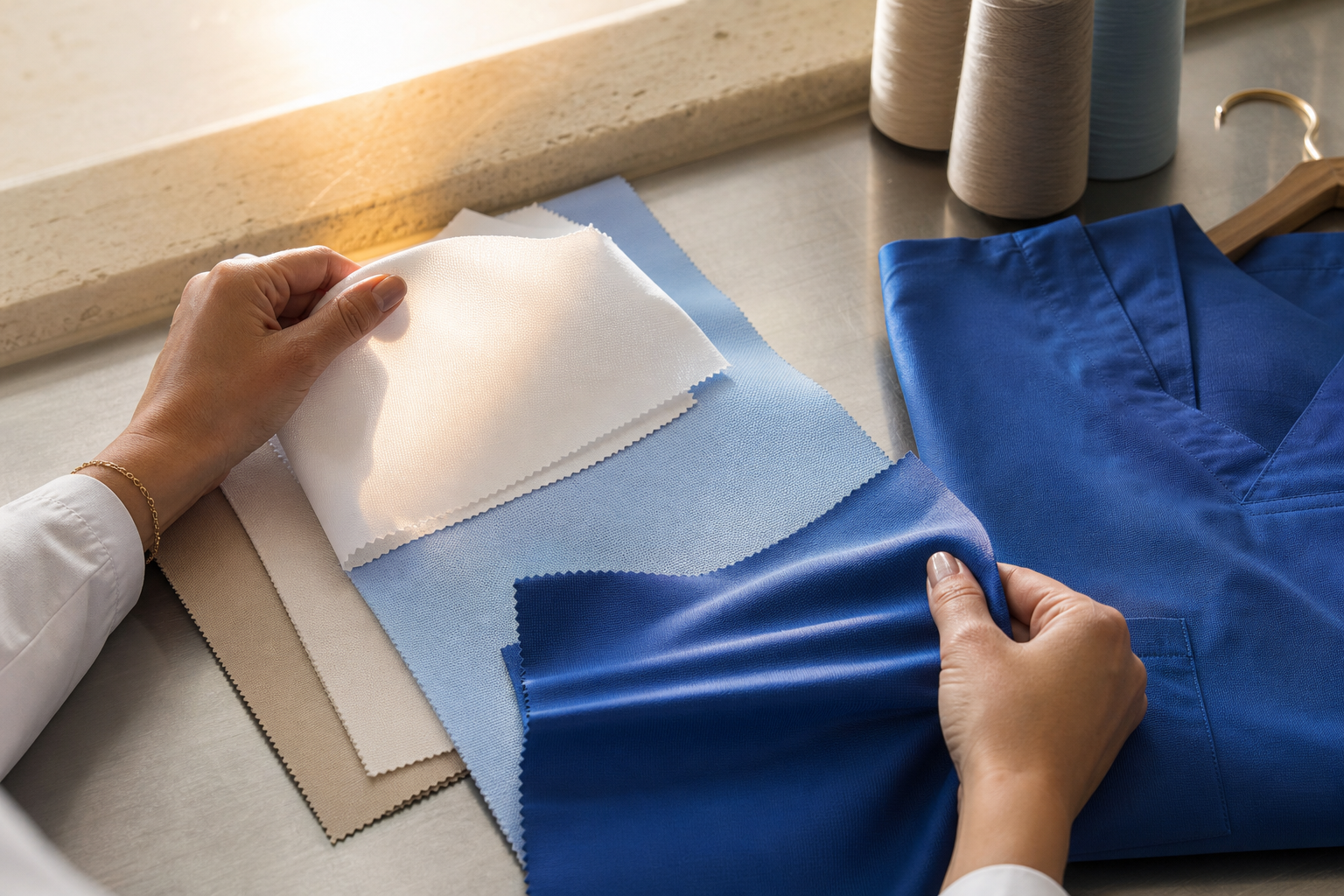
White, light blue, beige, pale gray, and other light shades are commonly considered for professional medical uniforms.
For these colors, fabric coverage deserves careful evaluation.
A lightweight fabric may look acceptable when dry but appear different when:
- · The fabric becomes damp
- · The fabric is stretched
- · The fabric is viewed under strong lighting
- · The garment is worn over different underlayers
This makes opacity evaluation especially important during fabric development.
Buyers can compare fabric samples under realistic lighting conditions and examine both dry and damp appearance.
7. Colorfastness and Strong Sunlight
Strong sunlight is another factor that Middle Eastern buyers may want to consider when developing colored medical uniforms.
Colorfastness is not determined by one factor alone. Fiber type, dye selection, dyeing process, finishing, color depth, and testing conditions can all influence performance.
Instead of relying on general statements such as “excellent colorfastness,” buyers should request relevant test results according to their product requirements.
For example, a buyer may establish requirements for:
- · Washing colorfastness
- · Rubbing colorfastness
- · Perspiration colorfastness
- · Light-related performance where relevant
The appropriate tests should depend on the intended end use and customer specification.
8. Dust and Daily Maintenance
Medical uniforms used in Middle Eastern markets may also encounter dusty outdoor environments.
For this reason, easy-care characteristics can be valuable in daily uniform programs.
Buyers may consider:
- · Wrinkle appearance
- · Surface cleanliness
- · Pilling resistance
- · Washing performance
- · Dimensional stability
- · Ease of pressing
A fabric that maintains a clean and professional appearance after routine care can be useful for healthcare uniform programs.
However, each performance characteristic should be evaluated through appropriate testing rather than assumed from fiber composition alone.
9. Stretch for Healthcare Professionals
Modern medical uniforms often need to support frequent movement.
Doctors, nurses, technicians, and other healthcare professionals may bend, reach, sit, walk, and move equipment throughout their working day.
Stretch fabrics can support garment mobility when properly developed.
For example, polyester/rayon/spandex constructions are commonly considered when brands want a combination of:
- · Professional appearance
- · Soft hand feel
- · Stretch
- · Recovery
- · Easy-care characteristics
The exact fiber ratio and fabric construction should be selected according to the target garment and required performance.
10. What GSM Should Middle Eastern Buyers Consider?
There is no universal GSM that is automatically suitable for all Middle Eastern medical uniforms.
A development program may include several weight options, for example:
- · Lightweight options for very hot environments
- · Medium-weight options for general hospital uniforms
- · Higher-GSM options for specific garments or cooler indoor environments
These ranges should be treated as development references rather than fixed industry standards.
The final decision should consider:
GSM + construction + air permeability + opacity + moisture management + garment design
This approach gives buyers more flexibility when developing different uniform collections.
11. Build Different Fabrics for Different Medical Uniform Programs
A hospital group may not need exactly the same fabric for every uniform.
For example:
Lightweight Collection
Designed around lighter garment weight and warm outdoor conditions.
Everyday Hospital Collection
Balanced for general clinical use, air-conditioned environments, and regular washing.
Premium Stretch Collection
Focused on mobility, hand feel, appearance, and modern uniform design.
Light-Color Collection
Developed with particular attention to opacity, color consistency, and professional appearance.
This type of product structure can help uniform brands address different customer requirements without relying on one fabric for every application.
12. What Should Buyers Ask Their Fabric Supplier?
Before approving a medical uniform fabric for the Middle Eastern market, buyers can request:
Basic specifications
- · Fiber composition
- · GSM
- · Width
- · Construction
- · Stretch and recovery
Comfort performance
- · Air permeability
- · Moisture management
- · Drying performance
- · Hand feel
Appearance performance
- · Opacity
- · Color consistency
- · Wrinkle appearance
- · Surface appearance
Durability
- · Pilling resistance
- · Colorfastness
- · Dimensional stability
- · Performance after the intended care process
The testing requirements should be agreed according to the final garment, market, and customer specification.
13. A Practical Development Strategy for Middle Eastern Markets
Rather than asking a supplier only for “lightweight medical fabric,” buyers can provide a more complete target specification.
For example:
Target market: Middle East
End use: Hospital scrubs
Climate: Hot and dry
Indoor environment: Strong air conditioning
Preferred hand feel: Soft and comfortable
Required performance: Breathability, moisture management, suitable opacity and durability
Color range: White, light blue and dark colors
This gives the fabric manufacturer a clearer development direction.
The supplier can then recommend suitable constructions and arrange sample testing.
Conclusion
Medical uniform fabric for the Middle East needs to respond to more than high outdoor temperatures.
The combination of hot weather, strong sunlight, dry conditions, air-conditioned hospitals, frequent movement, and professional appearance requirements creates a more complex fabric-selection process.
For healthcare uniform brands and procurement teams, a balanced approach is to evaluate GSM together with air permeability, moisture management, opacity, colorfastness, stretch, durability, and fabric construction.
The goal is not simply to make the lightest medical uniform.
It is to develop a fabric that performs appropriately across the environments where healthcare professionals actually work.

Yunai Textile
Post time: Oct-12-2026