
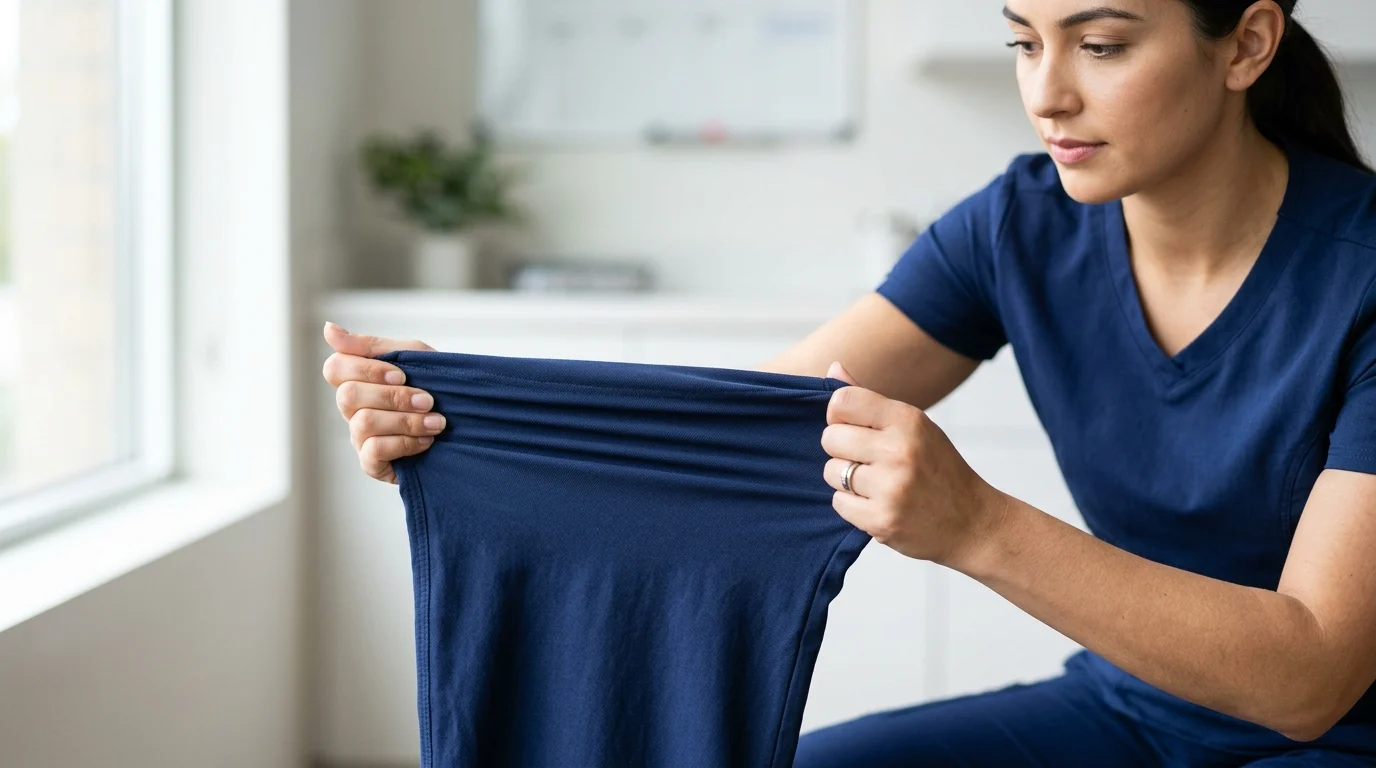
Why Choose Stretch Scrub Fabric
There has been a significant shift in the demands placed on medical uniforms. Historically, healthcare apparel relied heavily on rigid, 100% cotton or basic, non-stretch polyester blends. However, modern medical professionals face physically demanding, fast-paced environments that require their garments to perform more like activewear. While many hospitals and health systems still mandate traditional rigid-woven blends for specific units, budgets, or infection-control compliance, standard woven fabrics without elasticity are no longer universally sufficient. Healthcare workers increasingly require garments that move seamlessly with their bodies, leading institutional procurement managers to adopt stretch scrub fabric as a modern baseline for medical uniform programs.
What Stretch Scrub Fabric Means
At its core, stretch scrub fabric refers to a specialized textile blend that incorporates elastane—commonly known as spandex—alongside traditional base fibers such as polyester, rayon, or cotton. These functional textiles generally fall into two main types: two-way stretch, which stretches horizontally across the grain (typical of woven fabrics), and four-way stretch, which provides elasticity both crosswise and lengthwise (generally requiring knit constructions or specialized weaving techniques). To achieve highly functional elasticity, manufacturers typically integrate between 3% and 7% spandex. This ratio ensures the fabric provides adequate give for deep bending and reaching. However, elastane can break down under high-heat industrial laundering or autoclaving. Procurement officers must reconcile this by selecting lower-spandex blends or specialized mechanical-stretch polyesters if the garments will be subjected to rigorous commercial wash cycles, reserving high-spandex blends for milder care protocols.
Key Benefits for Healthcare Uniforms
The primary advantage of integrating a high-quality stretch blend into medical apparel is the dramatic improvement in wearer mobility during grueling 12-hour clinical shifts. Textile flexibility also directly impacts garment longevity. By allowing the fabric to give under sudden physical stress—such as lifting a patient or reaching for overhead equipment—stretch blends significantly reduce the risk of seam failure compared to rigid cotton alternatives. In comparative seam-stress scenarios, fabrics with elastane absorb tension that would otherwise cause thread breakage or fabric tearing at critical stress points like the shoulders and knees, significantly improving range of motion. Furthermore, advanced stretch textiles, such as premium polyester-spandex scrub fabrics, are specifically engineered to resist wrinkles and maintain a crisp, professional appearance even after rigorous daily use.
How to Compare Stretch Scrub Fabric Specifications

When evaluating textiles for medical apparel, strict technical specifications ensure the material performs under pressure. Comparing these specifications involves a deep dive into the fabric’s physical weight, structural construction, and specific fiber ratios. These technical metrics dictate everything from the garment’s drape to its long-term durability. For instance, fabric weights in this category typically range from a lightweight 150 GSM (grams per square meter) suited for warmer environments, up to a robust 200 to 250 GSM designed for structured applications. (Note: Claims of scrub fabrics reaching 300 GSM are unusually heavy for standard uniforms and are more typical of medical outerwear or canvas.)
Fiber Blend, Weave, and Knit Options
The construction method—specifically whether the fabric is woven or knitted—plays a pivotal role in its daily performance. Woven twill is a highly reliable choice for premium scrubs due to its inherent diagonal ribbing, which naturally hides superficial stains, resists tearing better than plain weaves, and typically provides reliable two-way stretch. For instance, woven medical stretch TR scrub fabric often features a substantial weight that provides excellent structure. However, modern premium scrubs also frequently utilize knit constructions, such as ponte or double knits. These knit alternatives are a valid and popular option, offering exceptional softness, fluid drape, and true four-way stretch. When choosing between them, buyers must clarify the clinical trade-offs: knit constructions may be prohibited by certain facility dress codes that require woven twill for opacity or professional consistency. Additionally, knits can be more susceptible to snagging or pilling under harsh industrial laundering.
Polyester, Rayon, and Spandex Comparison
To truly understand the performance of these technical fabrics, it is helpful to break down the individual fibers. Polyester provides the durable, colorfast, and wrinkle-resistant foundation. Rayon, a semi-synthetic fiber derived from purified cellulose, is strategically added to mimic the soft, breathable hand-feel of natural cotton. Finally, spandex delivers the essential elasticity.
The following table highlights illustrative examples rather than universal industry standards, demonstrating how different ratios impact performance:
| Fabric Blend | Primary Benefit | Typical Spandex % | Best Application |
|---|---|---|---|
| 72% Poly / 21% Rayon / 7% Spandex | Ultimate comfort, high stretch | 7% | Premium, tailored scrub sets (mild wash) |
| 95% Poly / 5% Spandex | High durability, low cost | 5% | Industrial laundry, basic scrubs |
| 65% Poly / 32% Cotton / 3% Spandex | Traditional feel, breathable | 3% | Institutional budget uniforms |
As the comparative table illustrates, a higher rayon and spandex content significantly elevates the comfort profile of the garment. However, buyers should note that blends exceeding 20% rayon require more careful laundering protocols than basic high-polyester alternatives to prevent premature pilling. Furthermore, practical caveats regarding dermatological sensitivity to spandex-rich synthetics must be considered. Institutional buyers must verify restricted substances and staff-safety compliance beyond raw fiber content by looking for internationally recognized skin-safety certifications, such as OEKO-TEX Standard 100 or equivalent. Some institutional policies cap synthetic-fiber percentages to accommodate these skin sensitivities or safety regulations, which can override comfort-driven fabric selection.
How to Source and Approve Stretch Scrub Fabric
Selecting the right material is a critical step for procurement managers building a functional medical uniform program. Finding a fabric that offers a high-quality stretch blend is only half the battle; ensuring consistent quality requires careful evaluation. Buyers should look for established standards regarding color accuracy, shrinkage resistance, and physical performance before committing to a specific scrub line.
Color Matching and Sample Approval
Evaluating color quality is essential, as scrubs are subjected to incredibly harsh washing conditions. High-quality garments should maintain excellent colorfastness, resisting fading from both frequent washing and daily wear.
Key Takeaways
- Choose scrub fabrics with 3% to 7% spandex when mobility, recovery, and comfort are priorities for clinical staff.
- Use two-way stretch for basic woven uniform programs and four-way stretch when staff need maximum freedom of movement.
- Match fabric weight to the working environment, with 150 GSM for lighter scrubs and 200 to 250 GSM for more structured, durable uniforms.
- Avoid high-spandex blends for high-heat industrial laundering unless the fabric is specifically engineered for those conditions.
- Prioritize polyester-spandex scrub fabrics when wrinkle resistance, long-shift comfort, and a crisp professional appearance are required.
Frequently Asked Questions
What percentage of spandex is best for scrub fabric?
Most functional stretch scrub fabrics use about 3% to 7% spandex. This range provides enough mobility for bending, reaching, and lifting while helping the fabric retain its shape.
Is two-way or four-way stretch better for medical uniforms?
Two-way stretch is often sufficient for standard woven scrubs, while four-way stretch offers greater mobility in both directions. Choose four-way stretch for active clinical roles and two-way stretch for cost-conscious or structured uniform programs.
What fabric weight should I choose for stretch scrubs?
A 150 GSM fabric works well in warmer environments, while 200 to 250 GSM offers more structure and durability. Very heavy fabrics near 300 GSM are usually better suited to outerwear than everyday scrubs.
Can stretch scrub fabric handle industrial laundering?
High heat can degrade elastane over time. For industrial laundering or autoclaving, consider lower-spandex blends or mechanical-stretch polyester fabrics designed for tougher wash protocols.
Why are polyester-spandex blends popular for scrubs?
Polyester-spandex blends combine stretch, wrinkle resistance, shape retention, and durability. They help medical uniforms maintain a professional appearance through long shifts and repeated daily wear.

Yunai Textile
Post time: Jul-24-2026