
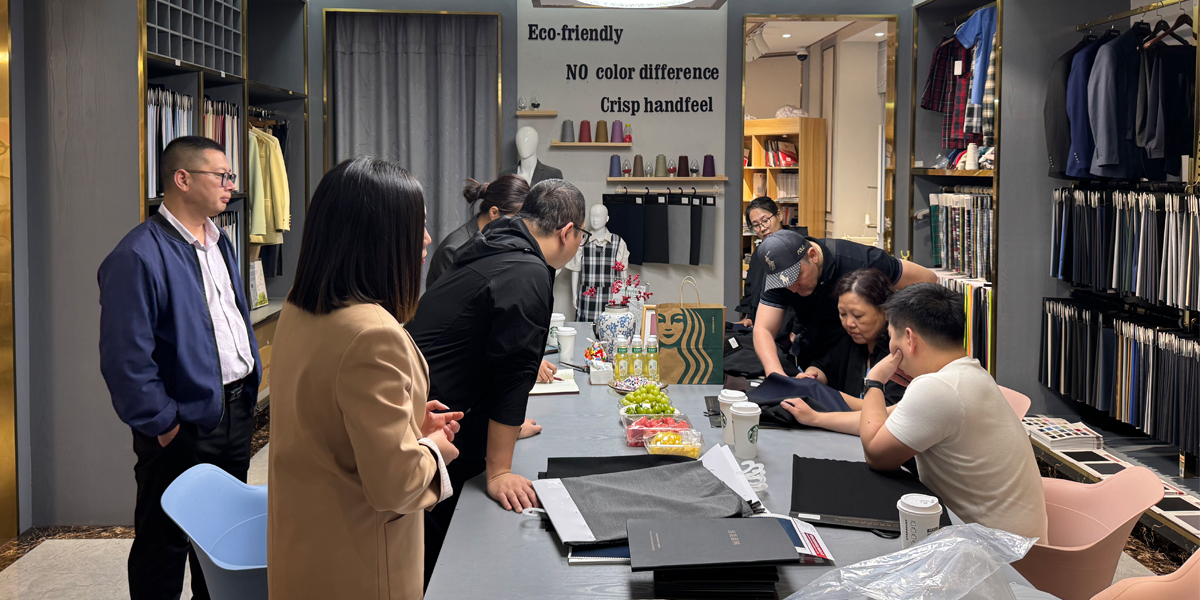
In the textile industry, long-term partnerships are built not only on consistent supply but also on continuous improvement and mutual trust. Yesterday marked a meaningful moment for us, as we welcomed back a valued long-term client for an in-depth, face-to-face discussion after a long time apart.
This meeting was not just a routine visit—it was a collaborative session focused on product evolution, quality refinement, and future development opportunities.
Bringing Real Production Experience to the Table
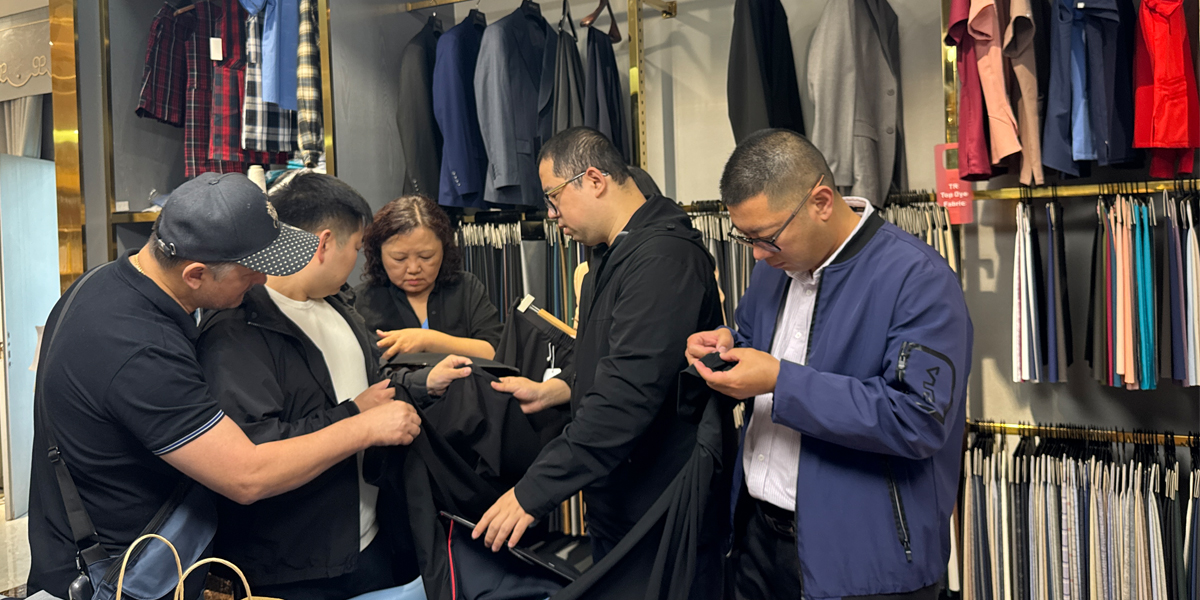
One of the most valuable aspects of this meeting was that our client came prepared. They brought along fabric samples from previous bulk orders sourced from us. These were not just swatches, but actual production fabrics that had gone through real manufacturing, garment construction, and market use.
This allowed both sides to evaluate the fabrics based on real-world performance rather than theoretical expectations.
The client expressed a clear goal: to upgrade the hand feel of the fabrics. While the existing products met standard requirements, their target market has shifted toward the high-end segment, where tactile experience plays a critical role in consumer perception.
This is a common evolution we see in the industry—brands moving from functionality-driven purchasing to experience-driven decision-making.
Collaborative Development: From Feedback to Innovation
During the discussion, we worked closely with the client to identify specific areas for improvement in new fabric development. These included:
- Softer and more refined hand feel
- Enhanced drape and structure
- Improved comfort for end-users
- Maintaining durability while upgrading texture
Our production supervisor was also directly involved in the conversation, providing technical insights into whether the desired effects could be achieved within existing production frameworks.
This kind of direct communication between client and production team is essential. It reduces misunderstandings and ensures that expectations are aligned with manufacturing realities.
We also discussed possible adjustments in yarn selection, finishing processes, and fabric construction to achieve the targeted improvements. These are critical factors in developing high quality woven fabric that meets premium market standards.
Facing Quality Standards with Transparency
As a professional fabric manufacturer, we believe that transparency is key to building trust.
In standard woven fabric production, it is widely accepted in the industry that, under the American 4-Point System, a defect rate within 3–5% is considered normal and acceptable. This applies to most commercial-grade fabrics.
However, not all clients operate under the same expectations.
The client we met yesterday serves a more premium market segment, where tolerance for defects is significantly lower. For them, even small imperfections can impact brand positioning and customer satisfaction.
During the meeting, the client emphasized the importance of achieving a lower defect rate than the industry standard.
We fully understand this requirement.
Rather than avoiding the topic, we addressed it directly—analyzing where defects may occur in the production process and identifying areas for tighter control. This includes:
- Stricter raw material selection
- Enhanced in-line inspection during weaving and finishing
- Additional quality control checkpoints beyond standard procedures
Our goal is not just to meet industry benchmarks, but to adapt to each client’s specific positioning.
This is especially important when producing suit fabric manufacturing and uniform fabrics, where consistency and appearance are critical.
A Responsible Approach to Problem-Solving
We always believe that problems are not obstacles—they are opportunities for improvement.
As a fabric manufacturer with nearly 20 years of experience, we do not shy away from challenges. Instead, we approach them with a solution-oriented mindset.
In this meeting, the client also provided constructive feedback on some of our existing fabric products. These suggestions covered aspects such as:
- Surface smoothness
- Color consistency
- Finishing stability
We welcomed this feedback.
Because real progress comes from listening to the market and continuously refining our products.
This is particularly relevant in categories such as uniform fabric supplier solutions, where long-term performance and repeatability are key factors for buyers.
Aligning Production Capabilities with Market Positioning
One of the key takeaways from this meeting is the importance of aligning production standards with the client’s market positioning.
Not all fabrics are created for the same purpose.
A fabric designed for mass-market use will have different cost structures, tolerances, and performance priorities compared to one designed for high-end garments.
For clients targeting premium markets, we are prepared to:
- Adjust production processes
- Allocate more resources to quality control
- Provide customized solutions tailored to their brand needs
This flexibility is what allows us to support a wide range of clients—from standard uniform suppliers to high-end fashion brands.
Strengthening Long-Term Partnerships
Beyond technical discussions, this meeting was also a reminder of the value of long-term relationships.
Reconnecting with our client after some time apart allowed us to better understand how their business has evolved, what challenges they are currently facing, and where they are heading next.
This kind of alignment is essential for building partnerships that go beyond transactions.
We are not just a supplier—we aim to be a long-term development partner.
Looking Ahead
This meeting has laid a strong foundation for future collaboration.
With clear goals for fabric upgrades, improved quality standards, and new product development directions, we are confident that the next phase of cooperation will bring even better results.
We will continue to:
- Invest in product development
- Strengthen quality control systems
- Maintain open and honest communication with our clients
Because in today’s competitive textile market, success is not just about producing fabric—it’s about delivering value, consistency, and trust.
Post time: Apr-15-2026