

Why Stretch Fabric Scrubs Matter
Healthcare facilities frequently grapple with uniform failures like seam blowouts and high replacement costs. Transitioning from rigid 100% cotton or standard polyester blends to stretch fabric scrubs directly addresses these pain points, improving wearer mobility and extending garment longevity for clinical institutions.
Key Fabric and Fit Benefits
Incorporating elastane or spandex into woven base materials transforms how medical uniforms perform under stress. Traditional scrubs often restrict motion, leading to seam failure and wearer fatigue. By utilizing advanced textiles, such as this example of a woven bamboo polyester blend, manufacturers achieve garments that stretch dynamically while retaining their structural integrity. Standard woven stretch fabrics typically feature a weight between 140 and 170 GSM (Grams per Square Meter), providing an optimal balance of opacity and breathability. This specific weight class ensures the material is robust enough to withstand daily clinical rigors while remaining lightweight enough to prevent thermal discomfort during extended 12-hour shifts.
Clinical Roles and Movement Needs
Garment specifications should map directly to the wearer’s movement profile. High-mobility clinical roles—such as physical therapists or emergency room nurses—perform tasks involving deep knee bends, overhead reaches, and lateral lifts. These profiles demand four-way stretch polyester elastane that expands crosswise and lengthwise to accommodate expansive movements without compromising the garment’s drape. Conversely, administrative or laboratory roles with primarily linear or forward-facing movement profiles may only require two-way stretch fabrics, which offer a typical 10% to 15% elongation in the width direction. Aligning the correct stretch capacity with these physical demands reduces musculoskeletal strain and supports daily wearer comfort.
How to Evaluate Scrub Specifications
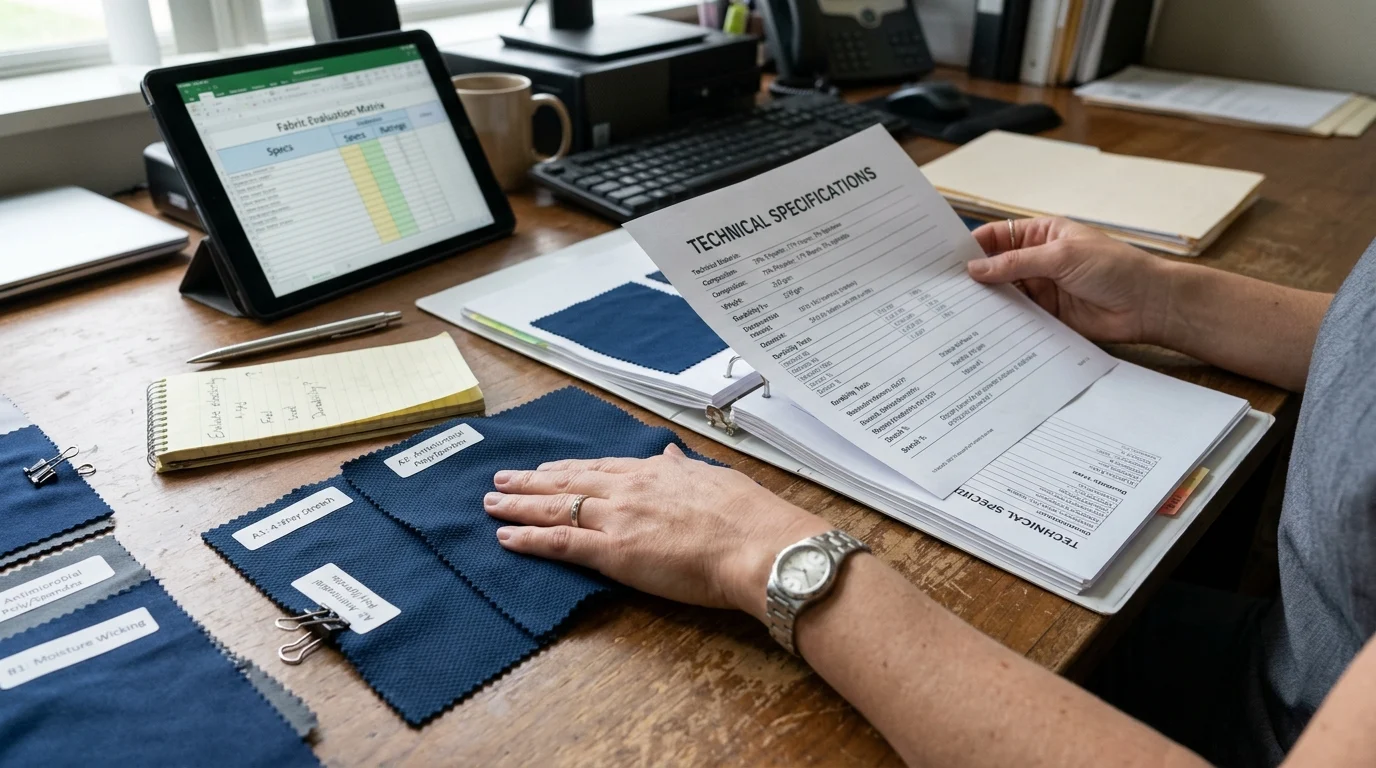
Selecting optimal stretch fabric scrubs requires a rigorous analysis of fiber composition, durability testing, and maintenance requirements. Procurement teams must evaluate technical specifications to ensure long-term performance and compliance with institutional hygiene standards.
Fiber Blend, Stretch, and Durability Metrics
The foundation of any high-quality stretch scrub lies in its fiber ratio. One popular example of a commercial tri-blend is a 72% polyester, 21% rayon, and 7% spandex twill. This specific ratio offers the durability and colorfastness of polyester, the soft hand-feel of rayon, and the high-recovery elasticity of spandex.
To build a concrete tech-pack specification, procurement teams should require the following baseline metrics:
- Fabric Weight: 140 to 170 GSM.
- Tensile Strength: Minimum 400N warp tensile strength (ISO 13934-1).
- Stretch Recovery: >90% recovery after repeated wash cycles (ASTM D2594 or D3107).
- Pilling Resistance: Grade 4 or higher after 2,000 abrasion cycles.
| Feature | 100% Cotton | Poly/Cotton (65/35) | Poly/Rayon/Spandex (72/21/7) |
|---|---|---|---|
| Stretch Capacity | < 2% | < 3% | 12% – 18% (4-way) |
| Average Lifespan | 30-40 washes | 50-60 washes | 75+ industrial washes |
| Shrinkage Rate | 4% – 5% | 2% – 3% | < 1.5% |
| Wrinkle Resistance | Low | Medium | High |
Note: Figures represent typical manufacturer estimates rather than universal standards. Lifespan estimates assume standard industrial laundering conditions (e.g., 60°C wash, commercial detergent, and tumble drying) using heat-resistant elastane.
Comfort, Care, and Compliance Factors
Beyond mechanical strength, comfort and hygiene are critical in fabric selection. Stretch fabrics utilized in healthcare must withstand aggressive laundering protocols, often involving wash temperatures exceeding 60 degrees Celsius for thermal disinfection. Procurement teams must account for elastane’s inherent limitations: standard spandex is highly sensitive to heat and chlorine. To reconcile the 75+ industrial wash cycle lifespan (noted in the table above) with 60°C thermal-disinfection protocols, specifications must explicitly require chlorine-resistant or heat-resistant elastane. This prevents rapid degradation, loss of elasticity, and microfiber shedding. Furthermore, many modern stretch scrubs integrate antimicrobial finishes; look for validation against testing standards like AATCC 100, where vendors typically report up to a 99.9% reduction in bacterial loads within 24 hours. Ensuring the fabric maintains a moisture-wicking capacity—often cited by manufacturers as drying 30% faster than standard cotton—is also vital for regulating body temperature during high-stress scenarios.
How to Source and Validate Scrubs
Transitioning a healthcare facility to stretch fabric scrubs involves strategic sourcing and systematic validation to mitigate financial and operational risks. A structured procurement process ensures the final product meets both clinical performance needs and budgetary mandates.
Sampling and Wearer Trial Steps
The validation phase must begin with a controlled wearer trial before committing to large-scale production. Procurement teams should source physical samples across a complete size run, typically ranging from XXS to 3XL, to evaluate grading and fit consistency. A standard wearer trial should last between 14 and 21 days, involving a cross-section of clinical departments. Participants must evaluate the garments on specific criteria, including seam comfort during active movement, pocket placement utility, and thermal retention. Following the trial, sample garments must undergo at least five accelerated commercial wash cycles (e.g., ISO 6330) to inspect for seam puckering, color bleeding, or loss of stretch recovery. Only fabrics demonstrating a dimensional stability (shrinkage limit) of less than 2% should proceed to the final approval stage.
Balancing Cost, Quality, and Infection Control
Sourcing stretch fabric scrubs requires balancing elevated unit costs against extended lifecycle value. While premium tri-blend stretch fabrics may carry an estimated 15% to 25% cost premium over basic poly-cotton poplin, their extended operational life—often exceeding 12 to 18 months of continuous use—reduces annual replacement expenditures. When negotiating with textile manufacturers, buyers must establish clear Minimum Order Quantities (MOQs), which vendors typically set between 1,000 and 3,000 meters for custom-dyed stretch fabrics. Additionally, contracts should stipulate a strict defect rate ceiling, often negotiated below 1.5% per shipment. Ensuring the manufacturer holds certifications such as OEKO-TEX Standard 100 guarantees that the stretch fibers and dyes used are free from harmful substances, aligning infection control protocols with environmental and wearer safety standards.
Key Takeaways
- Specify 140 to 170 GSM stretch woven fabrics to balance breathability, opacity, and durability for 12-hour clinical shifts.
- Match stretch direction to job function, using four-way stretch for high-mobility care roles and two-way stretch for lower-movement administrative or lab roles.
- Use fiber blends such as 72% polyester, 21% rayon, and 7% spandex when you need durability, soft hand-feel, and reliable elastic recovery.
- Require technical benchmarks such as minimum 400N warp tensile strength, over 90% stretch recovery, and Grade 4 pilling resistance after 2,000 abrasion cycles.
- Compare lifecycle performance, because poly-rayon-spandex scrubs can typically exceed 75 industrial washes with less than 1.5% shrinkage.
Frequently Asked Questions
What fabric weight is best for stretch medical scrubs?
A 140 to 170 GSM woven stretch fabric is a practical range for clinical scrubs because it balances opacity, breathability, and durability for long shifts.
When should a facility choose four-way stretch scrubs?
Choose four-way stretch for high-mobility roles such as ER nurses, physical therapists, and staff who bend, reach, lift, or move laterally throughout the shift.
Is two-way stretch enough for all clinical teams?
Not always. Two-way stretch may suit administrative, lab, or lower-mobility roles, but active care teams usually need four-way stretch for better comfort and seam protection.
What fiber blend works well for durable stretch scrubs?
A blend such as 72% polyester, 21% rayon, and 7% spandex offers polyester durability, rayon softness, and spandex recovery for repeated wear and laundering.
Which test results should buyers request before ordering scrub fabric?
Procurement teams should request tensile strength, stretch recovery, pilling resistance, shrinkage, and wash-performance data, ideally aligned with recognized methods such as ISO 13934-1 or ASTM D2594.

Yunai Textile
Post time: Nov-11-2026