
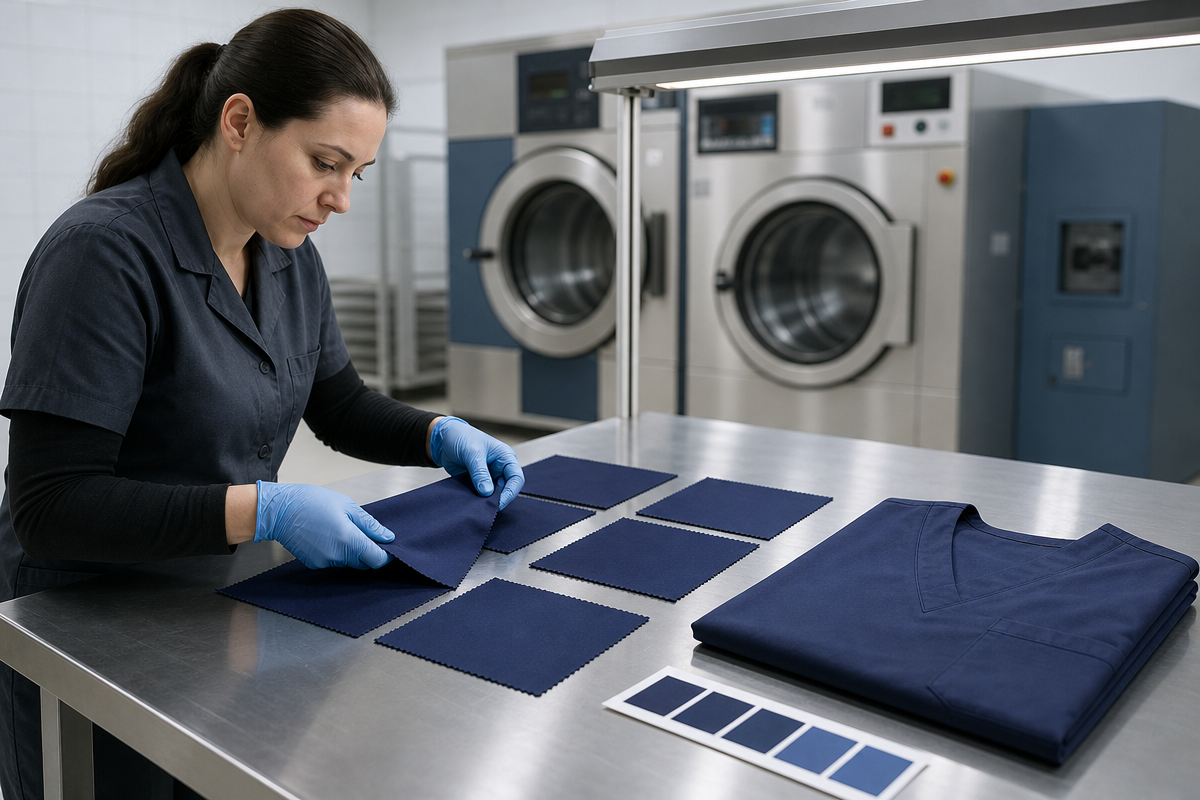
For hospitals, healthcare groups, uniform brands, and industrial laundry providers, choosing medical uniform fabric is no longer simply a matter of comparing the price per meter.
Scrub uniforms and medical workwear are washed repeatedly, often under demanding laundry conditions. Over time, fabric performance can directly affect replacement frequency, garment appearance, employee comfort, and the overall cost of ownership.
This is why buyers are increasingly looking beyond the initial fabric price and asking a more important question:
How much does this fabric really cost throughout its service life?
For buyers sourcing industrial laundry scrub fabric, properties such as dimensional stability, colorfastness, pilling resistance, and appearance retention can be just as important as the initial purchase price.
Why Industrial Laundry Changes the Fabric Selection Process
Medical uniforms are different from ordinary fashion garments.
A healthcare uniform may be worn frequently and subjected to repeated washing, drying, chemical exposure, and mechanical action. If the fabric loses its color, develops excessive pilling, shrinks noticeably, or changes hand feel after repeated laundering, the garment may need to be replaced earlier than expected.
For large hospitals, healthcare groups, laundry rental companies, and uniform programs, this can create additional costs beyond the original fabric purchase.
These costs may include:
- More frequent garment replacement
- Additional garment production
- Inventory replenishment
- Increased laundry management costs
- Color inconsistency between old and new uniforms
- Complaints about appearance or comfort
- Additional quality-control work
Therefore, a lower fabric price does not automatically mean a lower overall cost.
What Should Buyers Test After Repeated Washing?
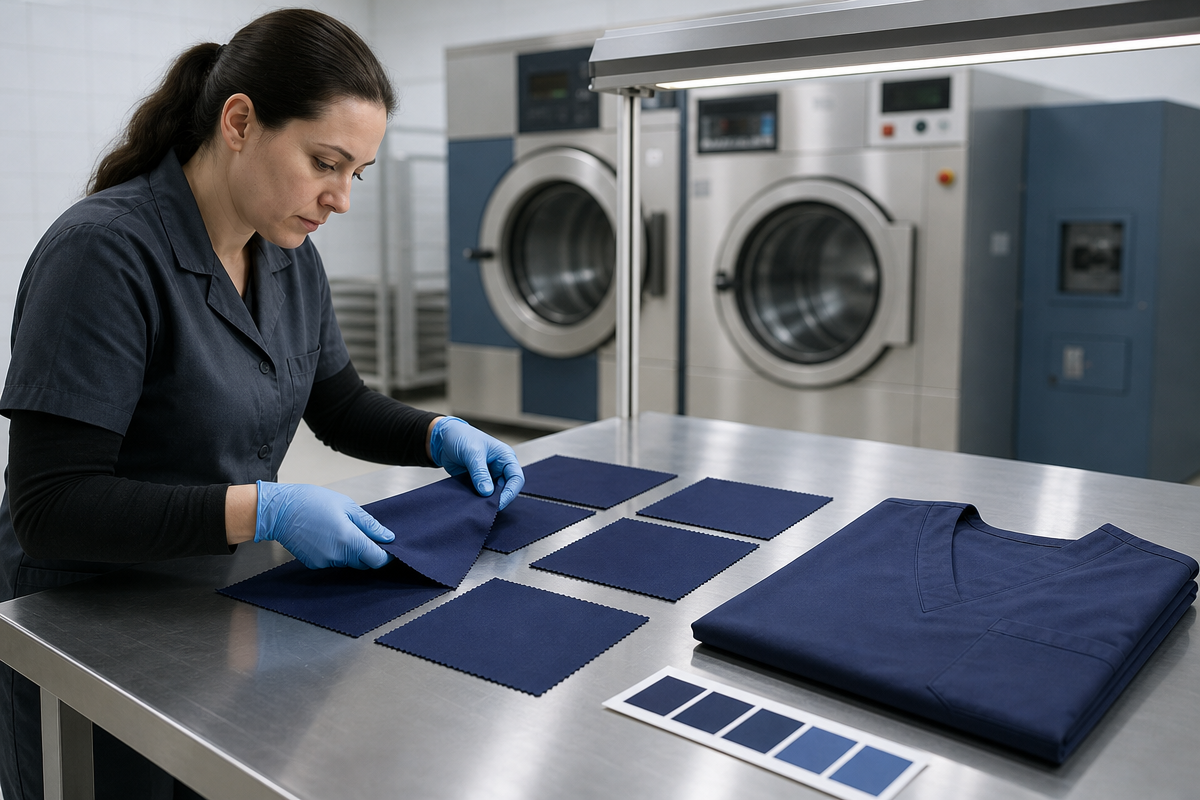
When evaluating industrial laundry scrub fabric, buyers should establish a defined washing and finishing procedure before comparing suppliers.
ISO 15797:2017 provides test procedures and equipment for evaluating workwear intended for industrial laundering. The standard covers properties including dimensional stability, color characteristics, creasing, seam puckering, pilling, and general visual appearance. ISO also notes that the selected washing and drying procedures should be appropriate for the fabric and intended application.
This provides a useful framework for medical uniform fabric development.
Instead of simply asking, “Is this fabric washable?”, buyers can ask more specific questions:
How does the fabric perform under a defined laundry process?
For example, a buyer may monitor:
1. Dimensional Stability
Shrinkage or growth can affect garment fit and pattern consistency.
For scrub manufacturers, even moderate dimensional changes can become a concern when garments are repeatedly processed through industrial laundry systems.
2. Colorfastness
Medical uniforms are often available in recognizable brand or institutional colors.
A fabric that gradually loses color or changes shade can make uniforms look inconsistent across departments, garment lots, or replacement cycles.
For buyers searching for colorfast hospital fabric, colorfastness testing should therefore be considered together with the actual washing conditions and intended end use.
3. Pilling Resistance
Repeated friction during wear and laundering can contribute to surface pilling.
Excessive pilling may affect the professional appearance of medical uniforms and can become particularly noticeable on frequently worn garments.
4. Hand Feel and Surface Appearance
Fabric performance is not only about laboratory numbers.
A scrub fabric may retain its dimensions and color while becoming noticeably different in surface feel after repeated processing.
For premium medical uniform programs, maintaining an acceptable combination of appearance, comfort, and performance is important.
What About Chlorine Resistance?
For some healthcare and institutional laundry programs, bleach resistance can be an important consideration.
This is particularly relevant when buyers are evaluating chlorine resistant medical uniform fabric.
However, “chlorine resistant” should not be treated as a universal claim.
The actual performance can depend on factors such as:
- Fiber composition
- Dye selection
- Fabric construction
- Finishing process
- Chemical concentration
- Washing temperature
- Exposure time
- Specific laundry procedure
- Fabric color
Therefore, suppliers should provide test conditions and results rather than simply making broad statements such as “does not fade.”
The same principle applies to any claim involving repeated industrial washing.
From Cost Per Meter to Cost Per Wear
Consider two hypothetical fabrics.
Fabric A costs less per meter but requires garments to be replaced more frequently.
Fabric B has a higher initial fabric cost but maintains acceptable performance for longer under the customer’s defined laundry conditions.
Looking only at the purchase price makes Fabric A appear cheaper.
Looking at the total cost of ownership creates a different calculation.
A simple framework can be:
Cost per wear = Total garment cost ÷ estimated usable wears
For a larger uniform program, buyers can expand the calculation to include:
Total ownership cost = Initial garment cost + replacement cost + laundry-related costs + inventory/replacement management costs
This does not mean that a more expensive fabric will always have a lower total cost. Instead, it gives procurement teams a more useful way to compare materials based on documented performance.
Build a Fabric Test Sheet Before Bulk Production
One practical approach is to create a standardized performance table for every shortlisted medical uniform fabric.
For example:
| Property | Before Washing | After Defined Laundry Cycles |
|---|---|---|
| Fabric Weight | Record | Record |
| Width | Record | Record |
| Dimensional Stability | Record | Record |
| Colorfastness | Test | Retest |
| Pilling | Test | Retest |
| Appearance | Record | Evaluate |
| Hand Feel | Evaluate | Evaluate |
| Color Difference | Record | Compare |
The exact test requirements should be determined according to the customer’s garment application and laundry process.
For industrial workwear, ISO 15797 can provide a useful reference framework for selecting relevant washing and finishing procedures.
ISO 30023:2021 also establishes qualification symbols for workwear intended for professional industrial laundering and references ISO 15797. Its scope includes washing, bleaching, tunnel finishing, and tumble drying after washing.
Why Test Conditions Matter More Than a Simple “100 Washes” Claim
One common mistake in fabric marketing is using a large washing-cycle number without explaining how the test was performed.
For example, saying that a fabric “can withstand 100 washes” without specifying the washing method, temperature, chemicals, drying conditions, fabric color, construction, and evaluation criteria does not provide enough information for a professional buyer.
A more responsible approach is to communicate:
Test method + washing conditions + number of cycles + measured result.
For example:
Tested under a defined industrial laundry procedure, with dimensional stability, colorfastness, and pilling evaluated before and after repeated washing.
This gives buyers information they can actually compare.
It also reduces the risk of making performance claims that cannot be reproduced in their own laundry environment.
How Fabric Suppliers Can Support Professional Procurement
For medical uniform manufacturers and institutional buyers, a fabric supplier should ideally provide more than a sample and a price quotation.
Useful technical support can include:
- Fabric composition and construction
- Weight and width specifications
- Recommended washing conditions
- Colorfastness test results
- Dimensional stability results
- Pilling test results
- Relevant third-party testing
- Bleaching or chlorine-related test information where applicable
- Bulk production shade-control procedures
- Pre-production and bulk sample confirmation
For customized medical uniform fabrics, suppliers can also work with buyers to define the required performance targets before bulk production.
This changes the conversation from “What is your price per meter?” to “What performance does this fabric need to deliver throughout its intended service life?”
The Future of Medical Uniform Fabric Procurement
For hospitals, laundry rental companies, healthcare brands, and large uniform programs, fabric selection is increasingly connected to lifecycle cost.
The most useful comparison is not always the cheapest fabric at the purchasing stage.
Instead, buyers should evaluate the relationship between:
Price → Laundry Performance → Garment Life → Replacement Frequency → Total Cost
For manufacturers supplying industrial laundry scrub fabric, the ability to document this performance can become an important part of the value proposition.
At YunAi Textile, we believe medical uniform fabric development should be based on the actual requirements of the end application. Rather than relying on unsupported claims about washing cycles, fabric performance should be evaluated through defined test procedures and measurable results.
For buyers looking for colorfast hospital fabric, chlorine resistant medical uniform fabric, or durable industrial laundry scrub fabric, the right question is not simply:
“How much does the fabric cost?”
It is:
“How much value can the fabric deliver throughout its intended service life?”
That is the foundation of a more practical and transparent approach to medical uniform fabric procurement.

Yunai Textile
Post time: Sep-17-2026