
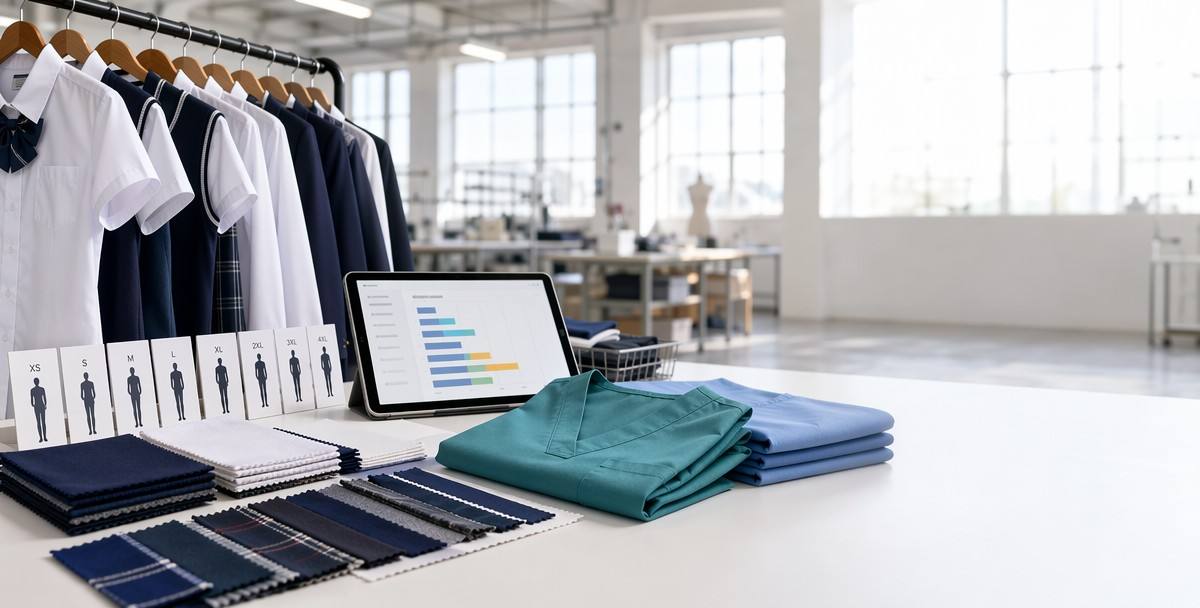
In today’s highly volatile global textile market, navigating the initial growth phases for small-to-medium medical and school uniform brands presents a monumental challenge. The primary obstacle is rarely a lack of end-consumer demand, but rather the crushing weight of upfront inventory costs, heavy capital expenditure, and the constant risk of deadstock. Traditional textile manufacturing facilities demand massive Minimum Order Quantities (MOQs) that easily deplete a startup’s working capital.
To break this deadlock, forward-thinking enterprises are adopting the Low MOQ Agile Response model. By shifting away from rigid mass production toward flexible, demand-driven manufacturing, this paradigm serves as the ultimate catalyst for institutional uniform brands attempting a successful cold start.
1. Navigating Global Market Uncertainty: Minimizing Inventory Risks for B2B Clients
For emerging school and medical uniform brands, their core B2B clients—ranging from municipal schools and elite private academies to regional hospitals and specialized medical clinics—are purchasing with unprecedented caution. Macroeconomic fluctuations have forced procurement departments to shrink upfront budgets. The historical reliance on “speculative, high-volume seasonal purchasing” has given way to an agile “on-demand fulfillment” framework.
Deploying premium fabrics such as 100 polyester school Uniform Fabric or highly specialized scrub uniform fabric under an agile model delivers distinct strategic advantages to B2B clients:
-
Eliminating the “First-Order Trial” Trust Barrier: When an emerging brand pitches to a major medical center or private educational institution, procurement committees are naturally hesitant to sign high-volume contracts. By providing a low MOQ entry point—such as 30 to 50 garments per style—brands allow institutional clients to run real-world wear trials with minimal financial risk. This significantly accelerates the B2B sales cycle.
-
Banishing Deadstock to Safeguard Working Capital: Uniforms inherently demand extensive size matrices, spanning from XS to 4XL, along with varied length modifications. Under traditional paradigms, matching this matrix requires ordering thousands of units, freezing vital capital. Utilizing versatile uniform fabric options within an agile framework enables brands to operate on a continuous loop of “Test Market – Generate Orders – Replenish Dynamically,” driving down Inventory Turnover Days.
-
Adapting Effortlessly to Fluctuating Institutional Demand: Mid-semester enrollment surges, sudden corporate re-brandings, and rapid hospital department expansions require rapid response. A low MOQ model turns your supply chain into an on-demand cloud utility, allowing uniform brands to fulfill quick re-orders instantly so B2B clients never bear the cost of market unpredictability.
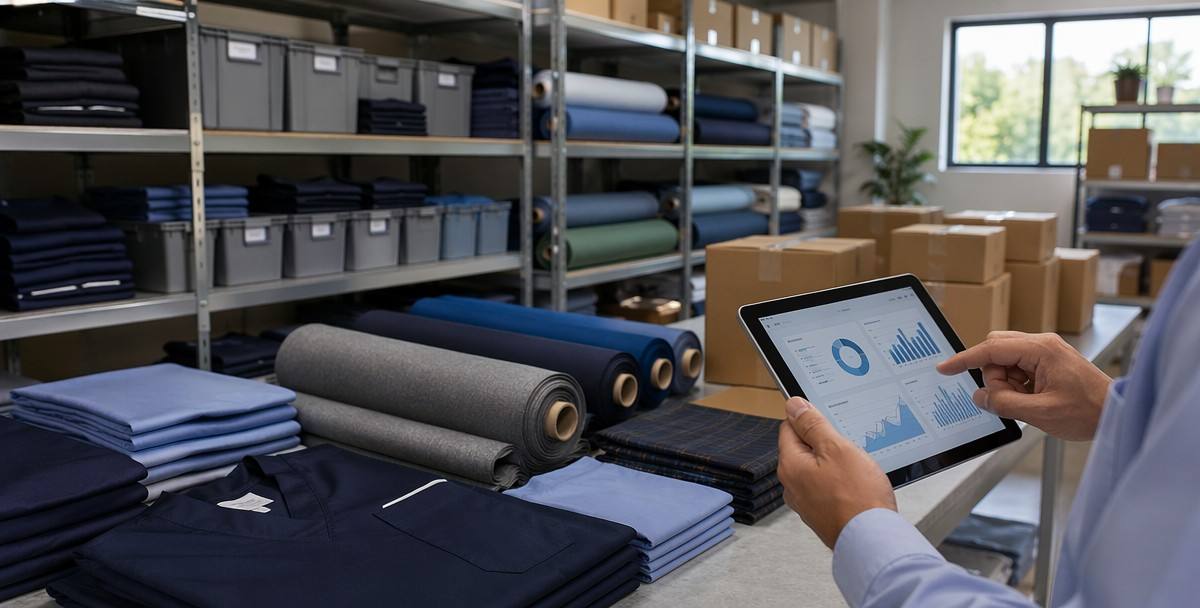
2. Striking the Balance: How Our Flexible Production Lines Harmonize Low MOQ with Cost Efficiency
The eternal dilemma within textile manufacturing has always been clear: Does lowering the minimum order quantity inevitably send the Unit Production Cost (UPC) soaring?
At YunAi Textile, we have shattered the old industry assumption that low MOQs mean prohibitive costs. By re-engineering our supply chain across three pillars—raw material standardization, advanced digital line scheduling, and lean modular production—we deliver competitive pricing alongside exceptional manufacturing agility.
Traditional Production Path: Mass Fabric Cutting ➔ Rigid Assembly Line ➔ Extended Lead Times = Rigid High MOQ
YunAi Textile Flexible Path: Base Fabric Standardization ➔ Intelligent Micro-Line Scheduling ➔ Laser Precision Cutting = Low MOQ + Scalable Unit Costs
Our approach begins with material optimization. We guide emerging brands to centralize their design foundations around highly standardized, premium core materials. For instance, stocking high-demand British Styles school Uniform Fabric or advanced 72 polyester 21 rayon 7 spandex fabric for medicalwear allows us to purchase raw fibers in massive bulk, achieving economies of scale at the raw material stage.
At YunAi Textile, our absolute control over fabric quality ensures that these standardized materials maintain excellent color consistency, anti-pilling performance, and fluid resistance across batches. Customization is then applied downstream via specialized tailoring, unique accents, panel inserts, and precision embroidery. By pooling the fabric base, we achieve mass-production cost efficiencies while supporting low-volume product variations.
Furthermore, our facility utilizes intelligent micro-line scheduling. Instead of shutting down massive assembly lines for small runs, we route low MOQ orders through dedicated agile cells. Experienced operators, cross-trained in multiple assembly techniques, switch between design patterns with minimal downtime. Combined with automated CAD grading and digital laser cutters, we maximize yield layout for medicalwear uniform fabric, eliminating material waste whether executing a run of 50 or 5,000 units.
Ultimately, YunAi Textile empowers brand partners by offering MOQs as low as 50 units while compressing production lead times to just 7–14 days. This ensures that growing brands retain the pricing power and quality controls of an industry giant while operating with the speed and dexterity of a lean digital startup.
Post time: Jul-13-2026