

Southeast Asia presents a distinctive environment for medical uniform fabric. High temperatures, high humidity, frequent rainfall, and long periods of perspiration can make fabric selection particularly important for healthcare uniforms.
Markets such as Malaysia, Thailand, Singapore, Indonesia, and the Philippines may require fabrics that can provide a suitable balance between breathability, moisture management, quick drying, coverage, durability, and professional appearance.
For medical uniform brands and healthcare apparel buyers, the goal should not simply be to choose the lightest fabric. Instead, fabric development should consider how the material performs in a warm and humid working environment.
1. Why Southeast Asia Requires Careful Fabric Selection
In many Southeast Asian markets, high temperatures and humidity can occur for extended periods.
Healthcare professionals may work in:
- · Hospitals
- · Clinics
- · Laboratories
- · Nursing facilities
- · Outdoor medical service environments
- · Air-conditioned clinical areas
This means a medical uniform may experience different conditions during the same working day.
The wearer may move from a humid outdoor environment into a strongly air-conditioned hospital and back again.
As a result, medical uniform fabric needs to be considered as part of the complete working environment.
2. Why Humidity Changes Fabric Performance
High humidity can affect how quickly moisture evaporates from fabric.
In a dry environment, moisture may evaporate relatively quickly when airflow is available.
In a humid environment, however, the surrounding air contains more moisture, which can affect drying behavior.
This is why a fabric that feels comfortable in a dry climate may perform differently in a humid tropical environment.
For Southeast Asian medical uniforms, buyers should therefore evaluate both:
Moisture management + drying performance
rather than relying only on moisture absorption claims.
3. Moisture Wicking and Quick Drying Are Different
These two terms are often used together, but they describe different aspects of fabric performance.
Moisture wicking generally refers to how moisture moves or spreads across the fabric.
Quick drying refers to how efficiently moisture can leave the fabric and return to the surrounding environment.
A simplified moisture pathway is:
Perspiration → spreading → movement → evaporation
A fabric that spreads moisture effectively may still need suitable construction and environmental conditions to dry efficiently.
For buyers, this means that “moisture wicking” should not automatically be interpreted as “quick drying.”
Comparative testing can provide more useful information.
4. Breathability Is Essential, But GSM Is Not Enough
Lower GSM can reduce garment weight, but it does not automatically guarantee better breathability.
Air permeability can depend on:
- · Fiber composition
- · Yarn structure
- · Fabric construction
- · Density
- · Thickness
- · Finishing
Two fabrics with the same GSM can therefore have different airflow characteristics.
For tropical medical uniform development, buyers can request air permeability data and compare samples using the same test conditions.
This can help separate actual airflow performance from assumptions based only on fabric weight.
5. Should Medical Uniform Fabric Be Extremely Lightweight?
Not necessarily.
Very lightweight fabric can be attractive for hot weather, but extremely low fabric weight may create other considerations.
These may include:
- · Reduced coverage
- · Show-through
- · Different wet-state appearance
- · Reduced garment structure
- · Durability requirements
This is especially important for white and pale-colored medical uniforms.
The objective should therefore be:
Lightweight enough for comfort + substantial enough for appropriate coverage and performance.
The correct balance depends on the garment and market.
6. Wet-State Appearance Matters
Humidity and perspiration make wet-state appearance particularly relevant in Southeast Asian markets.
A fabric can look different when moisture is present.
The appearance may change in terms of:
- · Opacity
- · Color depth
- · Surface appearance
- · Hand feel
- · Cling
This is particularly important for white, light blue, pale pink, and other light-colored uniforms.
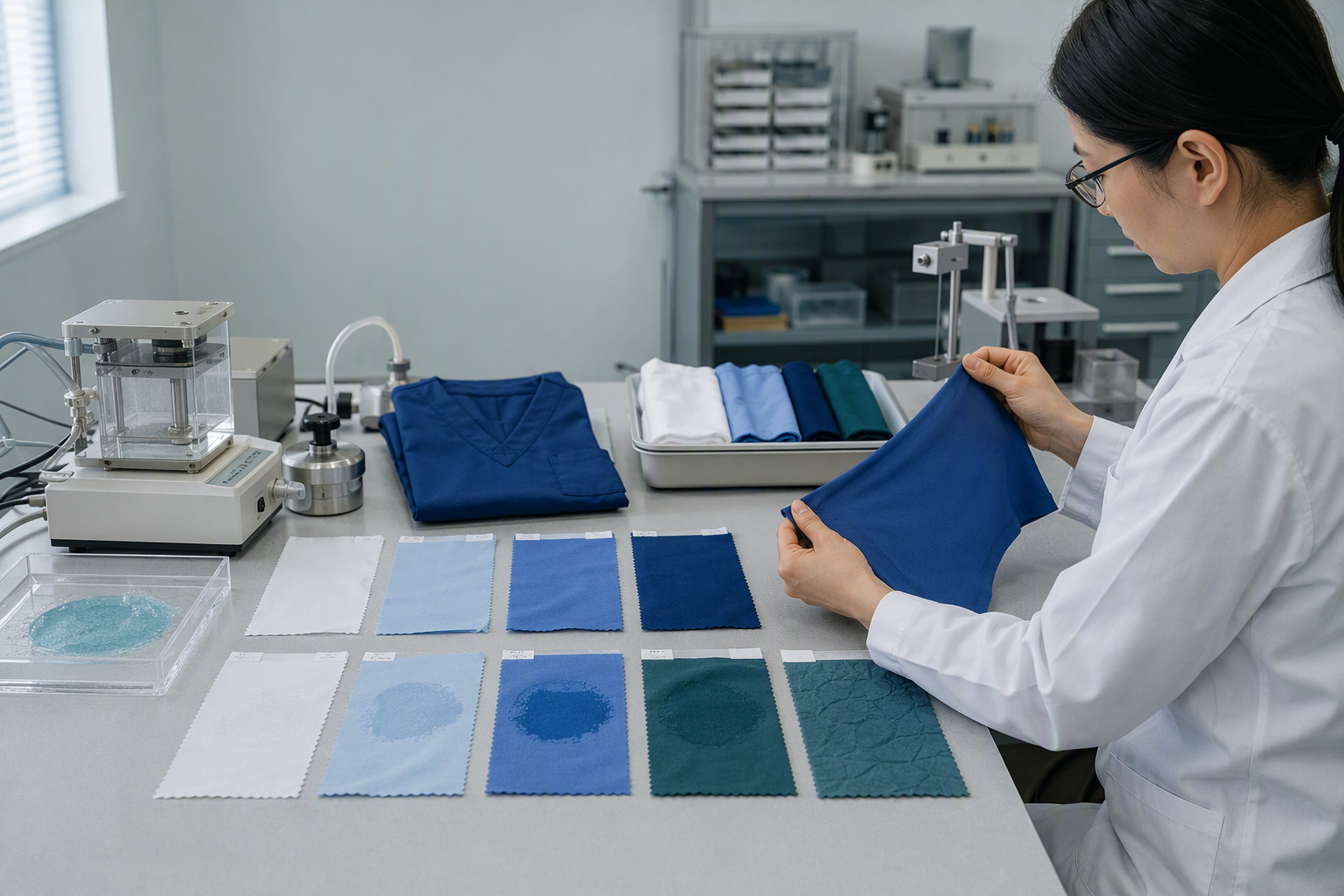
Medical uniform buyers can evaluate fabric samples in both dry and damp conditions.
This simple comparison can reveal information that may not be obvious from a specification sheet.
7. Fabric Construction Affects Comfort
Fiber composition is only one part of fabric development.
Construction also matters.
Factors such as yarn size, weave structure, fabric density, and finishing can influence:
- · Air permeability
- · Moisture movement
- · Hand feel
- · Stretch
- · Appearance
- · Durability
For example, a polyester/rayon/spandex medical fabric may offer a combination of softness, stretch, and easy-care characteristics, but the final performance still depends on the actual yarns, construction, finishing, and manufacturing process.
This is why buyers should evaluate the finished fabric rather than judging performance from fiber percentages alone.
8. Air Conditioning Creates a Second Environment
Southeast Asian healthcare workers may spend much of their day inside air-conditioned hospitals.
This creates an interesting contrast.
Outdoor:
Hot + humid + perspiration
Indoor:
Cooler + controlled humidity + air conditioning
A fabric that is comfortable outdoors should also provide an appropriate wearing experience indoors.
If the fabric becomes damp and remains wet for a longer period, the transition into a cooler environment may affect perceived comfort.
This makes moisture management and drying performance useful considerations for tropical medical uniform development.
9. Stretch and Mobility for Long Working Hours
Healthcare professionals may spend long periods walking, standing, bending, reaching, or sitting.
Medical uniforms therefore need sufficient mobility for everyday movement.
Stretch woven fabrics can be considered when developing modern scrub and medical uniform collections.
Potential benefits include:
- · Easier movement
- · Comfortable bending
- · Better garment flexibility
- · Support for modern fitted silhouettes
However, more stretch does not automatically mean better fabric.
Buyers should also evaluate:
- · Stretch percentage
- · Recovery
- · Fabric stability
- · Pilling
- · Appearance after washing
- · Dimensional stability
A balanced construction is generally more useful than maximizing one specification.
10. Durability Is Important in Tropical Medical Uniform Programs
Hot and humid environments are not the only consideration.
Medical uniforms may also be washed frequently as part of routine healthcare use.
Therefore, fabric selection should consider long-term performance.
Relevant evaluations may include:
- · Washing colorfastness
- · Rubbing colorfastness
- · Pilling resistance
- · Dimensional stability
- · Color consistency
- · Appearance after washing
- · Performance under the intended care process
Buyers should define the required testing according to the final garment and laundering conditions.
11. Different Southeast Asian Markets May Need Different Solutions
“Southeast Asia” is a broad market.
Malaysia, Thailand, Singapore, Indonesia, and the Philippines can have different customer requirements, garment designs, procurement systems, and working environments.
Therefore, one fabric should not automatically be considered suitable for every market.
A supplier may instead develop several options based on:
- · GSM
- · Fiber composition
- · Stretch level
- · Construction
- · Color
- · Finishing
For example, a brand could develop one lightweight tropical collection and another medium-weight collection for more air-conditioned environments.
12. What Should Buyers Ask Their Fabric Supplier?
For Southeast Asian medical uniform projects, buyers can request a fabric specification sheet containing:
Basic specifications
- · Fiber composition
- · GSM
- · Width
- · Construction
- · Stretch percentage
- · Air permeability
- · Moisture management
- · Drying performance
- · Hand feel
- · Opacity
- · Color consistency
- · Wet-state appearance
- · Surface appearance
- · Pilling resistance
- · Colorfastness
- · Dimensional stability
- · Performance after the intended washing process
Comfort performance
Appearance
Durability
This provides a more complete basis for comparing different medical uniform fabrics.
13. A Practical Fabric Development Brief
Instead of sending a supplier only the request:
“We need a lightweight fabric for Southeast Asia.”
A more useful development brief could be:
Market: Southeast Asia
End use: Medical scrubs
Environment: Hot and humid
Priority: Breathability and moisture management
Additional requirements: Quick drying, suitable opacity, stretch, durability
Colors: White, light blue, dark colors
Indoor environment: Air-conditioned hospitals
This gives the manufacturer more information about the actual end use.
The supplier can then recommend suitable constructions and arrange samples for comparison.
14. Build a Tropical Medical Uniform Fabric Package
For brands targeting multiple Southeast Asian markets, it can be useful to create a fabric package rather than relying on one fabric.
For example:
Option A — Lightweight Tropical Fabric
Focus:
- · Lower garment weight
- · Breathability
- · Warm-weather comfort
Option B — Balanced Everyday Fabric
Focus:
- · Breathability
- · Moisture management
- · Coverage
- · Durability
Option C — Stretch Premium Fabric
Focus:
- · Hand feel
- · Stretch
- · Recovery
- · Professional appearance
This approach allows brands to match fabric specifications with different product positioning and customer requirements.
Conclusion
Medical uniform fabric for Southeast Asia needs to address more than high temperature.
High humidity can influence moisture evaporation, while frequent perspiration makes moisture management and drying performance important considerations. At the same time, healthcare uniforms still need suitable coverage, durability, stretch, and professional appearance.
For medical uniform brands and procurement teams, the most useful approach is to evaluate GSM together with air permeability, moisture management, drying performance, opacity, stretch, construction, and durability.
A well-developed tropical medical uniform fabric should be designed around the real working environment—not simply labeled as “lightweight” or “quick dry.”

Yunai Textile
Post time: Oct-16-2026