

The Southeast Asian healthcare market is experiencing continuous development, creating new opportunities for medical uniform fabric suppliers, scrub brands, healthcare apparel manufacturers, and textile distributors.
Countries including Malaysia, Thailand, Singapore, Indonesia, the Philippines, and Vietnam have different healthcare systems, climates, and purchasing requirements. However, many buyers in the region share several important concerns when selecting medical uniform fabrics:
- Comfort in warm and humid environments
- Breathability and moisture management
- Easy-care performance
- Colour stability
- Durability during frequent washing
- Reliable supply and replenishment
- Flexible customization options
For suppliers entering Southeast Asia, the key is not to assume that one fabric specification fits every country. Instead, successful sourcing requires understanding local climate conditions, healthcare development trends, garment applications, and buyer expectations.
This article explains how healthcare uniform brands and procurement teams can evaluate medical uniform fabric for Southeast Asian markets.
1. Why Southeast Asia Is an Important Market for Medical Uniform Fabric
Southeast Asia has a growing healthcare sector supported by expanding medical infrastructure, private healthcare investment, medical tourism, and increasing demand for professional healthcare services.
Countries in the region have different levels of healthcare development, meaning medical uniform requirements can vary significantly.
For example:
- Private hospitals may focus more on professional appearance, brand identity, and customized uniforms.
- Healthcare distributors may prioritize stable supply, competitive pricing, and repeat ordering.
- Public healthcare projects may focus on durability, maintenance, and cost control.
For medical uniform fabric suppliers, this creates opportunities across different market segments.
However, successful market development requires understanding the buyer’s actual needs instead of simply promoting a standard fabric catalogue.
2. Climate Creates Demand for Breathable Medical Uniform Fabrics
One of the biggest characteristics of Southeast Asian markets is the tropical climate.
Many countries experience high temperatures and humidity throughout the year. Therefore, healthcare workers wearing uniforms for long shifts may place strong importance on:
- Breathability
- Lightweight construction
- Comfortable hand feel
- Moisture comfort
- Freedom of movement
For this reason, breathable medical uniform fabric is an important keyword and product direction for Southeast Asian buyers.
However, breathability should not be considered separately from durability.
A fabric that feels comfortable but loses shape quickly after washing may not meet the needs of professional healthcare environments.
The ideal medical scrub fabric should balance:
Comfort + Durability + Easy Care
rather than focusing on only one performance factor.
3. Stretch Medical Uniform Fabric Supports Modern Scrub Designs
Healthcare uniforms are becoming more modern in many markets.
Traditional loose-fitting uniforms are increasingly being replaced by designs with better shape, improved comfort, and more professional appearance.
This trend creates opportunities for fabrics with stretch performance.
For example, polyester-rayon-spandex blends such as TRSP and TSP fabrics can provide a combination of:
- Soft hand feel
- Better garment drape
- Stretch comfort
- Wrinkle recovery
- Durability
Four-way stretch fabrics can also be considered for scrub trousers, joggers, and fitted healthcare uniforms where movement flexibility is important.
For Southeast Asian buyers, the key evaluation points include:
- Stretch percentage
- Recovery after movement
- Fabric weight
- Breathability
- Surface appearance
- Washing performance
The final fabric choice should depend on the garment design and target customer group.
4. Easy-Care and Durable Fabrics Help Control Long-Term Costs
For many healthcare uniform buyers, fabric cost is only one part of the total purchasing decision.
A fabric that requires frequent replacement due to fading, pilling, shrinkage, or appearance loss can increase long-term operating costs.
Therefore, Southeast Asian medical uniform buyers may evaluate:
Anti-Pilling Performance
Healthcare uniforms need to maintain a clean and professional appearance.
Anti-pilling performance can help reduce visible surface damage after repeated wearing and washing.
Colourfastness
Many hospitals and healthcare groups use specific uniform colours to represent departments or maintain brand identity.
Stable colour performance is therefore important.
Dimensional Stability
Fabric shrinkage and shape changes can affect garment fitting and customer satisfaction.
Easy Maintenance
Healthcare uniforms need to fit practical washing and care routines.
A fabric supplier should provide clear care recommendations and relevant test information rather than only product images.
5. Malaysia, Thailand and Singapore: Professional Healthcare and Private Hospital Demand
Malaysia, Thailand, and Singapore represent interesting markets for medical uniform fabric suppliers because of their developed healthcare systems and international healthcare services.
In these markets, buyers may pay attention to:
- Professional appearance
- Fabric comfort
- Custom colours
- Reliable quality
- Supplier communication
- Documentation support
Private hospitals, medical groups, and healthcare brands may require uniforms that represent their professional image.
Therefore, suppliers with customization capability can provide additional value through:
- Custom colour matching
- Different GSM options
- Special finishing
- Fabric development support
- Sample confirmation before bulk production
For these markets, the supplier’s ability to support product development can be as important as the fabric itself.
6. Indonesia, Philippines and Vietnam: Practical Performance and Supply Reliability
Markets such as Indonesia, the Philippines, and Vietnam provide opportunities where practical fabric performance can become a key purchasing factor.
Buyers may focus on:
- Reliable delivery
- Competitive total cost
- Durable fabrics
- Easy-care performance
- Stable repeat orders
For healthcare uniform distributors and manufacturers, supply consistency is especially important.
A fabric supplier should be able to maintain:
- Same composition
- Same GSM
- Same colour standard
- Same finishing effect
- Stable production quality
A successful long-term relationship depends not only on the first sample but also on repeat-order performance.
7. Colour Customization Is Important for Healthcare Brands
Medical uniforms are no longer limited to traditional white or basic colours.
Many healthcare brands use different colours to create a professional identity.
Popular healthcare uniform colour categories may include:
- Navy
- Royal blue
- Burgundy
- Green
- Grey
- Black
- Custom brand colours
For Southeast Asian buyers, colour matching capability can become an important supplier advantage.
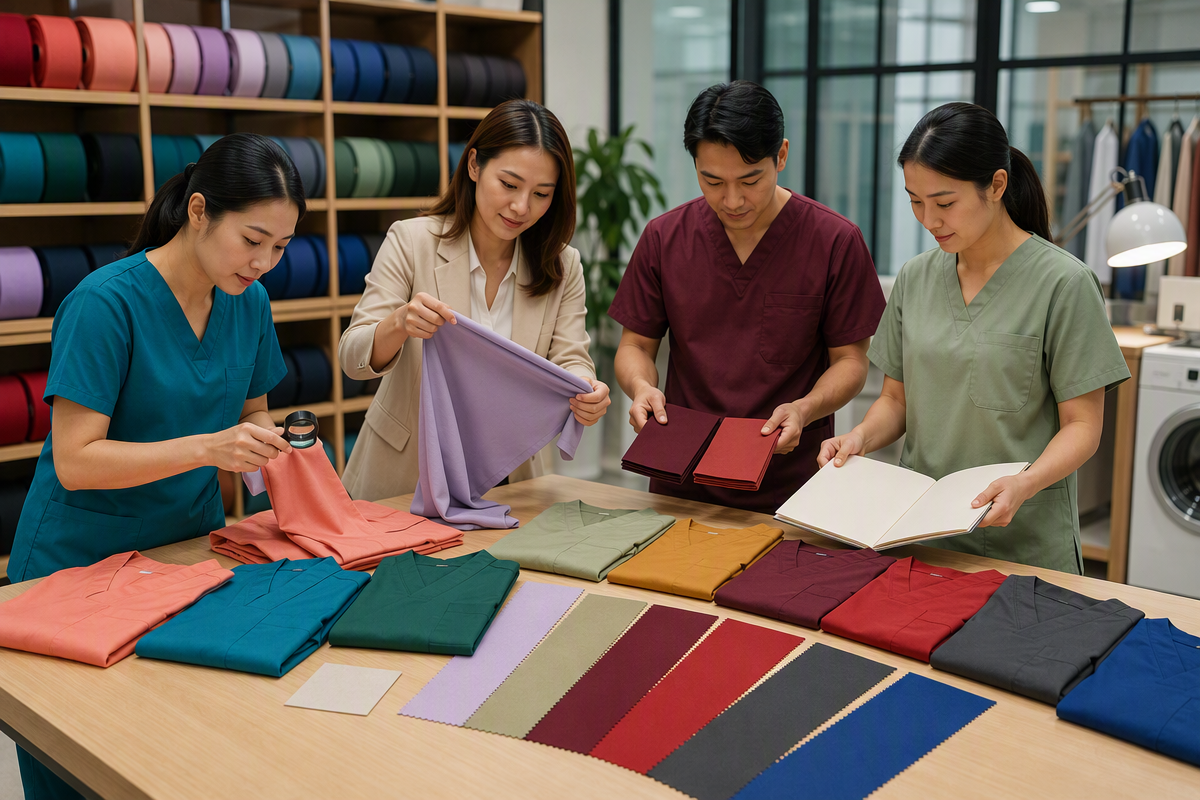
A professional colour approval process should include:
- Lab dip development
- Colour standard confirmation
- Bulk production checking
- Side-by-side comparison under controlled lighting
This helps reduce colour differences between approved samples and final production.
8. Documentation Helps Build Trust with International Buyers
As Southeast Asian healthcare markets become more connected internationally, buyers increasingly expect clearer product information.
A professional medical uniform fabric supplier should prepare:
- Fabric composition
- GSM information
- Construction details
- Width information
- Stretch performance
- Colourfastness test reports
- Anti-pilling test results
- Finishing information
- Care recommendations
For international healthcare brands and distributors, documentation helps simplify supplier evaluation.
It also allows buyers to compare fabrics based on measurable performance instead of only appearance.
9. How to Choose a Medical Uniform Fabric Supplier in Southeast Asia
When evaluating suppliers, buyers should consider more than fabric price.
A reliable supplier should demonstrate:
Product Development Capability
Can the supplier customize composition, GSM, colours, and finishes?
Quality Control System
Does the supplier inspect fabric during production, finishing, and before shipment?
Communication Efficiency
Can the supplier respond quickly during sampling and production?
Production Stability
Can the supplier support repeat orders with consistent quality?
Testing Support
Can the supplier provide relevant performance data?
Export Experience
Does the supplier understand international shipping, documentation, and customer requirements?
These factors can influence the success of long-term healthcare uniform programmes.
10. What Medical Uniform Fabrics Are Suitable for Southeast Asia?
There is no single universal fabric solution, but several fabric directions can be considered:
TRSP Medical Uniform Fabric
Suitable when buyers need:
- Comfort
- Stretch
- Professional appearance
- Durability
TSP Medical Uniform Fabric
Suitable for applications requiring:
- Flexible movement
- Easy-care performance
- Soft hand feel
Lightweight Medical Uniform Fabric
Suitable for warm climates where comfort and breathability are priorities.
Anti-Pilling Medical Fabric
Suitable for healthcare uniforms requiring long-lasting appearance.
Custom Performance Fabrics
Suitable for brands requiring special colours, finishes, or specifications.
The final choice should always match the customer’s garment design, healthcare environment, and target market.
Conclusion: Southeast Asian Medical Uniform Fabric Requires Balance
The Southeast Asian medical uniform market presents opportunities for fabric manufacturers, but success depends on understanding local purchasing priorities.
Unlike markets where industrial laundering or sustainability documentation may dominate purchasing discussions, Southeast Asian buyers often place strong attention on:
- Breathability
- Comfort in warm climates
- Easy maintenance
- Durable performance
- Customization
- Reliable supply
For medical uniform brands, wholesalers, and healthcare apparel manufacturers, the best sourcing decision is not simply choosing the cheapest fabric.
The better question is:
“Can this fabric deliver the comfort, durability, appearance, and supply stability required for healthcare professionals in Southeast Asian environments?”
For manufacturers such as YunAi Textile, this creates an opportunity to become more than a fabric supplier.
By providing customized medical uniform fabric solutions, technical support, quality control, and stable production, suppliers can help Southeast Asian healthcare brands develop uniforms that meet both professional requirements and local market expectations.

Yunai Textile
Post time: Sep-22-2026