
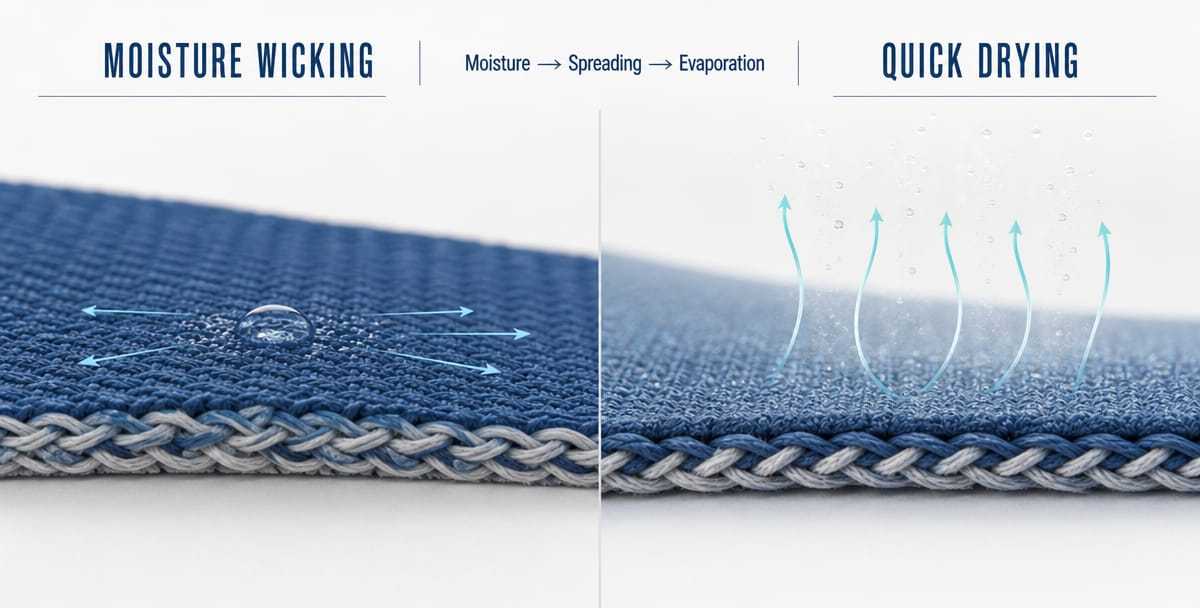
When medical uniform buyers look for fabric suitable for hot and humid climates, terms such as moisture wicking, moisture management, quick drying, and breathable often appear together.
These terms sound similar, but they describe different aspects of fabric performance.
For healthcare workers who wear scrubs for long shifts, especially in warm and humid environments, simply choosing a fabric that “absorbs moisture” may not be enough. A fabric may take in moisture but still leave the wearer feeling damp if that moisture does not spread and evaporate efficiently.
A better approach is to understand the complete moisture-management process:
Moisture absorption → moisture spreading → moisture transport → evaporation → drying
This article explains the differences between moisture wicking and quick drying and what medical uniform buyers should consider when selecting fabric for hot and humid climates.
What Is Moisture Wicking?
Moisture wicking generally refers to a fabric’s ability to move moisture away from the area where it is generated or accumulated.
During a long working shift, body moisture can come into contact with the inside surface of a medical uniform. If moisture remains concentrated in one area, the fabric may feel wet or uncomfortable.
A fabric with suitable moisture-management characteristics can help distribute moisture across a larger area.
This can potentially support faster evaporation by increasing the surface area exposed to air.
However, moisture wicking should not automatically be interpreted as “the fabric keeps you completely dry.”
Actual performance depends on several factors, including:
- Fiber composition
- Yarn structure
- Fabric construction
- Fabric density
- Finishing treatment
- Temperature
- Humidity
- Garment construction
- Air movement around the garment
Therefore, professional buyers should distinguish between a fabric’s moisture transport capability and the overall wearing experience of the finished garment.
What Does Quick Drying Mean?
Quick drying focuses on what happens after moisture reaches the fabric.
A fabric may absorb or spread moisture, but the next question is:
How quickly can that moisture leave the fabric?
Drying can be affected by:
- Moisture distribution
- Fabric thickness
- Fabric structure
- Fiber properties
- Ambient temperature
- Relative humidity
- Air circulation
- Garment construction
For this reason, a fabric that spreads moisture effectively may have an advantage in a warm environment, but its actual drying speed still depends on the surrounding conditions.
This distinction is important when evaluating fabrics for tropical or subtropical healthcare markets.
Moisture Wicking and Quick Drying Are Not the Same
It is useful to think about the two properties as different stages of moisture management.
Moisture wicking:
How effectively moisture is moved or distributed through the fabric.
Quick drying:
How efficiently moisture is released from the fabric through evaporation.
A simple example can help illustrate the difference.
Imagine a small drop of water landing on two fabrics.
On Fabric A, the moisture remains concentrated in a small area.
On Fabric B, the moisture spreads across a larger surface area.
Fabric B may create more surface area for evaporation, but that does not automatically prove that it will dry faster under every condition.
This is why a complete evaluation should consider both moisture spreading and drying performance, rather than relying on one marketing term.
Why This Matters for Medical Uniforms
Medical professionals may wear uniforms for extended periods while walking, standing, bending, and moving between different areas of a hospital or clinic.
In hot and humid climates, these conditions can make moisture management more important.
A suitable fabric may need to support several requirements simultaneously:
Comfort + Moisture Management + Breathability + Appropriate Coverage + Durability
The challenge is that improving one property does not necessarily guarantee improvement in all the others.
For example, reducing fabric weight may make a garment feel lighter, but excessive reduction in weight could affect coverage. Increasing fabric density may improve coverage, but it may also influence air permeability.
This is why medical uniform fabric development should focus on overall performance balance.
Fiber Composition Is Only the Starting Point
Fiber composition is one of the first specifications buyers usually ask about.
Polyester, rayon, and spandex are commonly used in different medical uniform fabric constructions, with each component contributing different characteristics.
Polyester can contribute to durability and dimensional stability.
Rayon can contribute to a soft hand feel and a comfortable fabric character.
Spandex can provide stretch and support freedom of movement.
However, the same fiber percentages can be developed into fabrics with different structures, weights, and finishes.
For example, two fabrics may both contain polyester, rayon, and spandex but provide noticeably different hand feel, air permeability, stretch recovery, and moisture behavior.
Therefore:
Fiber composition ≠ complete fabric performance
Buyers should consider composition together with construction, GSM, finishing, and test results.
Fabric Construction Can Influence Moisture Behavior
Fabric construction determines how yarns are arranged within the fabric and can influence the movement of air and moisture.
For medical uniform fabrics, buyers may need to evaluate:
- Fabric structure
- Yarn characteristics
- Fabric density
- GSM
- Thickness
- Stretch construction
- Finishing treatment
This is one reason why requesting a fabric sample before bulk production remains important.
A small sample allows buyers to evaluate hand feel, appearance, stretch, and general fabric behavior before finalizing a specification.
For more technical projects, laboratory testing can provide additional information beyond what can be judged by touch.
Why Humidity Changes the Equation
A quick-drying fabric does not operate in a vacuum.
Environmental conditions matter.
In a dry environment, moisture can evaporate relatively efficiently under suitable conditions. In a highly humid environment, the surrounding air already contains substantial moisture, which can reduce the driving force for evaporation.
This means that a fabric designed for a hot and humid market should not be evaluated only under ideal laboratory assumptions.
Buyers should consider the actual application:
High temperature + High humidity + Long working hours + Limited air movement
This is especially relevant for healthcare uniforms used in tropical and subtropical regions.
Air Permeability Still Matters
Moisture management should not be considered separately from breathability.
If air can circulate effectively through the fabric and around the garment, this can support the overall comfort of the wearer.
Air permeability testing can provide useful information about how readily air passes through the fabric under specified test conditions.
For buyers developing medical uniforms for hot climates, a useful fabric evaluation may therefore include:
- GSM
- Air permeability
- Moisture management
- Drying performance
- Colorfastness
- Pilling resistance
- Dimensional stability
No single number tells the whole story.
Don’t Ignore Coverage and Appearance
Medical uniforms are professional garments, not simply performance sportswear.
A fabric designed for hot weather still needs to provide an appropriate appearance for the healthcare environment.
This is particularly important for white and light-colored scrubs.
A fabric with excellent moisture management may not be suitable if it becomes excessively transparent when wet or does not provide the desired appearance in the finished garment.
Therefore, moisture performance should be evaluated alongside:
Coverage + Color + Hand Feel + Appearance + Garment Construction
For white or pale-colored medical uniforms, buyers may want to conduct additional wet-state visual evaluations.
What Tests Can Medical Uniform Buyers Request?
When evaluating a new fabric, buyers can ask their supplier what performance data are available.
Depending on the intended application, useful information may include:
1. GSM
Helps buyers understand the fabric’s weight and compare different specifications.
2. Air Permeability
Provides information about how easily air passes through the fabric under defined test conditions.
3. Moisture Management Testing
Can provide information about how moisture spreads and moves through the fabric.
4. Drying Performance
Can help buyers understand how the fabric behaves as moisture leaves the material.
5. Colorfastness
Important for medical uniforms that may be washed frequently.
6. Pilling Resistance
Relevant to maintaining a clean and professional appearance during repeated wear.
7. Dimensional Stability
Helps buyers evaluate how the fabric responds to washing and repeated care.
The exact testing program should be selected according to the end use, market requirements, and garment-care conditions.
How Buyers Should Compare Two Fabrics
Instead of asking:
“Which fabric dries faster?”
A more useful purchasing approach is to build a comparison sheet.
For example:
| Performance | Fabric A | Fabric B |
|---|---|---|
| GSM | Compare | Compare |
| Air permeability | Compare | Compare |
| Moisture management | Compare | Compare |
| Drying performance | Compare | Compare |
| Stretch | Compare | Compare |
| Colorfastness | Compare | Compare |
| Pilling | Compare | Compare |
| Dimensional stability | Compare | Compare |
| Wet-state appearance | Evaluate | Evaluate |
This makes the purchasing process more objective.
It also allows brands to select fabric according to the actual requirements of their target market instead of relying on a single marketing claim.
What About “All-Day Dry” Claims?
Medical uniform buyers should be cautious with absolute claims such as:
- “Never feels sweaty”
- “Stays completely dry all day”
- “100% sweat-free”
- “Dries instantly”
Real-world performance varies according to temperature, humidity, physical activity, garment construction, and washing conditions.
For B2B fabric purchasing, measurable performance data are generally more useful than exaggerated claims.
Instead of promising that a fabric will keep every wearer completely dry, a supplier can provide relevant test information and explain the conditions under which the fabric was evaluated.
This creates a more transparent basis for product development.
Building a Better Hot-Climate Medical Uniform Fabric
For healthcare brands developing uniforms for warm and humid markets, the goal should not be to maximize one individual performance characteristic.
Instead, the fabric should be developed around the complete application.
A practical performance framework can be:
1. Appropriate GSM
↓
2. Suitable Fabric Construction
↓
3. Air Permeability
↓
4. Moisture Management
↓
5. Drying Performance
↓
6. Appropriate Coverage
↓
7. Durability and Colorfastness
This approach allows buyers and fabric manufacturers to discuss specifications using measurable requirements rather than general descriptions.
Conclusion
Moisture wicking and quick drying are related, but they are not interchangeable terms.
Moisture wicking focuses on how moisture moves or spreads through the fabric, while quick drying focuses on how efficiently moisture leaves the fabric.
For medical uniforms used in hot and humid climates, both should be considered alongside breathability, fabric weight, coverage, durability, and the actual working environment.
The best fabric is not necessarily the one with the strongest marketing claim.
It is the fabric whose tested performance matches the real needs of the healthcare uniform and its target market.

Yunai Textile
Post time: Sep-30-2026