
In 2026, selling fabric internationally requires far more than competitive pricing and fast lead times. Global buyers—especially government departments, hospital groups, school systems, and multinational corporations—are prioritizing documentation, traceability, and certified safety standards. For wholesalers and fabric distributors, the ability to provide complete compliance documentation is no longer optional. It is a decisive competitive advantage.
When bidding for public tenders or large corporate contracts, compliance certificates often determine whether you even make it to the shortlist. Buyers want suppliers who understand regulations, can explain technical codes clearly, and proactively provide testing reports. In today’s textile market, compliance equals credibility.
This guide breaks down the most critical global standards wholesalers must understand to stay competitive in 2026 and beyond.
Why Compliance Is Now a Sales Tool—Not Just Paperwork
Large brands face increasing regulatory pressure in Europe and North America. Sustainability laws, chemical restrictions, and worker-safety standards are becoming stricter every year. Retailers and uniform distributors are now required to prove that their products meet environmental and safety regulations.
For wholesalers, this creates both risk and opportunity:
-
Risk if you cannot provide valid certificates.
-
Opportunity if you can provide them quickly and clearly.
Buyers prefer suppliers who reduce their compliance workload. When you present verified documentation upfront, you shorten the negotiation cycle and build trust instantly.
OEKO-TEX® and GRS: The “Big Two” for Global Brands
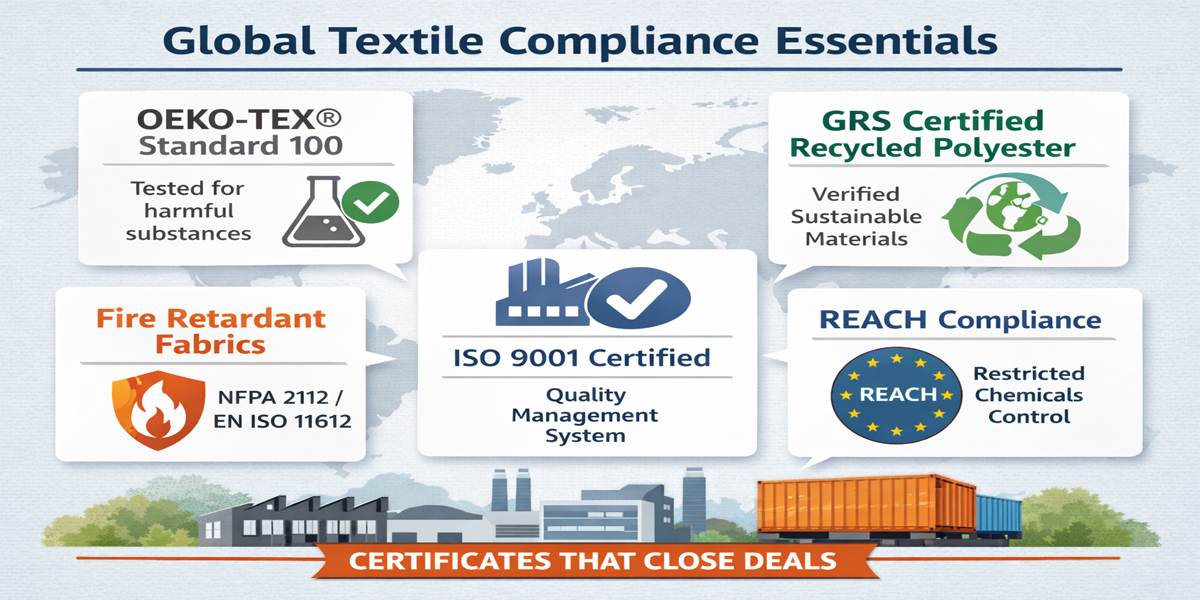
Two certifications dominate conversations in sustainable and safety-focused textiles: OEKO-TEX® and GRS.
1. OEKO-TEX Standard 100
OEKO-TEX Standard 100 certified fabric is one of the most recognized safety labels in the textile industry. It verifies that every component of a textile product—fibers, dyes, threads, buttons, and chemical finishes—has been tested for harmful substances.
For brands producing:
-
Medical scrubs
-
School uniforms
-
Corporate shirts
-
Children’s apparel
OEKO-TEX certification is often a minimum requirement.
Why it matters:
-
Ensures fabrics are free from restricted azo dyes, heavy metals, and formaldehyde.
-
Builds trust with parents, healthcare professionals, and safety-conscious consumers.
-
Reduces the risk of product recalls.
For wholesalers, offering OEKO-TEX certified fabric allows you to enter higher-value markets where compliance is non-negotiable.
2. Global Recycled Standard (GRS)
If you claim that your polyester is recycled, documentation is essential. GRS is the globally recognized system that verifies recycled content and audits environmental and social practices across the supply chain.
GRS recycled polyester fabric supplier credentials do more than prove recycled content. They also confirm:
-
Traceability of raw materials
-
Responsible chemical management
-
Social compliance within factories
-
Environmental impact monitoring
Brands using GRS-certified materials can justify retail price premiums of 10–15%. In competitive retail environments, that margin increase is significant.
For wholesalers, GRS documentation transforms a sustainability claim into a verified selling point.
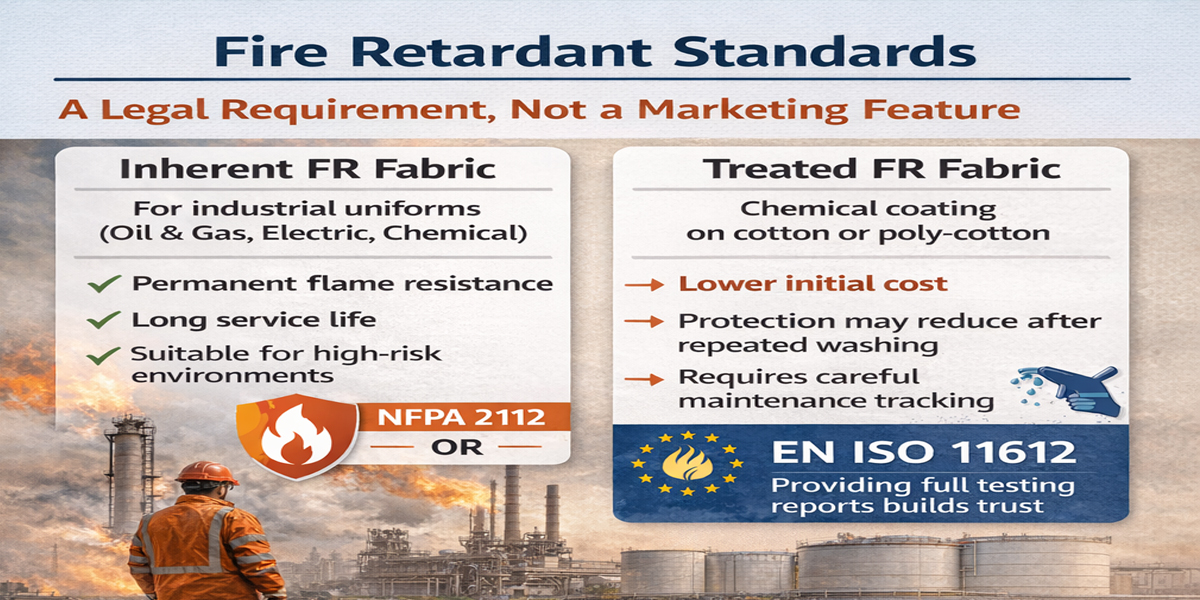
Fire Retardant Standards: A Legal Requirement, Not a Marketing Feature
For industrial uniforms in oil & gas, petrochemical plants, and electrical maintenance sectors, fire retardancy is a life-or-death compliance issue.
Understanding the difference between FR types is essential.
Inherent FR Fabric
Inherent FR fabric for industrial uniforms contains fibers that are naturally flame-resistant, such as aramid. The protection is built into the fiber structure and cannot be washed out.
Key advantages:
-
Permanent flame resistance
-
Long service life
-
Suitable for high-risk environments
Treated FR Fabric
Treated FR fabrics are typically cotton or poly-cotton blends with a chemical coating applied after weaving.
Key characteristics:
-
Lower initial cost
-
Protection may reduce after repeated washing
-
Requires careful maintenance tracking
Confusing inherent FR with treated FR in a sales pitch can create serious legal liability. Industrial buyers require precise documentation and verified performance data.
Understanding International Fire Safety Standards
Two widely referenced fire safety standards include:
-
National Fire Protection Association 2112
-
International Organization for Standardization EN ISO 11612
These standards evaluate heat resistance, flame spread, and thermal protection performance.
Providing full laboratory testing reports aligned with these codes demonstrates technical authority. When you can clearly explain what NFPA 2112 or EN ISO 11612 means for worker safety, you shift from being a salesperson to becoming a compliance consultant.
That positioning builds long-term client relationships.
REACH Compliance: Essential for the European Market
If your clients export to Europe, compliance with REACH regulations is mandatory.
European Chemicals Agency enforces REACH (Registration, Evaluation, Authorisation, and Restriction of Chemicals). This regulation restricts hazardous substances in products entering the European market.
REACH compliant textile fabric exporter status ensures that:
-
Restricted azo dyes are not present
-
Heavy metal levels are controlled
-
Hazardous chemical residues are below legal thresholds
-
Documentation is traceable and audit-ready
Failure to comply can result in shipment rejections, financial penalties, and damaged brand reputation.
For wholesalers, proactive REACH documentation simplifies customs clearance and reduces risk for your clients.
ISO 9001: Quality Consistency Roll After Roll
Beyond chemical and safety compliance, buyers also evaluate manufacturing reliability.
International Organization for Standardization ISO 9001 certification verifies that a factory follows a structured quality management system.
For buyers, ISO 9001 means:
-
Consistent dyeing quality
-
Controlled production processes
-
Documented inspection procedures
-
Continuous improvement systems
For wholesalers managing large uniform contracts, consistency matters. Corporate clients cannot afford shade variation across thousands of garments.
ISO 9001 certified textile manufacturer status reassures procurement teams that production standards remain stable batch after batch.
Why Compliance Speeds Up Large-Scale Deals
Large corporate clients and government buyers operate under strict risk management policies. Procurement teams often have zero tolerance for non-compliant goods.
When you provide:
-
OEKO-TEX reports
-
GRS transaction certificates
-
FR testing reports
-
REACH documentation
-
ISO 9001 certification
You remove friction from the purchasing process.
Compliance becomes the easiest way to “instant-close” high-volume contracts because the buyer’s legal and sustainability departments already have the documentation they need.
Turning Compliance Into Competitive Advantage
Many wholesalers treat certifications as passive paperwork. Successful suppliers treat them as active sales tools.
To maximize impact:
-
Present certificates early in negotiations.
-
Explain standards in simple, confident language.
-
Attach laboratory testing reports to quotations.
-
Highlight compliance logos on product pages.
-
Train your sales team to understand safety codes.
In 2026, technical knowledge differentiates serious suppliers from price-driven traders.
Final Thoughts: Compliance Is the New Currency
The global textile industry is evolving. Buyers are demanding transparency, sustainability, and verified safety standards. Compliance is no longer a back-office function—it is a frontline sales strategy.
Wholesalers who understand OEKO-TEX Standard 100 certified fabric, GRS recycled polyester fabric supplier, Inherent FR fabric for industrial uniforms, REACH compliant textile fabric exporter, and ISO 9001 certified textile manufacturer positioning will win larger, more stable, and more profitable contracts.
In a market where everyone competes on price, documentation and credibility are your strongest differentiators.
Compliance builds trust.
Trust closes contracts.
And contracts build long-term growth.
Post time: Mar-05-2026