
Introduction
For school uniforms, fabric performance is judged by more than appearance: it must withstand frequent washing, daily abrasion, and long hours of wear while maintaining a neat look. A 65% polyester, 35% rayon woven yarn-dyed fabric is designed to meet those demands by combining polyester’s strength and shape retention with rayon’s softer hand and improved comfort. This article examines how that blend performs in practical use, including durability, color stability, wrinkle behavior, drape, and suitability for shirts, skirts, and trousers. It also clarifies what the yarn-dyed construction contributes compared with other dyeing methods, helping readers assess whether this fabric is the right choice for consistent, long-term school uniform use.
Why Choose 65% Polyester 35% Rayon Yarn-Dyed Fabric for School
Selecting the optimal textile for educational institutions requires a rigorous balance of student comfort, garment longevity, and visual consistency. Among the most reliable options in the global textile market, the 65% polyester and 35% rayon blend—commonly referred to as T/R—stands out as a superior standard. This specific fiber composition is widely utilized for premium school shirting fabrics and formal institutional wear because it combines the best traits of synthetic durability and semi-synthetic breathability into a single woven structure.
Key benefits for school uniforms
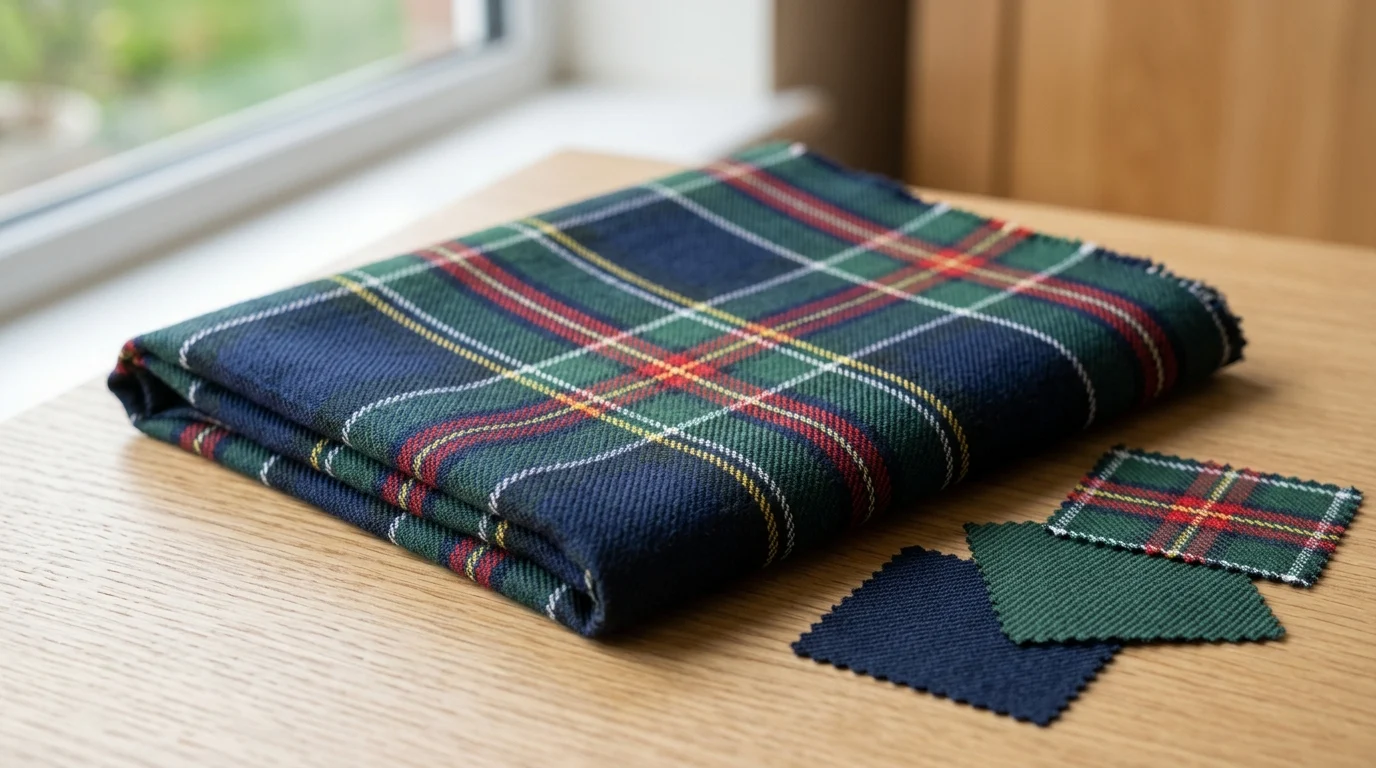
The foundational advantage of a 65/35 T/R blend lies in its structural integrity. Polyester provides exceptional tensile strength, dimensional stability, and abrasion resistance, while rayon introduces a cellulose-based softness that closely mimics natural fibers. For instance, T/R 65/35 plaid fabric is ideal for daily academic wear because it effectively resists the friction generated by classroom seating and heavy backpack straps. Typically manufactured at weights ranging between 150 and 220 grams per square meter (GSM), this fabric category offers sufficient body and drape for tailored trousers and pleated skirts without causing thermal discomfort during active school days. The precise 65/35 ratio ensures the garment holds its shape while remaining comfortable against the skin.
Yarn-dyed vs piece-dyed performance
The dyeing method heavily dictates a fabric’s long-term appearance and performance. Yarn-dyed textiles involve coloring individual threads in vats prior to the weaving process. This contrasts sharply with piece-dyed methods, where woven greige goods are dyed in a single continuous bath. Yarn dyeing is essential for creating intricate, permanent plaid, tartan, and check patterns. Because the dyestuff penetrates completely to the core, yarn-dyed materials can withstand over 50 heavy-duty industrial wash cycles without experiencing significant fading or color degradation. This inherent color stability makes it the premier choice for school skirt fabric, ensuring that complex tartans and official school colors remain crisp and vibrant from the first day of the academic year to the last.
What Performance Factors Should Buyers Evaluate
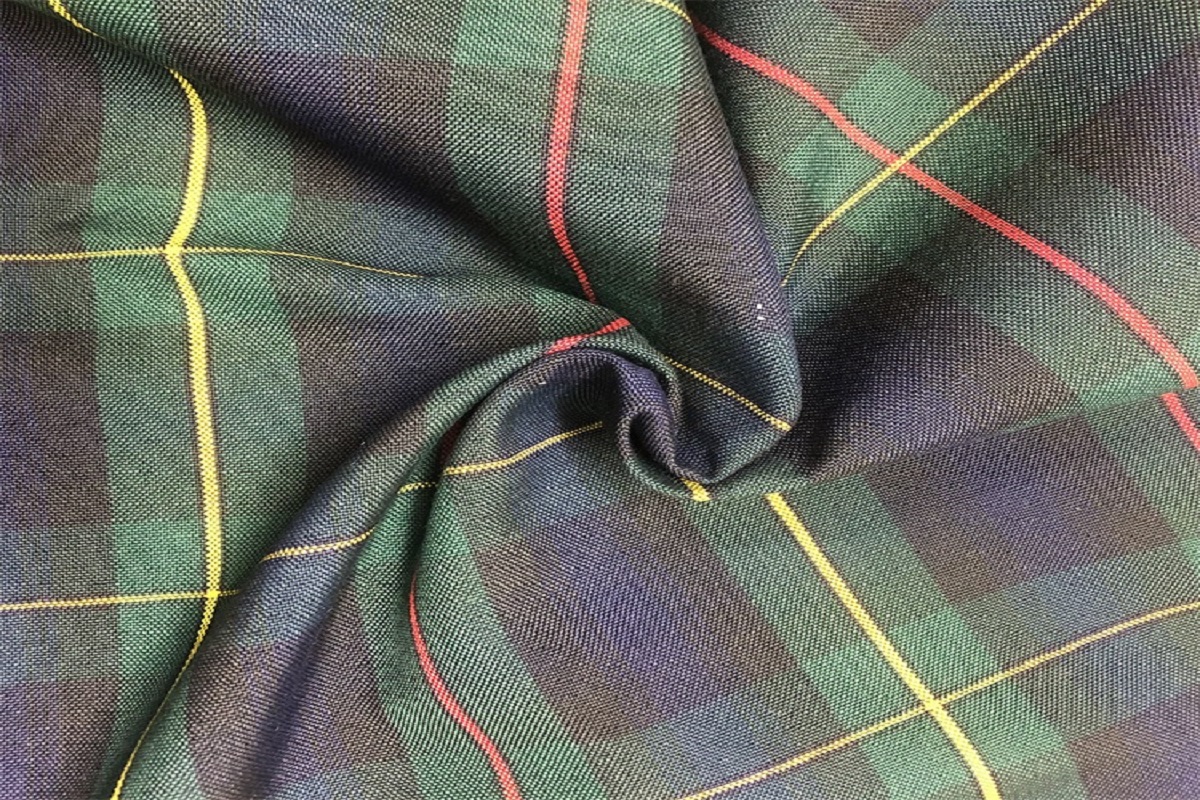
Beyond basic material composition, institutional buyers and garment manufacturers must evaluate textiles against rigorous performance metrics. A fabric’s theoretical benefits must translate directly into measurable results in laboratory testing to ensure it meets the demanding, high-impact lifecycle of student apparel.
Hand feel, durability, colorfastness, and wrinkle resistance
The intersection of tactile hand feel and mechanical durability defines premium uniform materials. A 35% rayon content significantly elevates the fabric’s softness, preventing the rigid, plastic-like texture often common in pure synthetic garments. Simultaneously, the robust 65% polyester matrix ensures the fabric achieves a warp tensile strength exceeding 400 Newtons (N), effectively preventing catastrophic tears. Wrinkle resistance is another critical performance metric; quality T/R blends typically demonstrate a wrinkle recovery angle greater than 120 degrees, drastically minimizing the need for daily ironing. Furthermore, semi-synthetic rayon fibers possess excellent moisture-wicking properties, making this specific blend a highly effective yarn dyed fabric good for summer climates where thermal regulation and moisture management are necessary for maintaining student focus.
Essential test criteria and comparison points
Procurement teams must rely on standardized testing protocols to validate textile quality before committing to bulk orders. Critical benchmarks include pilling resistance—aiming for Grade 3.5 to 4.0 on the ISO 12945-2 testing scale—and dimensional stability, where post-wash shrinkage must remain strictly below 3% to preserve garment fit. Colorfastness to washing, light, and rubbing must achieve a minimum of Grade 4 to prevent dye bleeding onto lighter garments or skin. Buyers frequently compare these T/R blends against traditional tc yarn dyed fabric (polyester/cotton blends) to assess the trade-offs between rayon’s superior drape and cotton’s traditional matte finish.
| Performance Metric | T/R 65/35 Yarn-Dyed | 100% Cotton | 100% Polyester |
|---|---|---|---|
| Dimensional Shrinkage | < 3% | 4% – 6% | < 2% |
| Pilling Resistance (1-5) | Grade 3.5 – 4.0 | Grade 4.0 | Grade 2.5 – 3.0 |
| Colorfastness (Washing) | Grade 4 – 5 | Grade 3 – 4 | Grade 4 – 5 |
| Wrinkle Recovery Angle | High (>120°) | Low (<90°) | Very High (>130°) |
How Should Schools and Suppliers Source and Specify It
Successfully implementing a comprehensive uniform program requires precise technical specifications and strategic global sourcing. Schools and their garment manufacturing partners must establish clear parameters to avoid costly supply chain disruptions and ensure strict batch-to-batch consistency across multiple production runs.
Define construction, quality standards, and approvals
The procurement specification process begins with defining exact textile construction parameters. A standard institutional specification might mandate a 32s/2 x 32s/2 yarn count, ensuring a highly dense, resilient weave suitable for high-stress uniform seams. When ordering custom yarn-dyed patterns to match specific school branding, buyers must account for factory Minimum Order Quantities (MOQs). For specialized yarn-dyed production, MOQs typically range from 1,500 to 3,000 meters per specific plaid or check design. The approval workflow is highly time-sensitive; creating custom lab dips for color matching and weaving physical strike-offs for school board approval generally requires a dedicated lead time of 10 to 14 days before bulk weaving operations can commence.
Balance cost, climate, service life, and supply reliability
Strategic financial planning must align with expected durability and regional environmental factors. T/R 65/35 yarn-dyed fabrics generally occupy a moderate, value-driven cost band, typically pricing between $1.80 and $2.80 per linear meter depending on the specific GSM weight, weave complexity, and added finishing treatments like stain-resistant coatings. While the initial procurement cost may be marginally higher than basic piece-dyed solids, the extended service life—reliably lasting one to two full academic years without structural failure—results in a significantly lower total cost of ownership for parents. By locking in strict specifications and forecasting volume requirements 90 to 120 days ahead of the back-to-school peak delivery season, suppliers can guarantee reliable deliveries and maintain quality control regardless of global supply chain fluctuations.
Key Takeaways
- The most important conclusions and rationale for 65% Polyester 35% Rayon Woven Yarn Dyed School Fabric
- Specs, compliance, and risk checks worth validating before you commit
- Practical next steps and caveats readers can apply immediately
Frequently Asked Questions
Why is 65% polyester 35% rayon yarn-dyed fabric suitable for school uniforms?
It balances durability, softness, and shape retention. The polyester adds strength and wrinkle resistance, while rayon improves comfort and drape for skirts, trousers, and blazers.
How does yarn-dyed fabric perform better than piece-dyed fabric?
Yarn-dyed fabric locks color into the yarn before weaving, so plaids and checks stay clearer and resist fading better after frequent industrial washing.
What performance standards should buyers check before ordering?
Confirm shrinkage under 3%, colorfastness Grade 4 or above, and pilling resistance around Grade 3.5–4.0. These standards help uniforms last through daily wear and washing.
Is this fabric comfortable for summer school uniforms?
Yes. The 35% rayon content adds softness and moisture management, while common 150–220 GSM constructions provide enough body without feeling overly heavy in warm weather.
Can I source customized school uniform fabric from iyunaitextile.com?
Yes. IYUNAI Textile offers customized 65/35 polyester-rayon woven yarn-dyed school fabric, including plaid and check designs for school skirts, trousers, and other uniform programs.

Yunai Textile
Post time: Jun-22-2026