
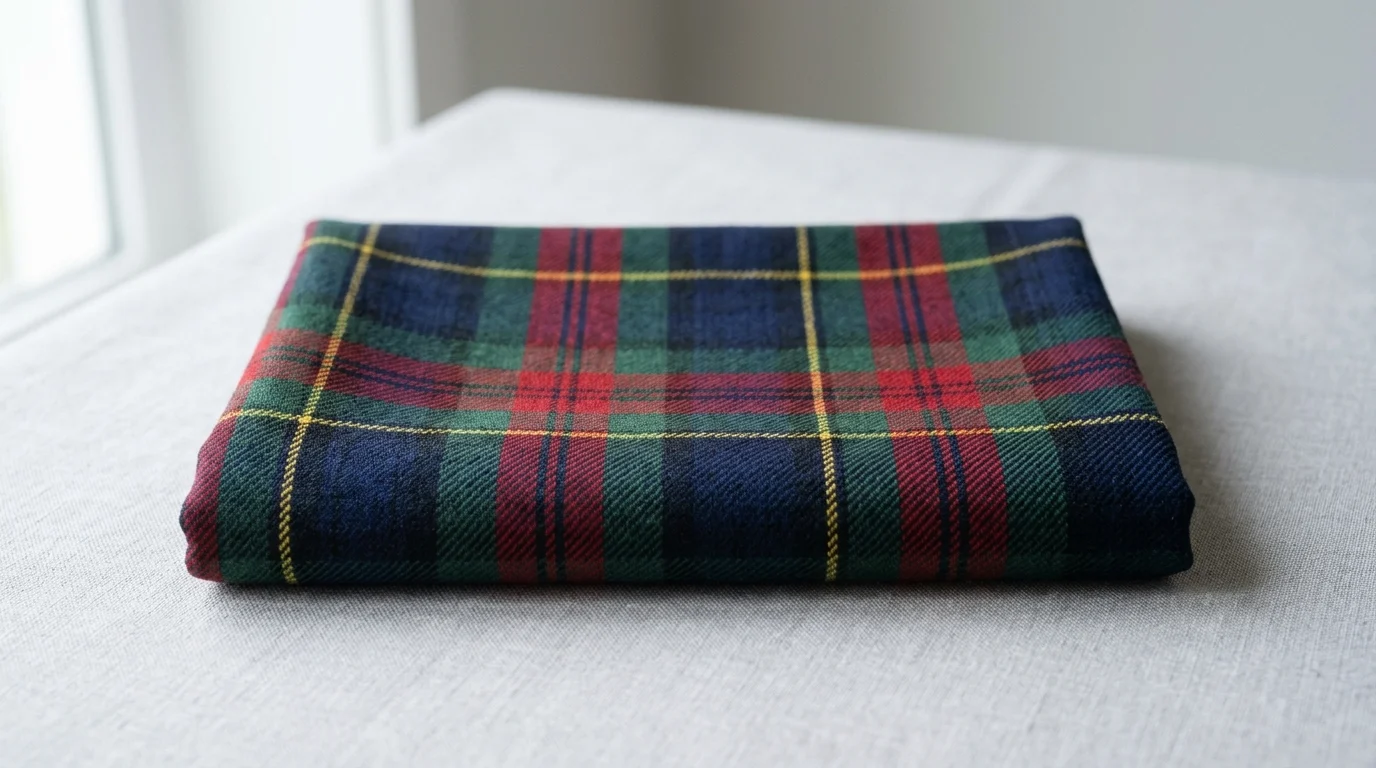
Why School Uniform Plaid Fabric Matters for Pleated Skirts
Selecting the appropriate school uniform plaid fabric is a critical decision for garment manufacturers and educational institutions. Pleated skirts and jumpers undergo rigorous daily wear, requiring textiles that maintain their structural integrity, resist wrinkling, and hold sharp pleats through repeated laundering cycles. While many traditional British and Irish academy uniforms—as well as premium or cold-climate programs—historically utilize wool or wool-blend tartans for their superior warmth and classic drape, heavyweight polyester and poly-blend twill plaid fabrics have emerged as viable, cost-effective options for modern US-style and international academy uniforms.
For these programs, the structural integrity of the textile is paramount; fabrics unsuited to the specific climate, student age, or laundering protocols can prematurely lose their shape and professional appearance. Crucially, buyers must distinguish between home care and industrial rental or lease programs. Industrial laundering, which utilizes high-heat tunnel finishing and heavy-duty extractors, imposes significantly stricter fiber, shrinkage, and heat-set requirements than standard home washing.
A key requirement for synthetic pleated garments is a fabric capable of withstanding high-temperature heat-setting. Without the correct fiber composition and heat treatment, pleats may flatten out after repeated washes, leading to increased replacement costs and uniform non-compliance. Consequently, understanding the underlying manufacturing processes and material trade-offs of these textiles is essential for ensuring long-term garment performance.
What Defines Yarn-Dyed Plaid Fabric
The defining characteristic of premium uniform plaids is the yarn-dyeing process. Unlike piece-dyed fabrics where patterns are printed onto a finished woven cloth, yarn-dyed textiles are created by dyeing individual yarns before they are woven together on the loom. This method ensures that the plaid pattern is structurally embedded into the textile, appearing identical on both sides of the cloth.
This inherent structural pattern is why yarn-dyed materials are a preferred school uniform fabric type for many academy apparel programs. Furthermore, yarn dyeing provides superior color penetration. Based on typical industry ranges, high-colorfastness uniform plaids often target an AATCC colorfastness rating of Grade 4.0 to 4.5 on the gray scale. This benchmark helps ensure that the rich reds, navy blues, and forest greens of traditional tartans resist bleeding into adjacent white yarns during high-temperature industrial laundering.
Why Weight, Twill, and Color Consistency Matter
The physical weight and weave structure directly determine how a skirt or jumper drapes on the wearer. For pleated garments, a heavyweight twill weave—typically ranging between 220 and 280 grams per square meter (GSM)—is optimal. The diagonal ribbing of a twill weave provides superior tear resistance and dimensional stability compared to standard plain weaves.
Color consistency is equally vital across different production batches. Because uniform programs often run for several years, a fabric produced in one academic year should closely match the fabric produced three years later. Manufacturers maintain strict spectrophotometer readings, typically aiming for a maximum Delta E (ΔE) color variation of less than 1.0 between dye lots to ensure seamless uniform continuity across the student body.
How Buyers Should Compare Plaid Fabric Specifications
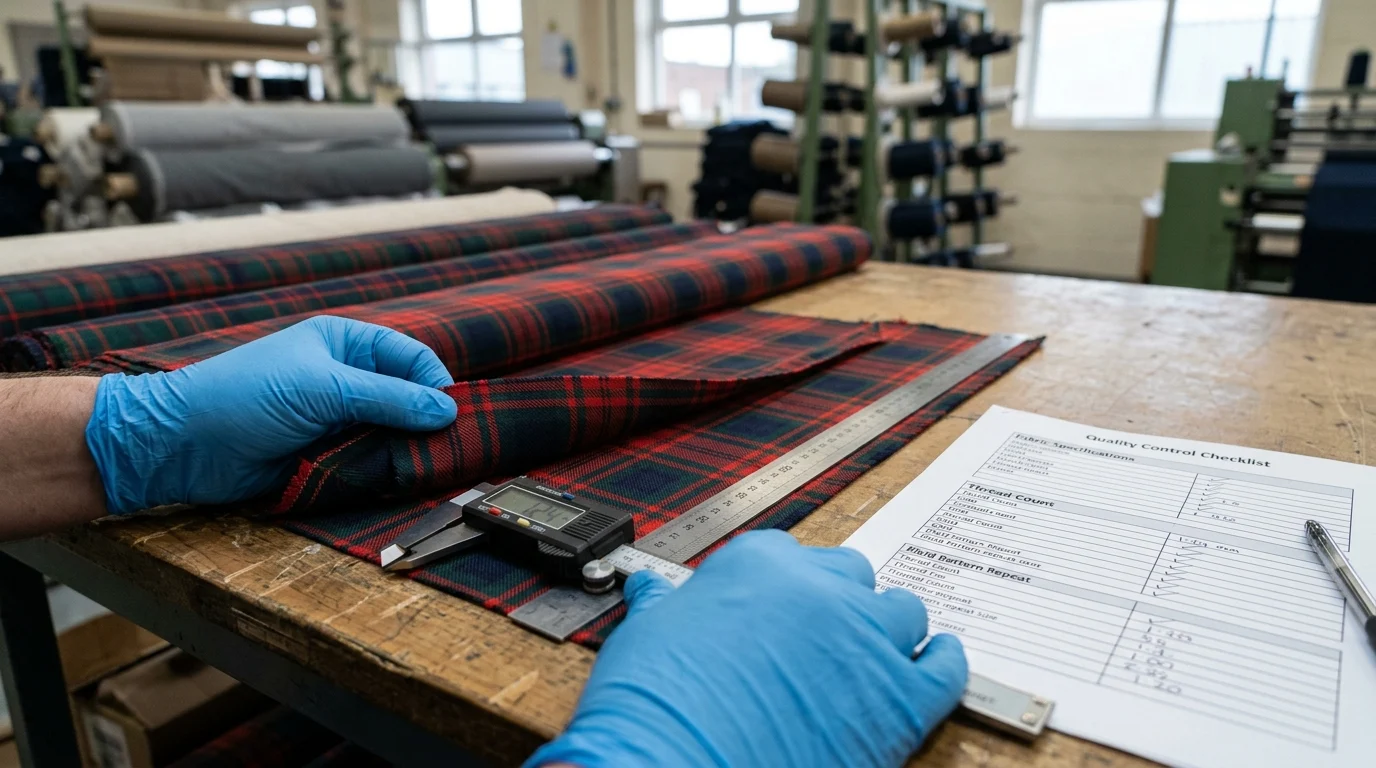
Which Fabric Construction Factors to Compare
The primary construction factor to evaluate is the fiber blend. While 100% polyester offers high durability and pleat retention, it comes with notable comfort limitations in active school environments, such as reduced breathability, static buildup, and heat sensitivity. Conversely, a polyester rayon plaid fabric provides a softer, more breathable hand-feel that mimics natural wool, making it highly desirable for premium uniform programs. However, this blend requires careful consideration: rayon loses strength when wet and can be prone to accelerated abrasion or shrinkage under harsh industrial washing, preventing an oversimplified preference based solely on softness.
Beyond comfort, buyers must also verify child-safety and compliance considerations, ensuring the chosen blend meets applicable flammability regulations, such as 16 CFR Part 1610 or ASTM D1230 standards for wearing apparel. The trade-offs between these blends regarding safety, shrinkage, pilling, and overall weight must be carefully weighed.
| Specification | 100% Polyester Twill | Poly-Rayon (65/35) Blend |
|---|---|---|
| Typical Weight | 220 – 260 GSM | 240 – 280 GSM |
| Pilling Resistance (ASTM D3512) | Grade 4.0 – 4.5 | Grade 3.5 – 4.0 |
| Shrinkage Rate | < 2% | 2% – 3% |
| Pleat Retention | Excellent (Heat-set) | Good (Requires care) |
| Tear Strength (ASTM D2261) | > 30N | > 25N |
As demonstrated in the comparison above, while poly-rayon blends offer improved breathability and a softer drape, 100% polyester variants generally provide higher ASTM-tested tear strength and lower shrinkage rates, making them a highly resilient choice for standard daily wear.
How to Evaluate Yarn-Dyed Plaid Fabric
Evaluating yarn-dyed textiles requires strict attention to pattern symmetry and skew. Because pleated skirts rely on precise geometric alignment, any distortion in the woven plaid will be highly visible once the garment is constructed. A standard supplier specification often requires a maximum skew tolerance of less than 2% across a typical 150 cm fabric width, though this can vary by manufacturer.
Additionally, the repeat size of the plaid pattern must be assessed. Large repeats (e.g., exceeding 15 cm) can lead to significant fabric waste during the cutting process, as markers must be carefully aligned to match the checks at the seams. Requesting detailed CAD (Computer-Aided Design) layouts of the fabric repeat prior to bulk ordering allows for accurate calculation of cutting yields and minimizes material loss.
How Procurement Teams Can Choose the Right Plaid Fabric
Transitioning from fabric selection to bulk procurement involves navigating complex supply chain variables.
Key Takeaways
- Choose 220–280 GSM heavyweight twill plaid fabric for pleated skirts and jumpers that need stable drape and daily-wear durability.
- Specify yarn-dyed plaid rather than printed plaid when uniforms require a pattern that is visible on both sides and resists fading.
- Confirm heat-setting performance before production because synthetic pleated garments can lose shape if the fabric is not engineered for high-temperature treatment.
- For industrial laundry programs, request tighter shrinkage, colorfastness, and heat-resistance standards than you would for home-wash uniforms.
- Use color-control standards such as Delta E below 1.0 to keep replacement skirts and jumpers visually consistent across multiple school years.
Frequently Asked Questions
What fabric weight is best for pleated school skirts?
For most pleated skirts and jumpers, a heavyweight twill plaid fabric around 220–280 GSM offers good drape, tear resistance, and pleat stability.
Why is yarn-dyed plaid preferred for uniforms?
Yarn-dyed plaid is woven from pre-dyed yarns, so the pattern is built into the fabric and appears on both sides, improving durability and color consistency.
Can polyester plaid fabric hold pleats well?
Yes, high-quality polyester or poly-blend plaid can hold sharp pleats when it is properly heat-set and specified for the intended washing conditions.
What colorfastness rating should uniform plaid fabric target?
Many high-colorfastness school uniform plaids target AATCC gray scale Grade 4.0 to 4.5 to reduce bleeding and fading during repeated laundering.
Is industrial laundering harder on plaid uniforms than home washing?
Yes. Industrial laundering uses higher heat, stronger extraction, and tunnel finishing, so fabrics need stricter shrinkage control, heat resistance, and pleat retention.

Yunai Textile
Post time: Aug-14-2026