
The global textile industry has reached a decisive turning point. In 2026, sustainability is no longer defined by a simple label like “organic” or “eco-friendly.” Instead, it is measured by traceable supply chains, circular design principles, chemical transparency, and—most importantly—product longevity.
For small-to-medium brands in Europe and North America, regulatory pressure is intensifying. Government tenders, corporate procurement policies, and even school uniform contracts increasingly require documented environmental compliance. At the same time, end consumers are more informed than ever. They demand proof, not promises.
For manufacturers of uniforms and functional fabrics, sustainability cannot be a seasonal marketing theme. Uniforms must endure industrial washing, outdoor exposure, and daily wear. Therefore, sustainability must be built into performance.
The future belongs to circular textiles—materials designed to last longer, recycle efficiently, and reduce environmental impact throughout their lifecycle.
The Rise of Recycled Polyester (rPET) and the Importance of Traceability
Polyester remains the backbone of the uniform and workwear industry. Its strength, wrinkle resistance, color retention, and cost efficiency make it indispensable. However, traditional virgin polyester is derived from fossil fuels.
This is where recycled polyester (rPET) has transformed the market.
In the past, recycled polyester carried a reputation problem. Early versions were inconsistent in quality—sometimes yellowish in tone, weaker in tensile strength, or prone to pilling. Today, that perception is outdated.
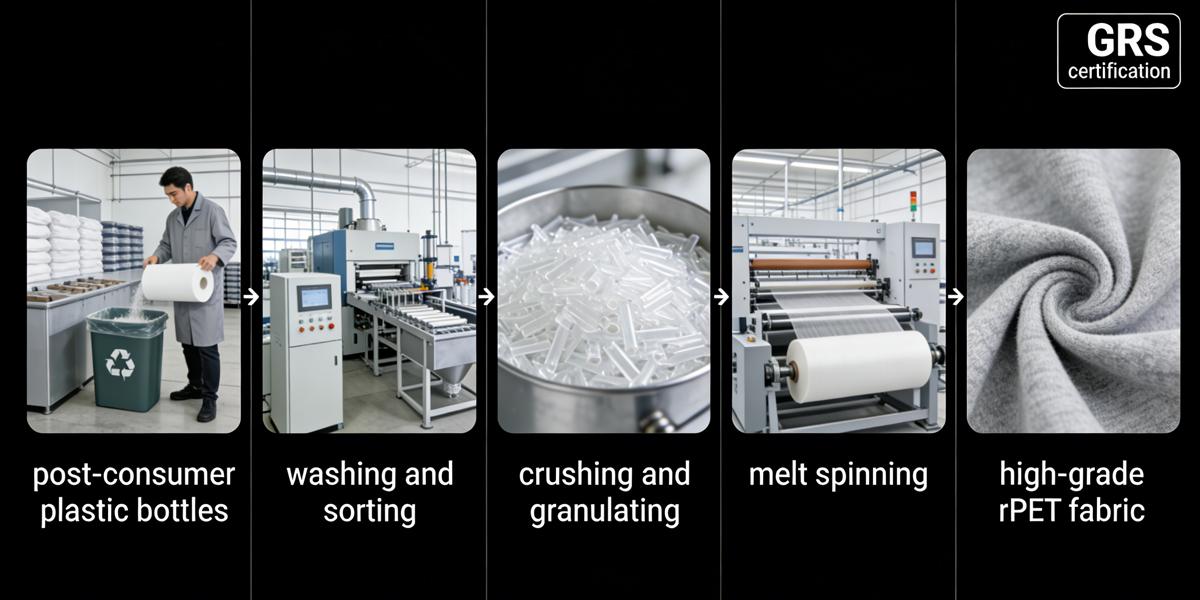
In 2026, high-grade rPET made from post-consumer plastic bottles is molecularly identical to virgin polyester. The polymer chains are rebuilt to the same structural standards. In practical terms, that means:
-
Equal durability
-
Equal dye uptake and colorfastness
-
Equal performance in abrasion resistance
-
No compromise in hand feel
For uniform brands, this is a game changer.
Why Traceability Matters More Than “Recycled”
However, simply labeling a fabric as “recycled” is no longer sufficient. In today’s compliance-driven market, traceability is everything.
The Global Recycled Standard (GRS) has become one of the most recognized certifications in global textile sourcing. GRS certification ensures:
-
Verified recycled content
-
Full supply chain traceability
-
Restricted chemical usage
-
Social and environmental compliance
Each shipment must be accompanied by a Transaction Certificate (TC), which tracks the recycled material from collection center to spinning mill to weaving factory.
For wholesalers and private-label brands, offering GRS-certified fabrics provides three major advantages:
-
Access to premium markets – Many government and corporate tenders now require documented recycled content.
-
Higher perceived brand value – Certified sustainability commands stronger margins.
-
Regulatory security – Clear documentation reduces compliance risks in EU and North American markets.
In short, traceability transforms recycled polyester from a claim into a competitive advantage.
PFC-Free Water Repellency: The New Standard for Functional Textiles
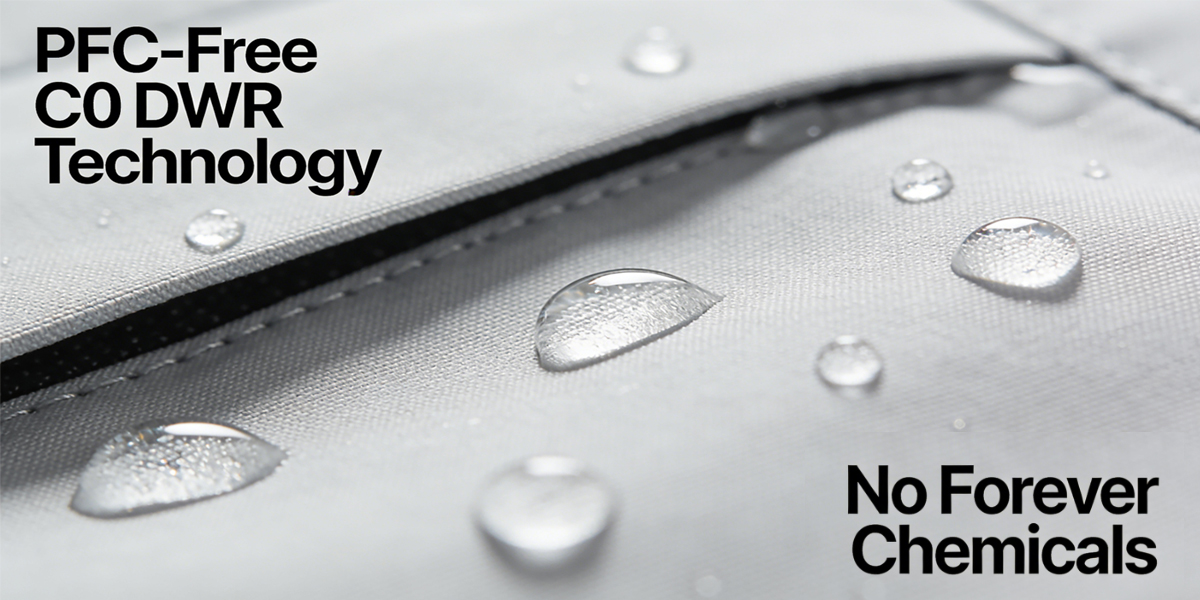
In outdoor and light-functional apparel, water repellency is essential. For decades, fluorocarbon-based chemicals (PFCs) were considered the gold standard for waterproof performance. They repel both water and oil extremely effectively.
However, these substances—often referred to as “forever chemicals”—do not degrade easily in the environment. Increasing scientific scrutiny and regulatory action have led to global phase-outs of long-chain fluorocarbons.
As a result, PFC-free finishing is no longer a niche preference. It is becoming the default expectation.
C0 DWR: A Safer Alternative
C0 DWR (Durable Water Repellent) finishes represent the new direction. Unlike traditional fluorocarbon finishes, C0 solutions:
-
Contain no intentionally added fluorocarbons
-
Are often bio-based
-
Have significantly lower environmental persistence
-
Are safer for skin contact
While C0 DWR may require slightly more care during washing to maintain optimal performance, it aligns with modern environmental standards and consumer expectations.
For wholesalers targeting the “Light Outdoor” market—urban commuters, school outerwear, and corporate softshell jackets—positioning products as PFC-free is a powerful selling point.
Today’s eco-conscious consumers are willing to accept minor maintenance trade-offs in exchange for reduced chemical exposure. Brands that communicate this transparently build trust.
Durability: The Purest Form of Sustainability
A common misconception in sustainable fashion is equating “natural” with “better.”
Cotton and linen are often seen as inherently sustainable. However, sustainability must be evaluated across the entire lifecycle of a garment.
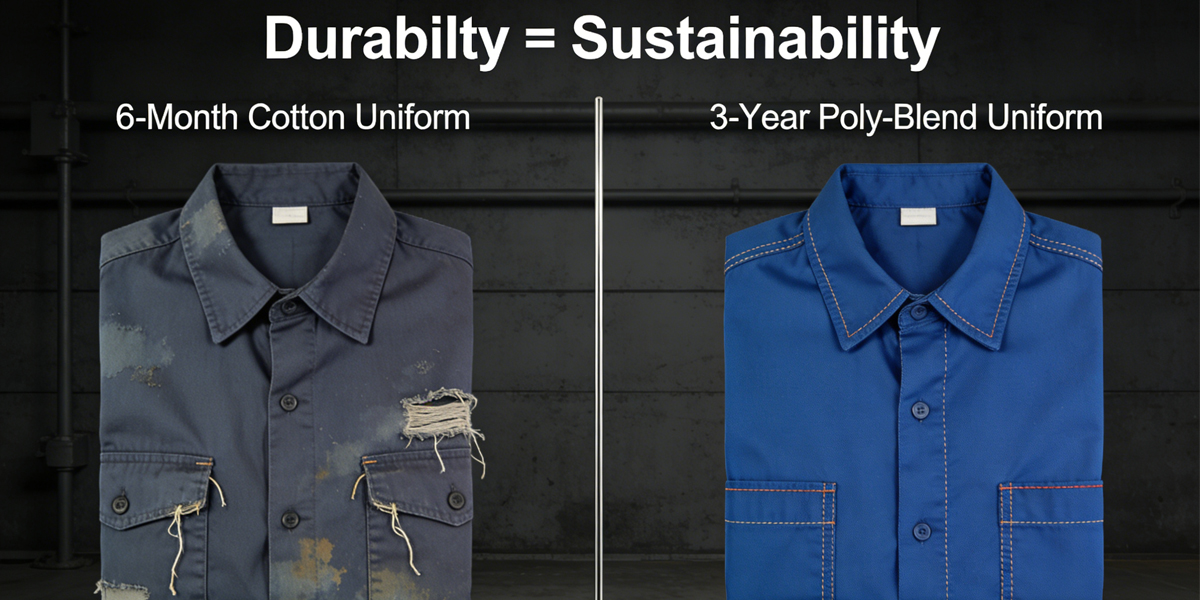
Cotton cultivation requires significant water, land, and energy inputs. If a 100% cotton uniform shirt wears out within six months under industrial laundering conditions, the environmental cost per wear becomes extremely high.
True sustainability considers:
-
Resource use during production
-
Product lifespan
-
Frequency of replacement
-
End-of-life disposal
Longevity as a Strategic Advantage
In the uniform sector, durability is not optional—it is essential.
High-performance Poly-Cotton or Poly-Viscose blends can last three years or more under daily use. By engineering fabrics with:
-
High abrasion resistance
-
Excellent colorfastness
-
Anti-pilling performance
-
Dimensional stability after washing
manufacturers significantly reduce replacement cycles.
Fewer replacements mean:
-
Lower cumulative carbon emissions
-
Reduced landfill waste
-
Lower procurement costs for clients
This approach reframes sustainability as “The Sustainable Life Cycle”—buying higher quality, replacing less often.
For corporate buyers, this message resonates strongly. Sustainability is no longer just an environmental story; it is also a cost-efficiency story.
Circular Design: Preparing for the Next Phase
Looking ahead, sustainability in textiles will increasingly focus on circularity.
Circular textiles are designed with their next life in mind. This includes:
-
Mono-material constructions that are easier to recycle
-
Clear fiber labeling for automated sorting
-
Reduced mixed-fiber complexity where possible
-
Designing for recyclability at the fabric development stage
For example, using 100% recycled polyester in certain uniform applications simplifies end-of-life processing compared to complex blends.
The industry is gradually shifting from a “take-make-dispose” model to a “design-use-recycle” model.
Manufacturers who anticipate this shift will become preferred partners for forward-thinking brands.
The Business Case for Sustainable Performance Fabrics
For wholesalers and brand owners, sustainability in 2026 is not about compromise—it is about integration.
The winning formula combines:
-
Recycled inputs (rPET with certification)
-
Safer chemical finishes (PFC-free treatments)
-
High durability and performance
-
Transparent documentation
When sustainability and functionality coexist, brands can confidently enter premium segments such as:
-
Government uniforms
-
Corporate workwear programs
-
School uniform contracts
-
Light outdoor commuter apparel
These segments value compliance, performance, and reliability over trend-driven fashion cycles.
Conclusion: Beyond “Organic” Toward Intelligent Sustainability
The sustainability conversation has matured.
In 2026, serious textile suppliers move beyond simplistic “organic” claims. Instead, they focus on:
-
Verified recycled content
-
Traceable supply chains
-
Chemical responsibility
-
Product longevity
-
Circular design thinking
For uniform and functional fabric manufacturers, sustainability must be engineered—not advertised.
By combining rPET innovation, GRS-certified traceability, PFC-free water repellency, and durability-focused design, brands can offer products that are environmentally responsible, economically efficient, and performance-driven.
That is the new definition of sustainable textiles:
Not just greener fibers—but smarter systems, longer lifespans, and measurable impact.
Post time: Mar-02-2026