
Introduction
Choosing fabric for a suit is not just about appearance; the intended use changes what matters most. In fashion suiting, drape, softness, and seasonal appeal often lead the decision, while uniform suiting fabric must perform under daily wear, repeated cleaning, and consistent use across many garments. That difference affects fiber selection, construction, durability, maintenance, and overall cost over time. Understanding these priorities helps buyers avoid using elegant but unsuitable textiles in demanding work environments. The discussion below explains how uniform suiting fabric is engineered differently from fashion cloth and what to evaluate when selecting materials for long-term professional use.
Fashion Suiting vs Uniform Suiting
When we approach the textile market, distinguishing between fashion suiting and uniform suiting is fundamental to a successful procurement strategy. In my experience overseeing textile sourcing, I frequently encounter clients who assume that a high-quality retail suit fabric will naturally translate into an excellent corporate uniform. However, the engineering, lifecycle expectations, and cost structures of these two categories are vastly different.
Understanding these distinctions prevents costly errors, such as deploying a delicate luxury fabric into a high-abrasion daily work environment. We must look beyond the initial drape and hand-feel to evaluate the structural integrity and long-term viability of the textile.
Key definitions and use cases
Fashion suiting is primarily driven by aesthetic appeal, seasonal trends, and individual comfort. Designers often prioritize luxury fibers like superfine merino wool, silk, or cashmere blends, which offer an exceptional drape and a luxurious hand-feel. These garments are typically worn occasionally, rotated frequently, and subjected to gentle dry-cleaning processes. The end-use case is focused on making a statement or adhering to high-end retail expectations, where the garment’s lifespan might only span a few fashion seasons before being retired.
Conversely, uniform suiting is engineered for rigorous daily wear, demanding a standardized corporate identity across diverse body types and roles. We deploy uniform fabrics in sectors ranging from hospitality and aviation to corporate banking. In these environments, the garment must withstand constant movement, repetitive friction, and frequent laundering. The priority shifts from seasonal novelty to multi-year consistency, ensuring that an employee hired today looks identical to one hired three years from now.
Performance priorities and technical differences
The technical differences between these two categories become apparent when we examine laboratory testing standards. Fashion fabrics might pass a Martindale abrasion test at 20,000 rubs, which is perfectly adequate for occasional wear. However, for uniform suiting, we require a minimum of 40,000 to 50,000 rubs to prevent premature wear at the elbows and seat. Additionally, colorfastness to washing and light in uniform fabrics must consistently hit a Grade 4 or 5 on the grey scale, whereas fashion fabrics may tolerate slight fading over time.
To achieve this performance, we often rely on engineered synthetic blends rather than pure natural fibers. For instance, a well-constructed 65 polyester 35 rayon fabric offers the breathable, soft hand of rayon combined with the exceptional tensile strength and wrinkle resistance of polyester. This specific ratio has become an industry standard for balancing cost, durability, and employee comfort.
| Feature | Fashion Suiting | Uniform Suiting |
|---|---|---|
| Primary Focus | Aesthetics, drape, luxury feel | Durability, consistency, easy care |
| Abrasion Resistance | ~20,000 Martindale rubs | >40,000 Martindale rubs |
| Typical Composition | Fine wool, silk, linen, cashmere | Polyester/rayon blends, poly/wool |
| Care Requirements | Dry clean only | Machine washable, industrial laundry |
| Lifecycle Expectancy | 1-3 years (intermittent wear) | 1-2 years (daily, rigorous wear) |
How to Choose Uniform Suiting Fabric
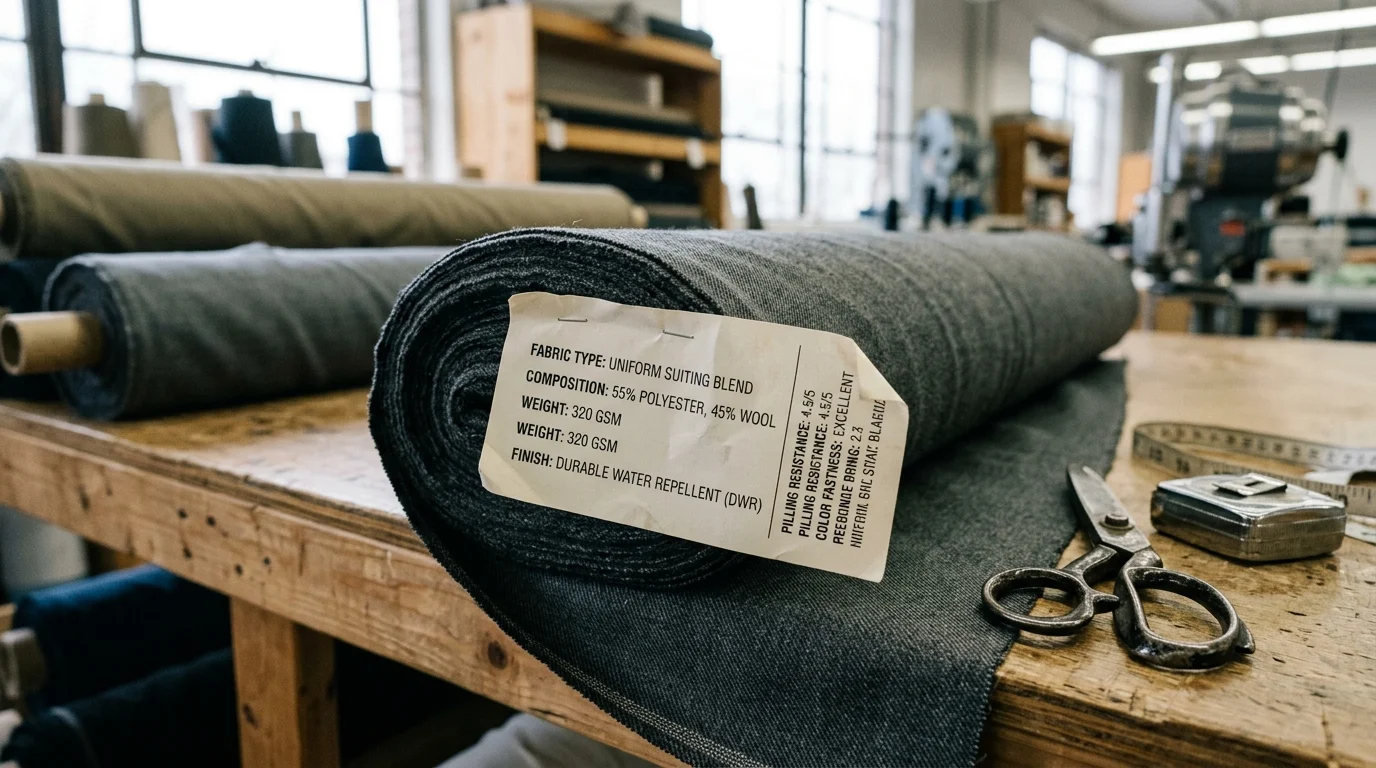
Selecting the right textile for a corporate apparel program goes far beyond picking a color from a swatch book. When I guide purchasing teams through the selection process, we focus heavily on risk mitigation and supply chain resilience. A uniform program is a long-term investment, and the fabric serves as its foundational building block.
We must rigorously evaluate both the physical properties of the fabric and the operational capabilities of the textile mill. Failing to establish strict parameters during the initial selection phase inevitably leads to inconsistent garments, employee complaints, and budget overruns.
Quality control and sourcing checks
Robust quality control begins before the fabric is ever cut. When sourcing suit pants fabrics, we mandate comprehensive testing protocols. I always recommend utilizing the universally recognized 4-Point System for visual inspection, stipulating a strict defect rate of fewer than 3 points per 100 linear yards. This ensures maximum yield during the manufacturing process and prevents unsightly flaws in the finished garments.
Beyond visual checks, dimensional stability is critical. Uniforms undergo frequent washing, and shrinkage must be tightly controlled to less than 2% in both the warp and weft directions. Pilling resistance is another major factor; we require a minimum Grade 4 on the ICI pilling box test to ensure the fabric does not develop unsightly bobbles after a few months of wear. Furthermore, modern uniform requirements often demand enhanced mobility for active staff. Incorporating 4 way stretch fabric wholesale options into the procurement strategy allows for better ergonomic movement without compromising the tailored silhouette expected in corporate environments.
Long-term supply and consistency factors
The most challenging aspect of managing a uniform program is maintaining visual consistency over several years. Unlike retail fashion, where fabrics are ordered once per season, an ideal polyester rayon fabric for suit program requires identical dye lots across multiple production runs. We enforce a strict color tolerance, requiring a Delta E (ΔE) value of less than 0.8 between the master standard and any subsequent bulk production lot. This guarantees that replacement jackets match existing trousers perfectly.
Logistical factors also dictate fabric choice. We must carefully negotiate Minimum Order Quantities (MOQs) with our suppliers. A typical bespoke uniform fabric might require an MOQ of 3,000 to 5,000 meters per color. If a client’s program cannot support this volume, we must pivot to high-quality stock-supported fabrics. Finally, lead times must be factored into the rollout schedule. Custom milling and dyeing generally require 45 to 60 days before the fabric even reaches the garment factory, making long-term forecasting and strong supplier relationships essential to the program’s success.
Key Takeaways
- The most important conclusions and rationale for uniform suiting fabric
- Specs, compliance, and risk checks worth validating before you commit
- Practical next steps and caveats readers can apply immediately
Frequently Asked Questions
What makes uniform suiting fabric different from fashion suiting?
Uniform suiting is built for daily wear, frequent washing, and long-term consistency, while fashion suiting focuses more on drape, luxury feel, and seasonal style.
What abrasion level should uniform suiting fabric meet?
For most corporate uniforms, choose fabric tested at 40,000–50,000 Martindale rubs to reduce wear at elbows, knees, and seat areas.
Why is 65 polyester 35 rayon popular for uniform suiting?
This blend balances softness, breathability, wrinkle resistance, and strength, making it a practical choice for durable, comfortable uniforms.
What quality checks should buyers request before ordering?
Ask for Martindale abrasion, colorfastness, dimensional stability, and 4-Point System inspection results, ideally under 3 points per 100 linear yards.
How can I contact IYUNAI Textile about uniform suiting fabric?
Use the contact page at iyunaitextile.com/contact-us/ to discuss fabric specs, testing requirements, and bulk uniform fabric sourcing.
Post time: Jun-03-2026