
For many mid-sized apparel brands and wholesalers, cost pressure is constant. Buyers are asked to reduce sourcing prices. Merchandisers are pushed to increase margins. And when a mill offers fabric at 15–20% below market rate, the offer can be difficult to ignore.
But the lowest sticker price is rarely the lowest total cost.
In global apparel manufacturing, the real cost of cheap fabric often appears later — in returns, production delays, customer complaints, and damaged brand reputation. As an established woven fabric manufacturer working with uniform brands, medical wear companies, and business apparel suppliers, we have repeatedly seen how “cheap fabric” quietly becomes the most expensive decision in the supply chain.
This guide breaks down the hidden costs of low-priced fabric sourcing and explains what mid-sized brands must evaluate before placing their next order.
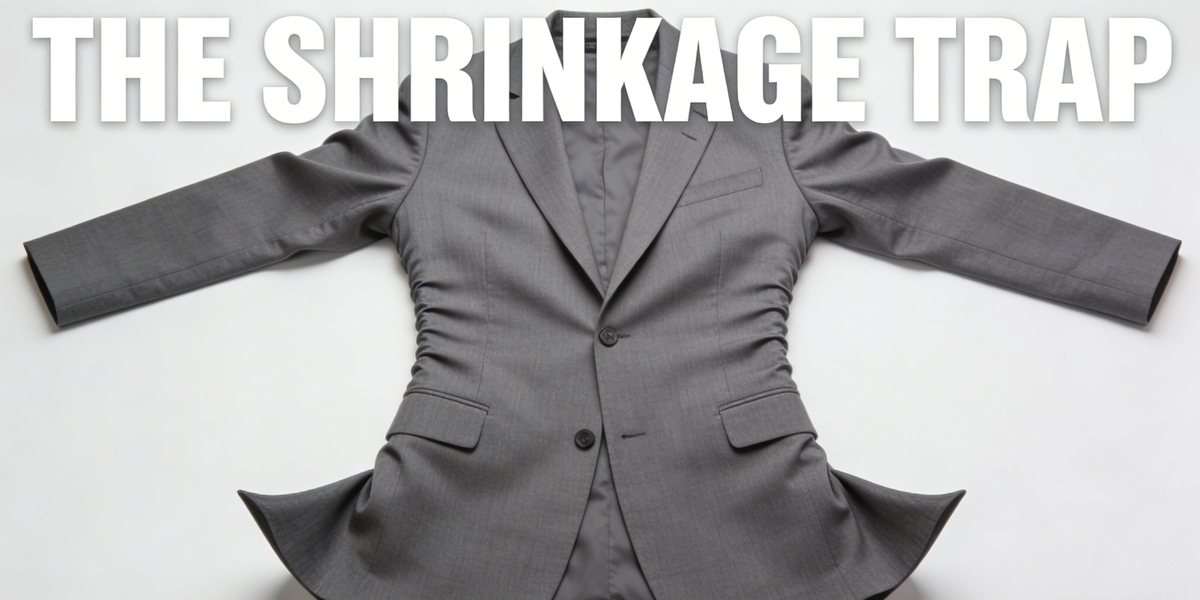
1. The Shrinkage Trap: How 5% Becomes a Reputation Problem
Shrinkage is one of the most underestimated risks in garment production.
Some low-cost mills artificially “stretch” fabric during the drying and finishing process to increase the final yardage output. This makes the roll appear heavier and more cost-effective on paper. However, this tension is not stable. Once the fabric is cut and sewn into garments, the internal stress remains locked inside the structure.
When the end customer washes the garment for the first time, the fabric relaxes.
The result?
-
Shrinking sleeves
-
Twisted side seams
-
Warped plackets
-
Distorted silhouettes
On a specification sheet, a 5% shrinkage rate may seem manageable. But in a tailored men’s suit or fitted business shirt, 5% is catastrophic. It turns a “Large” into something closer to a “Small.” In structured garments like blazers or uniforms, shrinkage can also affect shoulder balance and sleeve pitch — destroying the garment’s professional appearance.
For brands selling to corporate clients, schools, hospitals, or government institutions, even a small size inconsistency can trigger bulk complaints or contract penalties.
The Professional Standard
High-quality manufacturers use Sanforization and controlled heat-setting to stabilize fabric dimensions before shipment. These processes reduce internal stress and lock the fabric structure into a stable form.
In professional woven production, acceptable shrinkage tolerance should stay within 1–2%. Anything beyond that creates downstream risk.
Stable shrinkage means:
-
Consistent garment sizing
-
Fewer returns
-
Better customer reviews
-
Lower after-sales costs
For mid-sized brands, shrinkage control is not a technical detail. It is brand protection.
2. Pattern Distortion and Fabric Memory Problems
Shrinkage is not the only dimension issue. Cheap fabrics often suffer from poor structural memory.
If tension is uneven across warp and weft directions, the fabric may skew or torque after washing. In plaid or striped fabrics, this leads to visible pattern distortion. Checks that were aligned during cutting suddenly appear crooked.
In uniforms, this is unacceptable. In fashion retail, it destroys perceived quality.
Pattern misalignment also creates production inefficiencies:
-
Cutting markers fail
-
Matching checks becomes labor-intensive
-
Sewing time increases
-
Fabric waste rises
What appeared as a “cheap fabric deal” becomes an expensive production headache.
3. Latent Defects: The Chemical Time Bomb
Some fabric problems do not show up immediately.
They appear weeks later — sometimes after the garment reaches the consumer.
These are called latent defects.
3.1 pH Instability and Skin Irritation
Low-cost dyeing mills may use substandard chemicals to reduce processing costs. If post-treatment neutralization is incomplete, the fabric’s pH level may remain unstable.
This can cause:
-
Skin irritation
-
Rashes
-
Allergic reactions
The risk is especially serious for:
-
Medical scrubs
-
Hospital gowns
-
Corporate shirts worn all day
-
School uniforms
In sensitive sectors such as healthcare, a single complaint about fabric irritation can lead to supplier blacklisting.
Reputable mills use certified chemical systems and conduct lab testing to ensure skin safety. Certifications such as OEKO-TEX Standard 100 verify that fabrics meet strict human-ecological requirements.
For brands operating in Europe or North America, chemical compliance is not optional. It is mandatory for long-term growth.
3.2 Formaldehyde Residue
Formaldehyde-based resins are sometimes used in wrinkle-resistant finishing. When applied improperly, residue levels can exceed safe limits.
Consequences include:
-
Strong chemical odor
-
Regulatory rejection
-
Import inspection failure
-
Customer safety claims
For mid-sized brands expanding into international markets, failing compliance testing at customs can delay entire shipments and damage buyer relationships.
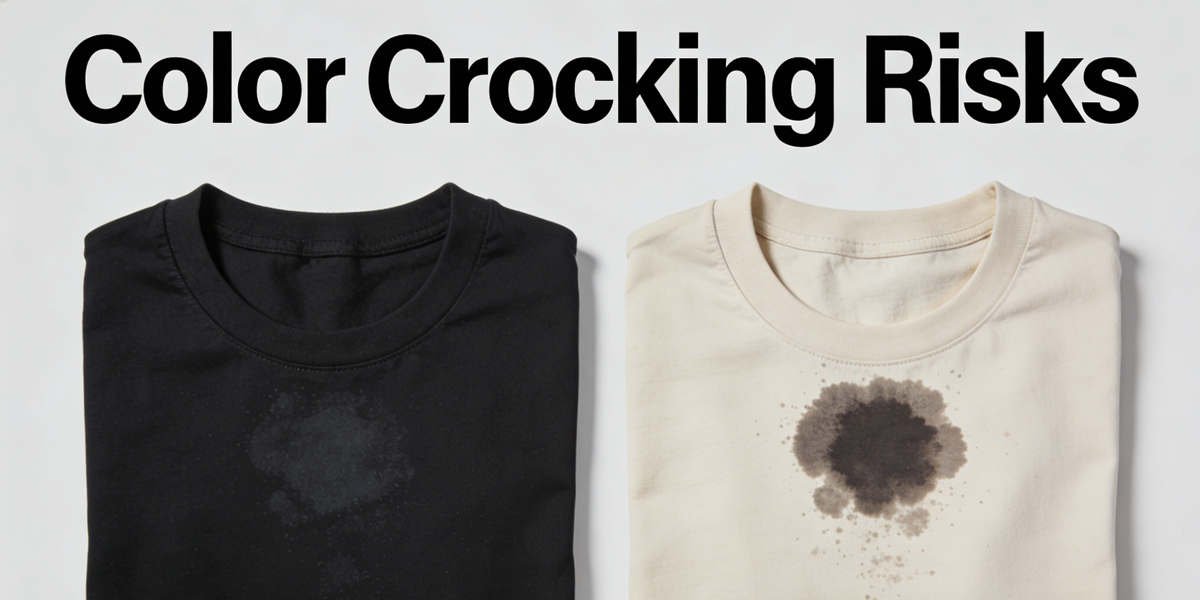
3.3 Color Crocking and Dye Bleeding
Another common hidden defect is poor color fastness.
If dyes are not properly fixed:
-
Dark fabric rubs off onto lighter garments
-
Jackets stain car seats
-
Uniforms bleed in washing machines
This phenomenon is called color crocking.
For a wholesaler, a single batch of bleeding fabric can trigger:
-
Mass recalls
-
Refunds
-
Legal disputes
-
Permanent reputation damage
Color fastness must be tested against rubbing, washing, perspiration, and light exposure. Professional mills perform laboratory testing under standardized protocols before shipment.
4. Inconsistent Width: The Silent Profit Killer
Fabric width consistency directly affects production efficiency.
If a roll is labeled as 150 cm wide but fluctuates to 147 cm mid-roll, automated cutting markers will not align correctly.
This leads to:
-
Marker reprogramming
-
Cutting delays
-
Extra fabric consumption
-
Increased labor cost
In high-volume garment production, even a 2–3 cm variance can increase fabric consumption by 5–8%.
That “cheap” fabric can easily become more expensive per finished garment than a premium alternative.
Usable Width vs. Nominal Width
Professional suppliers guarantee usable width, not just theoretical width.
Brands should always request:
-
Width tolerance documentation
-
Edge quality inspection
-
Full roll measurement reports
Paying 5% more for consistent width can reduce overall garment production costs by 10% through improved material utilization.
5. Edge Defects and Selvage Problems
Low-quality weaving often results in:
-
Pin holes near the selvage
-
Loose edges
-
Uneven tension
These edge defects limit usable width and increase fabric waste.
In automated cutting environments, even minor selvage damage can trigger machine stops and recalibration.
For mid-sized brands scaling production, such disruptions slow growth and increase hidden operational costs.
6. Delivery Instability and Supply Chain Risk
Cheap mills often operate with:
-
Weak quality control systems
-
Limited production planning
-
Inconsistent dye lot control
This leads to:
-
Shade variation between batches
-
Missed delivery dates
-
Re-dyeing costs
-
Emergency air shipments
Air freight alone can erase any initial fabric savings.
In structured categories like medical wear, school uniforms, and corporate attire, color consistency across reorder cycles is critical. A 2% shade variation can cause visible mismatch between old and new uniforms — forcing brands to discount inventory.
Stable suppliers invest in:
-
Lab dip archives
-
Color management systems
-
Batch traceability
This infrastructure costs money — which is why ultra-cheap fabric rarely provides it.
7. The True Cost Equation: Price vs. Total Cost of Ownership
Mid-sized brands should evaluate fabric sourcing through Total Cost of Ownership (TCO), not purchase price.
The real cost of cheap fabric includes:
-
Returns and exchanges
-
Customer complaints
-
Warranty claims
-
Recall risk
-
Production delays
-
Fabric waste
-
Lost contracts
-
Brand reputation damage
When calculated holistically, the 10–20% initial savings often disappears.
In fact, many experienced wholesalers discover that stable, compliant, dimensionally controlled fabric increases net profit over time — even at a higher unit cost.
8. A Strategic Approach to Fabric Sourcing
Before selecting a supplier, mid-sized brands should verify:
-
Shrinkage tolerance reports
-
Heat-setting and finishing methods
-
Chemical compliance certification
-
Color fastness test results
-
Width consistency documentation
-
Batch traceability systems
-
Quality control procedures
Ask not only “What is the price per meter?” but also:
-
What is the long-term risk exposure?
-
What is the reorder consistency?
-
How will this fabric perform after 30 washes?
Professional sourcing decisions protect brand equity.
Conclusion: Cheap Fabric Is Often the Most Expensive Choice
In competitive markets, pricing pressure is real. But cutting corners at the fabric level introduces structural risk into your entire brand ecosystem.
The hidden costs of cheap fabric are not theoretical. They appear in:
-
Ill-fitting garments
-
Skin irritation claims
-
Color bleeding complaints
-
Production inefficiencies
-
Lost institutional contracts
For mid-sized brands aiming to scale sustainably, the goal should not be the cheapest supplier — but the most stable one.
Because in the long run, consistency protects margin.
And in apparel manufacturing, reputation compounds faster than savings.
When evaluating your next fabric order, remember:
The cheapest fabric is often the most expensive decision.
Post time: Mar-03-2026