

Why GRS Certified Recycled Polyester Matters for Medical Scrubs
The textile sourcing industry is witnessing a fundamental shift in how it approaches high-performance medical textiles. The traditional reliance on virgin synthetics is rapidly giving way to recycled alternatives, driven by both ecological necessity and evolving institutional mandates. Incorporating recycled polyester (rPET) into medical apparel is no longer just a niche marketing tactic; it is becoming a baseline requirement for competitive procurement.
Manufacturing rPET consumes up to 45% less energy and generates approximately 30% fewer carbon emissions compared to virgin polyester extrusion. However, making claims about sustainability is easy—proving it is where the Global Recycled Standard (GRS) comes into play. For supply chain managers, GRS certification provides the verifiable traceability needed to ensure materials genuinely divert plastic waste from landfills without compromising clinical performance.
What Recycled Polyester and GRS Certification Mean
Recycled polyester is predominantly spun from post-consumer PET bottles, though it can also utilize pre-consumer industrial waste. The plastic is sterilized, crushed into flakes, melted into pellets, and finally extruded into yarn. While the chemistry remains identical to virgin polyester, the supply chain is entirely different. This necessitates reliance on the Global Recycled Standard.
GRS is an international, voluntary standard that sets requirements for third-party certification of both pre-consumer and post-consumer recycled inputs, as well as chain of custody. To qualify for GRS certification, a fabric must contain a minimum of 20% recycled material. However, to display the consumer-facing GRS logo on garments, the fabric must contain at least 50% recycled content overall. Beyond material composition, GRS also enforces strict social and environmental processing criteria, ensuring that chemical restrictions are met throughout the dyeing and finishing stages. It is important to clarify that GRS certification validates recycled inputs and traceability; it does not constitute a holistic “eco-friendly” label for the finished garment, as dyeing, finishing, and non-recycled blend components still carry environmental impacts.
How Sustainability Supports Hospital Procurement and Brand Positioning
Sustainability is increasingly written into the scoring matrices of institutional tenders. Certain forward-looking healthcare networks have established aggressive Environmental, Social, and Governance (ESG) targets, with some emerging guidelines encouraging 15% to 25% of their textile procurement to come from verified sustainable sources.
Integrating GRS-certified rPET into product lines directly supports these institutional goals while elevating brand positioning. It allows premium uniform brands to differentiate themselves in a crowded market. When pitching to procurement boards, presenting a fully traceable, lower-carbon garment provides a distinct competitive advantage over suppliers relying solely on conventional virgin synthetics.
How Recycled Polyester Scrub Fabric Compares with Virgin Polyester
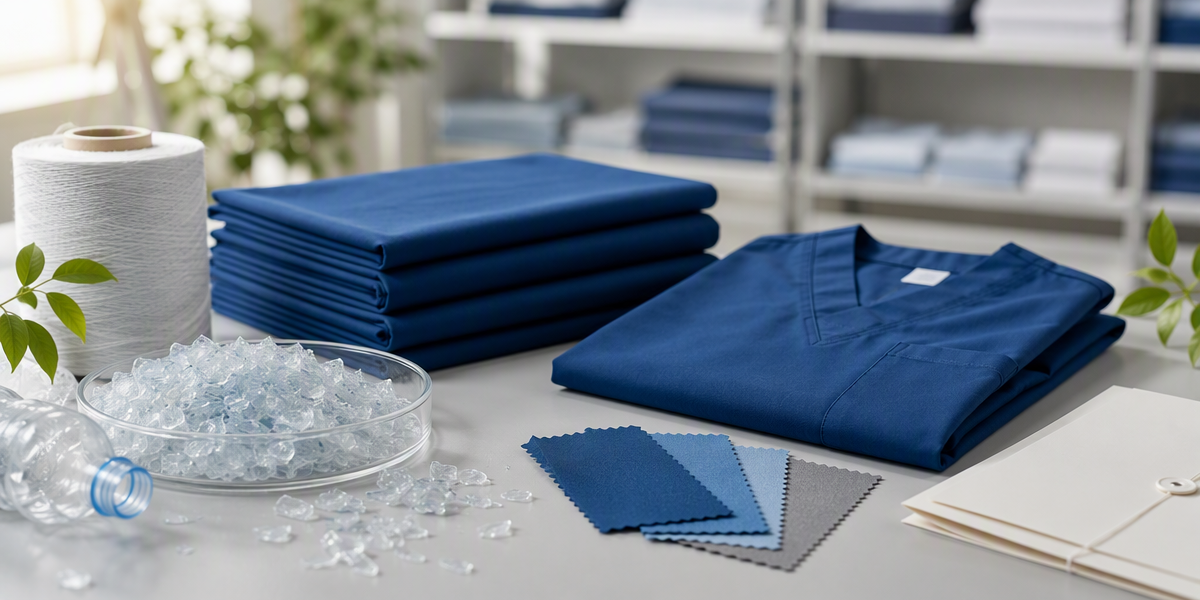
When evaluating fabric blends for scrub suits, a common concern among designers and buyers is whether recycled polyester can match the rigorous demands of healthcare environments. Medical professionals require garments that withstand high-temperature industrial laundering, resist bodily fluids, and offer exceptional mobility.
The short answer is yes. Because the polymer chains in rPET are chemically identical to virgin polyester, the inherent properties of the fiber generally remain intact. However, technical caveats do exist: rPET can suffer from intrinsic viscosity degradation during the mechanical recycling process, and feedstock contamination risks can occasionally cause batch-to-batch inconsistency. Therefore, the blending and finishing processes dictate the final performance, making rigorous quality control essential.
Key Performance Specifications to Compare
To make informed sourcing decisions, procurement teams must evaluate performance data. Below is a comparative baseline for high-quality twill fabrics engineered for medical environments. Rather than precise numerical benchmarks—which fluctuate based on specific mill capabilities and fabric constructions—this table offers qualitative guidance on how GRS-certified rPET blends compare to their virgin counterparts.
| Specification Metric | Virgin Polyester Blend | GRS Certified rPET Blend |
|---|---|---|
| Tensile Strength (Warp/Weft) | Baseline standard | Comparable; occasionally slightly lower but within clinical tolerance |
| Pilling Resistance | Baseline standard | Comparable; minor variance depending on yarn spinning quality |
| Colorfastness to Washing | Excellent | Identical to virgin |
| Shrinkage (at 60°C wash) | Minimal | Identical to virgin |
| Material Cost Premium | Baseline | Variable market estimate (buyers commonly report a +10% to 18% premium) |
As the comparison illustrates, the structural and performance differences are negligible under standard testing. The primary variance lies in the cost structure, where the specialized collection, sorting, and extrusion processes for rPET typically introduce a variable premium over virgin materials.
Comfort, Durability, and Moisture Management Trade-Offs
While the raw specifications align closely, trade-offs in comfort and moisture management must be carefully managed. Recycled polyester, like its virgin counterpart, is naturally hydrophobic. To achieve the breathability and softness required for long clinical shifts, manufacturers rarely use 100% rPET. Instead, it is typically blended with cellulosic fibers and elastomers.
For example, utilizing a standard polyester-rayon-spandex formulation combines the durability of recycled polyester with the moisture-wicking softness of rayon and the dynamic 4-way stretch of spandex. It is crucial to calculate how this impacts GRS compliance: to achieve exactly 72% total recycled content in this blend, the polyester component itself must be 100% rPET. If a partial rPET blend is used in that layer, the final total could drop below the 50% consumer-facing logo threshold.
Additionally, there are environmental caveats to consider. Like all synthetic textiles, recycled polyester sheds microplastics at rates comparable to virgin polyester during laundering. The primary environmental benefit of rPET is upstream waste diversion and reduced carbon emissions, rather than reduced use-phase pollution. Furthermore, while the inputs are recycled, polyester-rayon-spandex blends are generally not recyclable in standard post-consumer mechanical streams. Blending rPET with non-recycled fibers complicates true end-of-life recyclability, representing a necessary compromise to guarantee the daily comfort and performance healthcare workers demand.
How to Source GRS Certified Recycled Polyester Scrub Fabric
Shifting production to sustainable materials introduces new layers of complexity in vendor management. When transitioning a supply chain to incorporate polyester-rayon-spandex medical workwear fabric made from recycled inputs, mitigating the risk of greenwashing becomes a top priority.
Securing the right supplier requires moving beyond marketing claims
Key Takeaways
- Choose GRS-certified recycled polyester when medical scrub programs require verified recycled content and traceable supply chain documentation.
- Use the 20% recycled-content threshold for GRS certification and the 50% threshold when planning garments that may display the GRS logo.
- Compare rPET with virgin polyester on laundering durability, stretch recovery, fluid resistance, and comfort rather than assuming recycled fiber means lower performance.
- Highlight that recycled polyester production can use up to 45% less energy and generate about 30% fewer carbon emissions than virgin polyester.
- Prepare certification documents and recycled-content claims before hospital tender submissions, especially where sustainable textiles may represent 15% to 25% of procurement targets.
Frequently Asked Questions
What is GRS-certified recycled polyester in medical scrub fabric?
It is polyester made from verified recycled inputs, commonly post-consumer PET bottles, with third-party certification under the Global Recycled Standard for recycled content, traceability, and processing controls.
Does recycled polyester perform like virgin polyester in scrubs?
Yes. Recycled polyester has the same basic polymer chemistry as virgin polyester, so it can deliver comparable durability, color retention, wash resistance, and easy-care performance when properly engineered.
How much recycled content is required for GRS certification?
GRS certification requires at least 20% recycled material in the fabric. To use the consumer-facing GRS logo on garments, the product must contain at least 50% recycled content overall.
Why does GRS matter for hospital procurement?
GRS provides traceable proof of recycled content, helping suppliers meet ESG-focused tender requirements and giving procurement teams clearer documentation for sustainable textile sourcing.
Is GRS certification the same as saying a scrub is fully eco-friendly?
No. GRS verifies recycled inputs, chain of custody, and certain processing criteria, but dyeing, finishing, trims, and non-recycled blend components can still affect the garment’s total environmental impact.

Yunai Textile
Post time: Aug-18-2026