
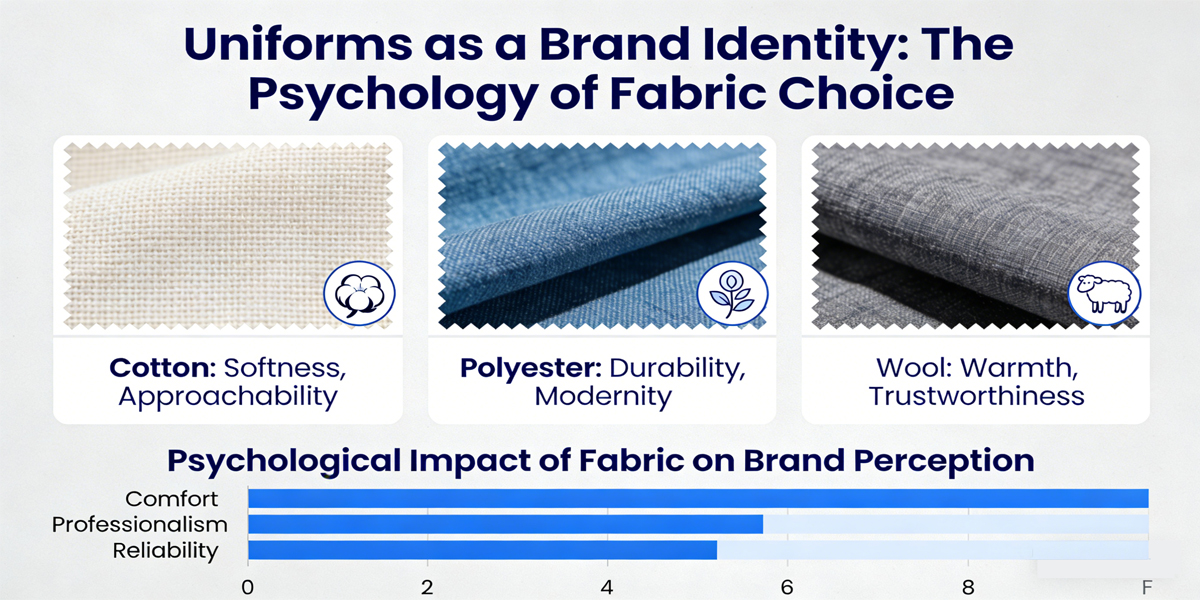
In today’s competitive B2B apparel market, uniforms are no longer just functional garments. For your clients—the brands—they are strategic tools. A uniform is a walking billboard, a symbol of authority, and a silent communicator of corporate values.
Before an employee says a single word, the fabric they wear has already delivered a message.
Understanding the psychology of fabric choice helps wholesalers, manufacturers, and sourcing managers position their products more effectively. It also enables brands to strengthen customer trust, employee confidence, and overall brand consistency.
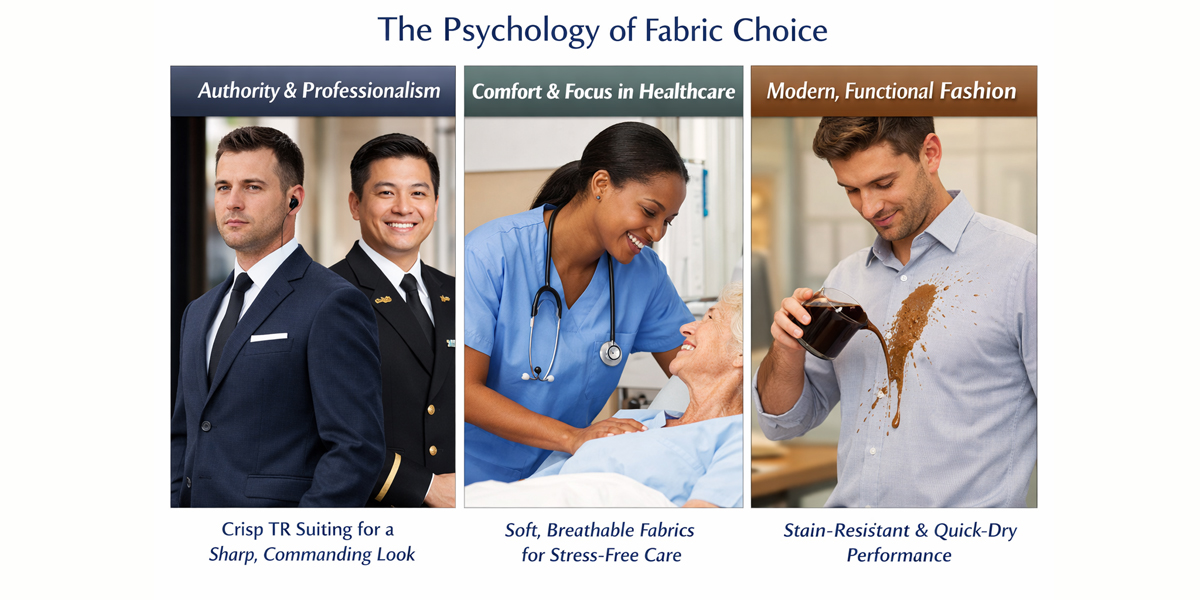
This article explores how textile selection influences perception in three key sectors: corporate authority, healthcare productivity, and modern functional fashion.
Why Fabric Psychology Matters in Uniform Design
Consumers and clients make subconscious judgments in seconds. Research in behavioral psychology consistently shows that texture, structure, and visual consistency influence how people perceive professionalism, competence, and trustworthiness.
In uniform-based industries—banking, hospitality, healthcare, security, retail—fabric choice directly impacts:
-
Brand perception
-
Employee confidence
-
Customer trust
-
Operational performance
A poorly chosen fabric can undermine even the most carefully designed uniform program.
Conversely, a well-engineered textile enhances brand credibility.
For wholesalers and fabric manufacturers, understanding this dynamic creates a powerful sales advantage.
The Texture of Authority: Suiting and Structured Fabrics
In industries such as security services, financial institutions, airlines, and high-end hospitality, uniforms must project authority and reliability.
The psychology behind this is straightforward: humans associate structure with discipline.
A crisp, medium-to-heavy weight TR (polyester-viscose) twill fabric creates sharp silhouettes and clean lines. This structure communicates:
-
Stability
-
Organization
-
Professionalism
-
Control
When a blazer fabric is too lightweight or overly soft, it wrinkles easily. Wrinkling signals carelessness. Even if unintentional, the subconscious message is clear: lack of structure equals lack of control.
Spring-Back Resilience and Visual Integrity
High-quality suiting fabrics are engineered with “spring-back” resilience. This means the fabric recovers quickly from creasing and maintains its form after long wear.
For example:
-
A hotel concierge working a 12-hour shift
-
A bank employee seated for extended periods
-
A security officer standing in outdoor conditions
If their uniform loses structure by midday, the brand image deteriorates.
Professional suiting fabrics maintain “visual integrity.” This is the ability to look sharp and disciplined throughout the workday.
Brands are willing to pay a premium for this consistency because authority must appear effortless.
For wholesalers, positioning structured suiting fabrics as “brand reinforcement tools” rather than simple textiles significantly increases perceived value.
The Comfort = Productivity Equation in Healthcare
Healthcare uniforms follow a different psychological framework.
In hospitals, clinics, and laboratories, the key emotions are:
-
Empathy
-
Trust
-
Calmness
-
Efficiency
Medical professionals work under high pressure. If their uniforms are stiff, non-breathable, or irritating to the skin, discomfort increases stress and reduces focus.
This is where rayon-rich blends and soft-touch fabrics become strategic.
Softness and Emotional Perception
Soft fabrics subconsciously communicate care and approachability. Patients often feel more comfortable interacting with healthcare workers wearing uniforms that look breathable and gentle rather than rigid and harsh.
Beyond perception, comfort has measurable operational benefits:
-
Reduced physical distraction
-
Better mobility
-
Improved morale
-
Lower fatigue during long shifts
Offering 4-way stretch fabrics with moisture-wicking properties enhances movement and thermal regulation. In fast-paced clinical environments, this directly supports performance.
Wholesalers should position healthcare fabrics not as “scrub materials,” but as productivity-enhancing tools.
When nurses and doctors feel comfortable, they are more focused on patient care. When patients perceive comfort and professionalism, institutional trust rises.
Breathability, Mobility, and Stress Reduction
Textile engineering plays a major role in modern healthcare uniform programs.
Key performance factors include:
-
Air permeability
-
Moisture management
-
Stretch recovery
-
Anti-static properties
-
Easy-care durability
Blended fabrics that combine polyester strength with rayon softness create an optimal balance between structure and comfort.
In procurement discussions, this allows wholesalers to move the conversation away from price per meter and toward performance per shift.
The psychological benefit? Comfort reduces cognitive load.
When employees are not distracted by heat, itchiness, or restricted movement, they can perform with greater focus and confidence.
Functionality as Modern Luxury
In corporate-casual, retail, and “light outdoor” segments, the psychology shifts again.
Here, functionality is perceived as modern luxury.
Consumers increasingly associate performance features with innovation and premium value.
A shirt that resists stains, dries quickly, or repels water creates a strong first impression.
Imagine a salesperson demonstrating coffee rolling off a treated fabric. The visual effect immediately communicates:
-
Technological advancement
-
Attention to detail
-
Forward-thinking brand positioning
This “wow factor” is not superficial. It creates emotional engagement.
Functional finishes such as:
-
Stain resistance
-
Anti-static treatment
-
Quick-dry technology
-
Wrinkle resistance
transform a basic uniform into a high-value asset.
Instead of selling a “blue corporate shirt,” you are selling a “performance uniform designed for real life.”
For wholesalers, these functional upgrades are powerful tools for increasing Average Order Value (AOV). Clients are more willing to invest when they see tangible performance benefits.
Color Psychology in Uniform Fabrics
Color choice also plays a critical role in brand perception.
-
Dark navy and charcoal gray signal authority and stability.
-
Light blue conveys trust and calmness.
-
Green tones in healthcare environments reduce anxiety.
-
Earth tones in outdoor or corporate-casual settings communicate sustainability and modernity.
Fabric finish influences how these colors are perceived. Matte textures often appear more sophisticated, while excessive sheen can feel less professional in certain sectors.
Wholesalers who understand color psychology can guide clients toward strategic decisions rather than simply offering shade cards.
Durability and Long-Term Brand Impression
Uniforms endure repeated washing, exposure to sunlight, and daily wear.
Poor-quality fabrics lose color vibrancy, pill easily, or distort in shape. This deterioration sends negative brand signals.
Durability is not just about longevity—it is about consistency of perception.
When uniforms maintain their original appearance over time, the brand appears stable and reliable.
Investing in higher-quality fibers, controlled dyeing processes, and tested finishes ensures that garments look professional even after dozens of wash cycles.
This reliability reduces replacement frequency and improves return on investment for institutional clients.
Selling the Psychology, Not Just the Fabric
For wholesalers and manufacturers, the key takeaway is this:
Clients are not buying fabric.
They are buying identity reinforcement.
Instead of focusing solely on technical specifications, sales conversations should include:
-
How does this fabric influence customer perception?
-
How will employees feel wearing it for 10–12 hours?
-
Does it support the brand’s core message?
-
Will it maintain its visual authority over time?
By framing fabric selection within brand psychology, wholesalers elevate their role from supplier to strategic partner.
Post time: Mar-04-2026