
What GSM Is Best for Scrub Fabric in Hot and Humid Climates?

When sourcing medical uniform fabric for hot and humid climates, one of the first questions healthcare brands ask is: What GSM is best for scrub fabric?
GSM, or grams per square meter, is an important fabric specification. It helps buyers understand fabric weight and compare different materials. However, choosing the right GSM involves more than selecting the lightest available option.
For medical uniforms, fabric weight needs to be balanced with breathability, coverage, moisture management, durability, hand feel, and the working environment.
A lightweight fabric may be suitable for some applications, while a slightly heavier fabric may provide better coverage and a more structured appearance for others.
For healthcare uniform brands targeting the Middle East, Southeast Asia, Latin America, and Africa, understanding how GSM influences fabric performance can help create more suitable products for different markets.
1. What Does GSM Mean in Medical Uniform Fabric?
GSM stands for grams per square meter. It measures the mass of one square meter of fabric.
For example, a fabric with a specification of 200 GSM weighs approximately 200 grams per square meter.
In medical uniform manufacturing, GSM is commonly used to compare fabric weights and establish product specifications.
However, GSM does not directly tell buyers:
- · How breathable the fabric is
- · How quickly the fabric dries
- · How soft the fabric feels
- · How much stretch it provides
- · Whether white fabric will be sufficiently opaque
- · How durable the fabric will be
- · How comfortable the finished garment will feel
These properties depend on other factors, including fiber composition, yarn characteristics, fabric construction, finishing, and garment design.
Therefore, GSM should be treated as one part of a complete fabric specification rather than a standalone quality indicator.
2. Is Lower GSM Always Better for Hot Weather?
Many buyers assume that lower-GSM fabric is automatically more comfortable in hot weather.
This assumption is understandable because lightweight fabric can reduce the overall weight of a garment.
However, lower GSM does not automatically mean better breathability or better comfort.
A fabric’s air permeability depends on its construction, density, thickness, and other characteristics.
Similarly, reducing fabric weight may affect coverage, structure, and durability, depending on how the fabric is developed.
For example, a very lightweight white scrub fabric may feel light in the hand but may not provide the desired coverage under strong lighting.
A slightly heavier fabric with a suitable construction may provide a more balanced combination of lightness, breathability, and appearance.
The goal should not be to select the lowest possible GSM.
Instead, buyers should identify the fabric weight that meets the requirements of the intended garment and working environment.
3. How Different GSM Ranges May Suit Different Applications
There is no universal GSM standard for all medical uniforms.
The appropriate weight depends on the fabric construction, intended garment, target market, and performance requirements.
The following ranges can be used as general development starting points, not as fixed industry standards.
Lightweight Medical Uniform Fabric: Approximately 120–170 GSM
Lightweight fabrics may be considered for applications where reducing garment weight is a priority.
Potential applications include:
- · Warm-weather medical uniforms
- · Lightweight healthcare tops
- · Certain tropical-climate uniforms
- · Garments designed for frequent movement
However, buyers should pay particular attention to coverage, fabric stability, and durability.
For white and pale-colored uniforms, opacity should be evaluated carefully.
A lightweight fabric may be suitable for one garment design but less suitable for another, even when both are intended for hot weather.
Medium-Weight Medical Uniform Fabric: Approximately 170–220 GSM
This range can be a useful starting point for developing medical uniform fabrics that need to balance weight, coverage, and everyday performance.
Depending on construction and composition, fabrics in this range may be considered for:
- · Everyday medical scrubs
- · Stretch healthcare uniforms
- · Hospital and clinic uniforms
- · Professional medical apparel
For buyers who need a combination of comfort and a more substantial fabric appearance, this range may offer useful development options.
However, actual breathability and comfort still need to be evaluated through fabric samples and relevant testing.
Medium-to-Heavy Medical Uniform Fabric: Approximately 220–260 GSM
Higher-GSM fabrics may be considered when buyers prioritize a more substantial hand feel, greater structure, or particular coverage requirements.
Potential applications include:
- · Structured medical uniforms
- · Certain premium scrub collections
- · Uniforms requiring a more substantial appearance
- · Specific garment designs that benefit from additional fabric weight
However, higher GSM does not automatically mean better durability, better opacity, or lower breathability.
These properties still depend on the actual fabric construction and finishing.
For hot and humid climates, buyers should carefully evaluate whether the additional weight is appropriate for the intended working environment.
4. Why Fabric Construction Matters as Much as GSM
Two fabrics with the same GSM can perform differently.
This is because fabric weight does not describe the complete structure of a textile.
Important factors include:
Fiber Composition
Polyester, rayon, and spandex can be combined in different proportions to achieve different fabric characteristics.
Polyester can contribute to durability and dimensional stability.
Rayon can contribute to softness and a comfortable hand feel.
Spandex can provide stretch and support freedom of movement.
However, the final performance depends on the complete fabric construction rather than fiber composition alone.
Yarn Characteristics
Yarn count, yarn structure, and other yarn properties can influence fabric thickness, surface characteristics, and construction.
Fabric Density
Warp and weft density influence the spaces within a woven fabric.
This can affect air permeability, coverage, and the overall appearance of the fabric.
Finishing
Finishing processes can influence hand feel, surface appearance, and other fabric properties.
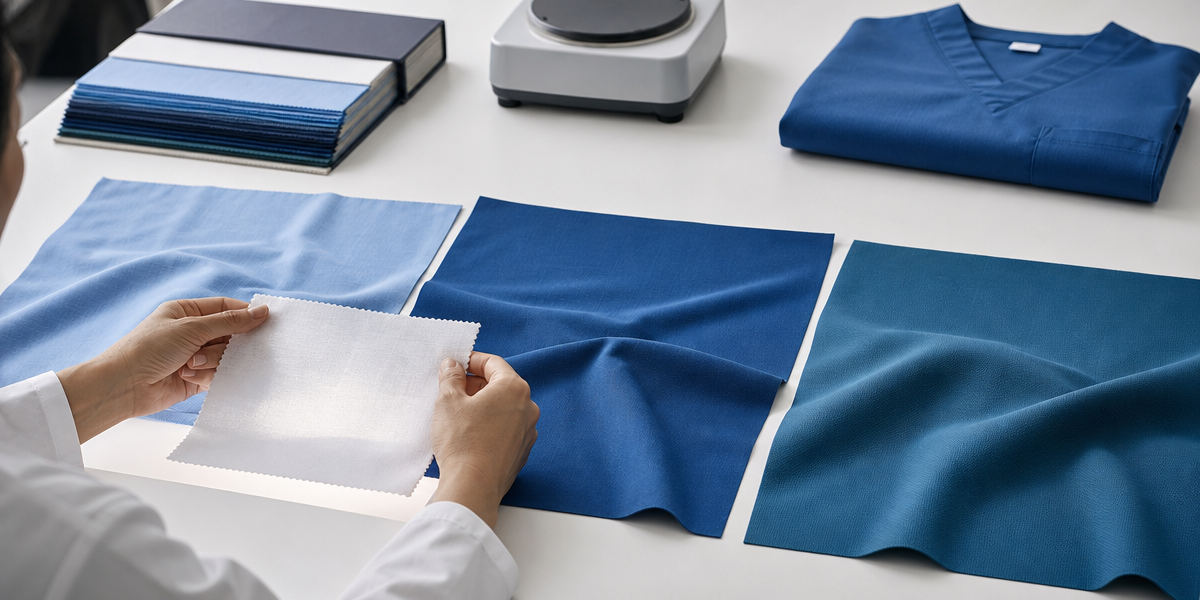
Therefore, buyers should compare actual fabric samples and specifications rather than assuming that fabrics with identical GSM will provide the same performance.
5. GSM and Breathability: What Buyers Should Know
Breathability is particularly important for medical uniforms used in hot and humid environments.
However, GSM is not a direct measurement of air permeability.
A lower-GSM fabric may have lower air permeability than a heavier fabric if their constructions differ.
Likewise, two fabrics with similar GSM may provide different airflow characteristics.
For this reason, buyers should request air permeability data when breathability is an important purchasing requirement.
A useful comparison should include:
- · GSM
- · Fabric construction
- · Fabric density
- · Air permeability
- · Fabric thickness
- · Moisture management
- · Drying performance
This provides a more complete understanding of fabric performance than weight alone.
6. GSM and Opacity: Especially Important for White Scrubs
Coverage is an important consideration when developing white and light-colored medical uniforms.
White, light blue, pale green, and other light shades may require additional attention because insufficient coverage can affect the appearance of the finished garment.
GSM can influence coverage, but it is not the only factor.
Opacity may also depend on:
- · Fiber characteristics
- · Fabric construction
- · Fabric density
- · Color
- · Finishing
- · Garment design
- · Lighting conditions
- · Whether the fabric is dry or damp
A higher-GSM fabric is not automatically opaque, and a lower-GSM fabric is not automatically unsuitable.
For medical uniform brands, the most reliable approach is to evaluate the actual fabric in the intended color and, where possible, in the finished garment.
Wet-state appearance may also be relevant for applications where moisture exposure is expected.
7. Choosing GSM for Hot and Humid Markets
Different markets can have different climate conditions, working environments, and uniform requirements.
Rather than assigning one GSM to an entire region, buyers should consider the specific application.
Middle East
In hot and dry outdoor conditions, reducing garment weight may be important.
However, many healthcare workers spend most of their working hours in air-conditioned hospitals and clinics.
Buyers may therefore need to balance lightweight construction with coverage, hand feel, and indoor comfort.
Southeast Asia
High temperature and humidity can make breathability and moisture management important considerations.
For these markets, buyers may evaluate GSM together with air permeability, drying performance, and garment construction.
Latin America
Climate conditions vary significantly across the region.
Healthcare uniforms designed for tropical coastal areas may have different requirements from those used in cooler or higher-altitude locations.
Buyers should define the target market and application before selecting a fabric weight.
Africa
Climate conditions and healthcare applications also vary widely across the continent.
For some buyers, lightweight construction may be important. Others may place greater emphasis on durability, coverage, colorfastness, and ease of care.
The appropriate GSM should reflect the actual requirements of the uniform program.
8. What About Air-Conditioned Hospitals?
Medical uniforms are not always worn outdoors.
Healthcare workers may move between hot outdoor environments and strongly air-conditioned indoor spaces.
This can create different comfort requirements from those of outdoor workers.
For example, a very lightweight fabric may be suitable for a particular outdoor application but may not provide the desired coverage or hand feel for a uniform worn throughout an indoor hospital shift.
When developing medical uniforms for these environments, buyers should consider:
- · Typical indoor temperature
- · Outdoor exposure
- · Length of working shifts
- · Garment fit
- · Fabric hand feel
- · Coverage
- · Breathability
- · Overall garment weight
The best GSM depends on how the uniform will actually be used.
9. How to Compare Different GSM Options
For healthcare uniform brands, comparing several fabric weights can provide a clearer basis for product development.
For example, a buyer developing a new scrub collection may request three versions of a similar fabric construction.
|
Specification |
Option A |
Option B |
Option C |
| GSM | 170 | 200 | 230 |
| Fabric composition | Compare | Compare | Compare |
| Fabric construction | Compare | Compare | Compare |
| Air permeability | Test | Test | Test |
| Hand feel | Evaluate | Evaluate | Evaluate |
| Coverage | Evaluate | Evaluate | Evaluate |
| Stretch and recovery | Test | Test | Test |
| Colorfastness | Test | Test | Test |
| Dimensional stability | Test | Test | Test |
This approach allows buyers to evaluate the differences between fabric weights while keeping other specifications as consistent as possible.
If the construction or composition also changes, those differences should be recorded because they may influence the results.
10. What Should Buyers Ask Their Fabric Supplier?
Before confirming a medical uniform fabric specification, buyers can ask:
1. What GSM options are available?
2. What is the fiber composition?
3. What is the fabric construction?
4. What is the finished fabric width?
5. Is air permeability testing available?
6. Is moisture-management or drying-performance data available?
7. How does the fabric perform in white and light colors?
8. What are the colorfastness results?
9. What is the dimensional stability after washing?
10. Can the supplier develop a different GSM while maintaining the required fabric style?
These questions can help buyers establish a more complete technical specification.
For customized projects, buyers should also confirm the final sample before bulk production.
11. A Practical GSM Selection Checklist
Before selecting a fabric weight, healthcare uniform buyers can define the following requirements.
Target application: Hospital, clinic, outdoor healthcare, or another environment.
Target climate: Hot and humid, hot and dry, or mixed indoor and outdoor conditions.
Garment type: Scrub top, trousers, complete uniform, or another garment.
Color: White, light blue, dark colors, or a mixed-color collection.
Performance priorities: Breathability, moisture management, coverage, stretch, durability, or other requirements.
Testing requirements: GSM, air permeability, colorfastness, dimensional stability, and relevant additional tests.
Once these requirements are clear, the fabric manufacturer can recommend suitable development options for evaluation.
Conclusion
There is no single GSM that is best for every medical uniform in hot and humid climates.
Lightweight fabrics can help reduce garment weight, while medium-weight or heavier fabrics may offer a different balance of coverage, structure, and hand feel.
However, GSM alone cannot determine breathability, drying performance, opacity, or durability.
For medical uniform brands and fabric buyers, the most practical approach is to evaluate GSM together with fabric construction, air permeability, moisture management, coverage, and the actual working environment.
The right GSM is not necessarily the lowest or highest number. It is the fabric weight that meets the requirements of the finished medical uniform.

Yunai Textile
Post time: Oct-07-2026