
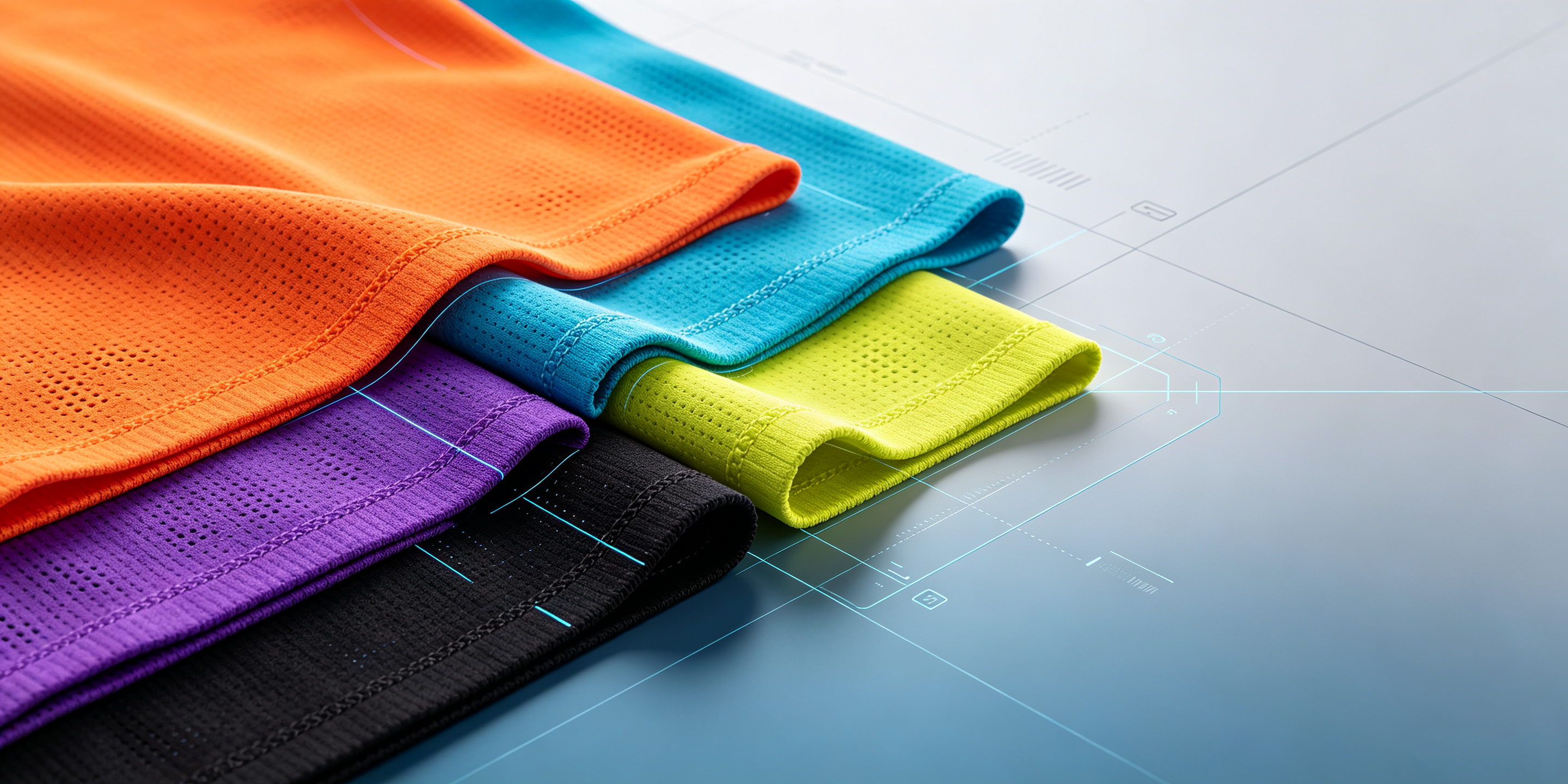
Why GSM Matters in Polyester Stretch Sportswear
Evaluating GSM (Grams per Square Meter) is the first step in athletic apparel development. Selecting the appropriate weight for stretch sportswear drives how a garment performs in real-world conditions. Balancing lightweight agility with structural integrity requires a precise understanding of how fabric density behaves during exercise.
What GSM Means for Stretch Fabrics
GSM is the textile industry’s standard measurement for fabric weight. Determining the ideal material for performance apparel—whether a standard knit or a composite fabric for hardshell jackets—requires analyzing the specific synthetic fiber blend. High-performance stretch fabrics typically combine 80% to 90% polyester with 10% to 20% elastane (spandex). Because elastane is less dense than polyester, adding more stretch does not inherently increase weight; rather, any GSM increase results from the tighter knit construction and higher tension required to process elastane.
While standard knit sportswear spans a broad range from 130 GSM to over 300 GSM, GSM alone does not dictate performance. Variables like yarn denier, stitch density, and specific constructions—such as single jersey, interlock, or rib knits—behave differently at identical weights. Note that these GSM guidelines apply specifically to standard circular knits; they do not directly translate to warp knits, brushed-back fabrics, or woven outerwear laminates.
How GSM Affects Breathability, Coverage, and Feel
Balancing GSM, breathability, and coverage requires precision. Lightweight fabrics below 150 GSM generally feature a more open knit structure, maximizing airflow and moisture-wicking capabilities to keep athletes cool. However, lower density introduces a significant risk of sheerness when the fabric stretches. Designers often evaluate this using the “squat test” to check opacity. It is important to note that this is an informal field check, not a standardized ASTM or ISO test. Formal opacity validation should account for stretch percentage and size grading under controlled conditions, as lower-GSM fabrics—especially in light colors—may fail across different size ranges.
Conversely, pushing the GSM above 250 ensures opaque coverage and a substantial hand-feel. The trade-off is thermal retention, as denser fabrics trap body heat and take longer to dry. Furthermore, a 250 GSM fabric with 20% elastane may feel heavier against the skin than a 250 GSM non-stretch polyester. This is not a difference in actual mass per area, but rather a denser hand-feel and higher perceived compression, which directly impacts comfort and range of motion.
How to Compare Lightweight and Midweight Fabrics
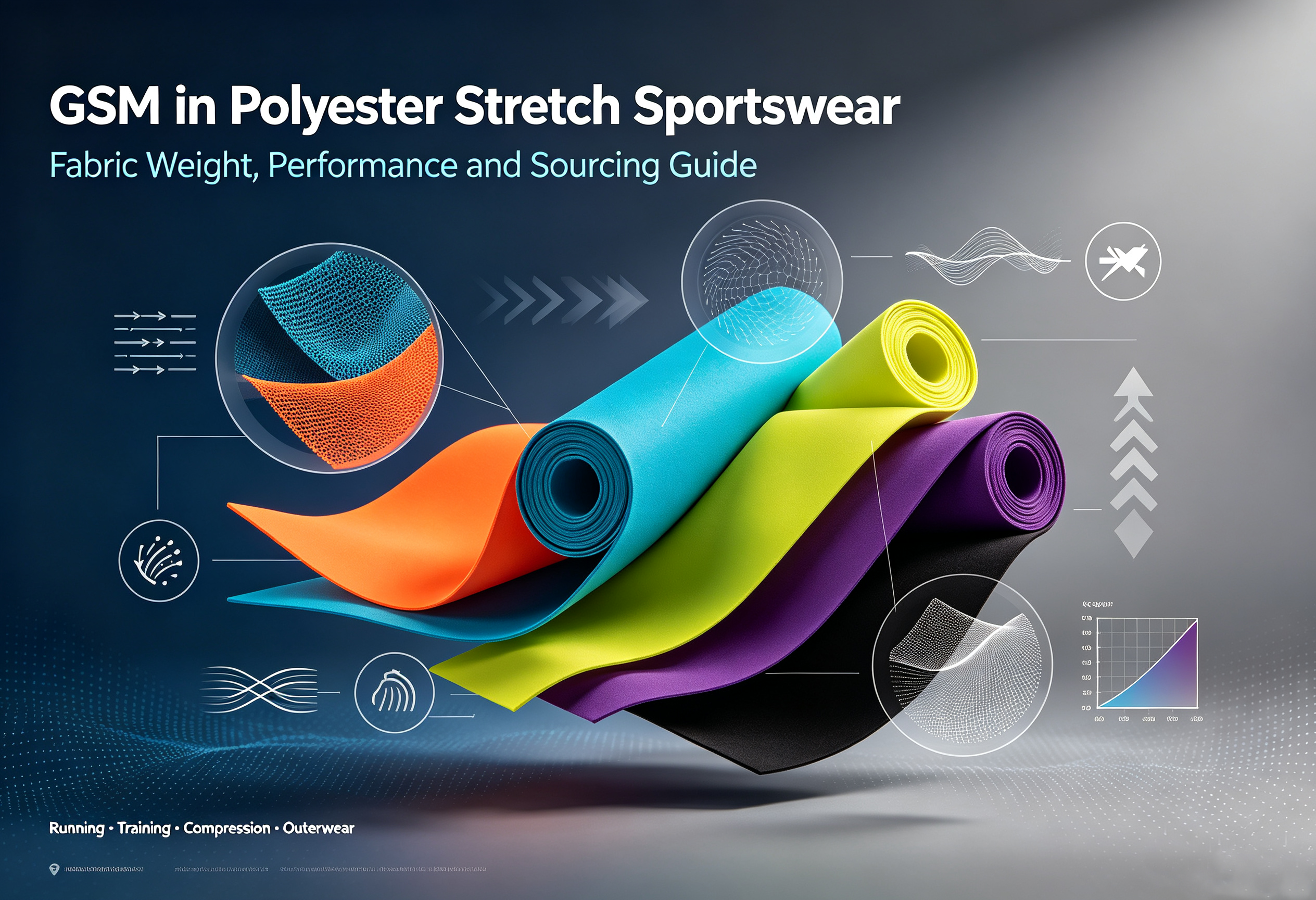
Moving from theoretical metrics to practical application requires comparing specific weight categories. Choosing between a lightweight and a midweight fabric fundamentally defines a garment’s market positioning and end-use.
Recommended GSM Ranges by Sportswear Use
Different athletic disciplines demand distinct fabric weights to optimize performance. Below is a comparative breakdown of recommended GSM ranges based on standard industry applications:
| Sportswear Category | Recommended GSM Range | Primary Fabric Characteristics |
|---|---|---|
| Running Tops & Singlets | 120 – 150 GSM | Maximum breathability, ultra-lightweight, fast-drying |
| Base Layers & T-Shirts | 150 – 190 GSM | Balanced moisture management, moderate stretch |
| Yoga & Training Leggings | 220 – 280 GSM | High opacity (squat-proof), strong compression, durable |
| Outerwear & Soft Shells | 250 – 320+ GSM | Weather resistance, thermal retention, structural rigidity |
Identifying the ideal lightweight stretch polyester blends for transitional apparel usually means targeting midweight coverage (150–190 GSM) to balance breathability with mild weather protection. It is critical to distinguish knit stretch sportswear from woven outerwear. While heavy soft shells often use woven laminates, you cannot apply knit GSM guidelines directly to woven systems. Instead, rely on heavier stretch polyester knits (220+ GSM) to ensure protection against the elements while maintaining necessary mobility.
Trade-Offs: Durability, Compression, and Structure
Every GSM selection involves calculated trade-offs. Lightweight fabrics (under 150 GSM) are more susceptible to abrasion and pilling from backpacks or rough surfaces. Midweight to heavyweight fabrics (200–280 GSM) deliver superior durability.
Importantly, GSM primarily governs opacity and thermal retention, not compression. Compression is driven by knit tension and elastane percentage. While a higher modulus—the material’s resistance to stretching—often accompanies higher elastane content, the fabric’s structural engineering dictates how secure the garment feels. Durability also scales with weight and construction. For contact sports or rigorous training environments, a durable soft shell jacket fabric or heavy knit must withstand turf friction and harsh industrial laundering. Sourcing fabrics no lighter than 200 GSM ensures the garment maintains its structural integrity and recovery properties over a long lifecycle.
How to Specify GSM When Sourcing
Procurement is where theoretical fabric selection meets mass manufacturing. When finalizing a technical pack for a factory, you must specify the GSM with exact parameters. Ambiguity in weight specifications frequently causes bulk production rejections and costly delays.
GSM Tolerances, Testing, and Sample Approval
Because no textile production run is perfectly uniform, you must establish a strict commercial tolerance when working with a composite fabric supplier. A commonly accepted commercial tolerance for knit and woven stretch fabrics is ±5%, though contractual limits vary by supplier and region. Under a 5% benchmark, if the target is 220 GSM, the acceptable bulk delivery must fall strictly between 209 and 231 GSM.
To verify this during sample approval, technicians use a circular GSM cutter to punch an exact 100-square-centimeter sample and weigh it on a calibrated digital scale. Crucially, you must measure GSM for stretch knits in a standardized relaxed state; sampling fabric under tension significantly alters the weight reading and causes disputes during bulk production. Request physical strike-offs (small test runs) at the target GSM to evaluate the stretch modulus and recovery rate. This ensures the factory’s knitting machines are properly tensioned before you authorize thousands of yards of bulk production.
Final GSM Selection Checklist
Streamlining the procurement process requires a strict set of criteria before approving a final GSM specification:
- Align weight with core activity: Prioritize sub-160 GSM for high-perspiration activities and 220+ GSM for high-impact or cold-weather gear.
Key Takeaways
- Use 120–150 GSM polyester stretch fabrics for running tops and singlets when breathability, low weight, and fast drying are the top priorities.
- Choose around 150–190 GSM for base layers and sports T-shirts to balance comfort, coverage, and everyday training durability.
- Evaluate GSM together with elastane content, yarn denier, stitch density, and knit construction because identical GSM values can produce different hand-feel and performance.
- Test lightweight fabrics below 150 GSM for opacity under stretch, especially in light colors and larger size grades.
- Expect fabrics above 250 GSM to provide stronger coverage and a more substantial feel, but account for greater heat retention and slower drying.
- Do not apply standard circular-knit GSM guidelines directly to warp knits, brushed-back fabrics, or woven laminated outerwear materials.
Frequently Asked Questions
What does GSM mean in polyester stretch sportswear fabric?
GSM means grams per square meter, a standard measure of fabric weight. In stretch sportswear, it helps compare light, midweight, and heavy fabrics, but it should be evaluated with knit structure, yarn denier, elastane content, opacity, and intended activity.
What GSM is best for running tops and singlets?
Running tops and singlets usually perform best around 120–150 GSM. This range supports maximum breathability, low weight, and fast drying, but designers should check opacity because very light stretch fabrics can become sheer under tension.
Is higher GSM always better for sportswear?
No. Higher GSM can improve coverage, durability, and compression feel, but it may reduce breathability and dry more slowly. The best choice depends on the sport, season, fit, color, stretch level, and whether the garment needs ventilation or support.
Why can two fabrics with the same GSM feel different?
Fabrics with the same GSM can feel different because of yarn denier, stitch density, knit type, elastane percentage, and finishing. For example, a 250 GSM polyester-spandex knit may feel more compressive than a 250 GSM non-stretch polyester fabric.
How can brands avoid sheerness in stretch sportswear?
Use an appropriate GSM, test the fabric under stretch, and check light colors carefully. Informal squat tests are useful during sampling, but formal opacity review should consider stretch percentage, garment size grading, and real movement conditions.

Yunai Textile
Post time: Aug-31-2026