
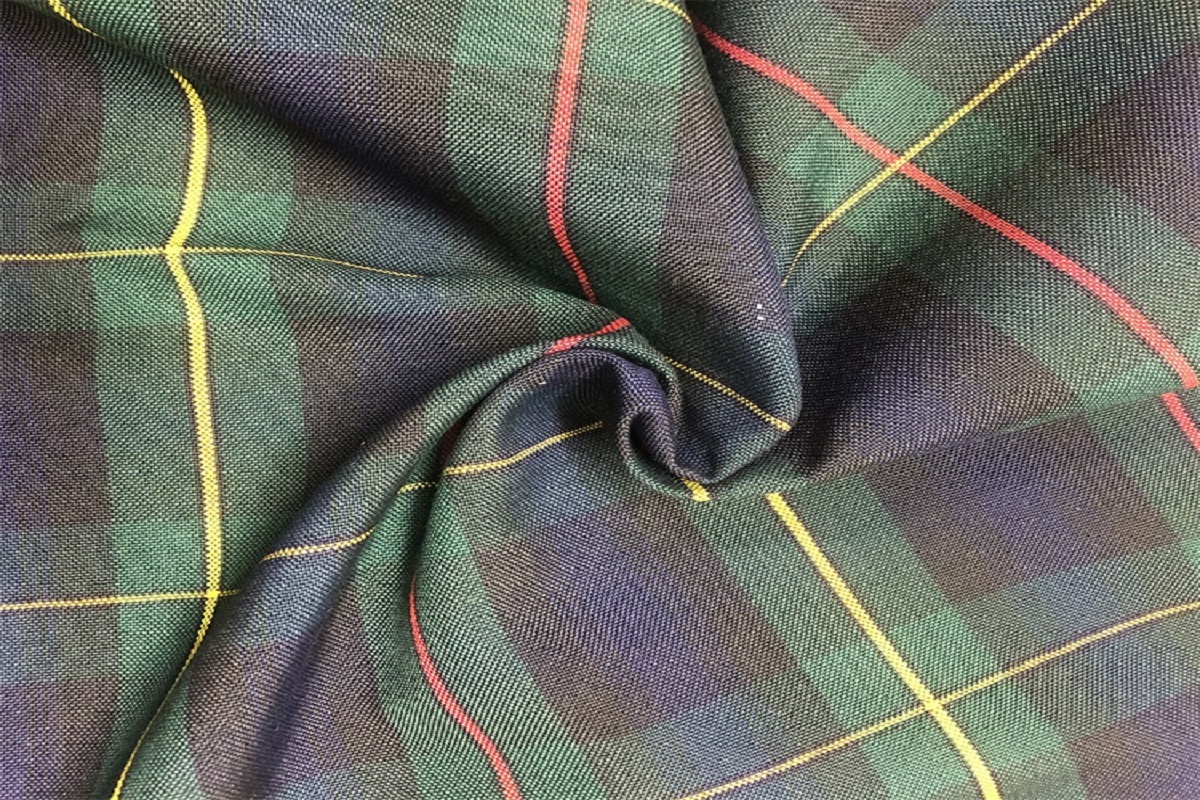
What School Uniform Plaid Fabric Is Made Of
The classic aesthetic of educational institutions relies heavily on high-quality uniform plaid material. Whether tailored into a pleated skirt, a traditional jumper, or a structured plaid school blazer, this textile must balance traditional visual appeal with exceptional durability. Understanding the exact chemical composition and physical construction of these textiles is the critical first step in successful garment procurement for the education sector.
Common fibers used in school uniform plaid
The foundation of any durable school uniform fabric lies in its specific fiber blend. The industry standard is predominantly a Polyester/Viscose (TR) blend, which strategically combines the high wrinkle resistance of synthetic polyester with the breathability and soft hand-feel of semi-synthetic viscose rayon. A highly specified and globally recognized ratio is 65% polyester and 35% viscose rayon (commonly denoted as 65/35 TR). This specific composition ensures the garment retains sharp, permanent pleats and resists crushing during a standard 8-hour school day. Occasionally, Polyester/Cotton (TC) blends are utilized for summer-weight garments, though they may require more rigorous ironing and tend to lose dye saturation faster than viscose blends over repeated washing cycles.
Yarn construction, weave type, and yarn-dyed plaid
Beyond the raw fibers, the mechanical construction dictates the fabric’s long-term performance. Authentic tartan and plaid patterns are achieved through a specialized yarn-dyed process, meaning the individual yarns are vat-dyed before being woven together on the loom, rather than printing a flat pattern onto a finished greige cloth. This is typically executed using a 2/2 twill weave, which provides a distinct diagonal ribbing that enhances both the drape of a skirt and the tear strength of a tailored jacket. Standard yarn counts for these textiles range from 32s/2 to 40s/2. By utilizing plied yarns—where two single yarns are twisted together—mills effectively double the tensile strength of the fabric, preventing premature wear at high-friction points like elbows, knees, and stitched hems.
How to Compare Plaid Fabric Performance
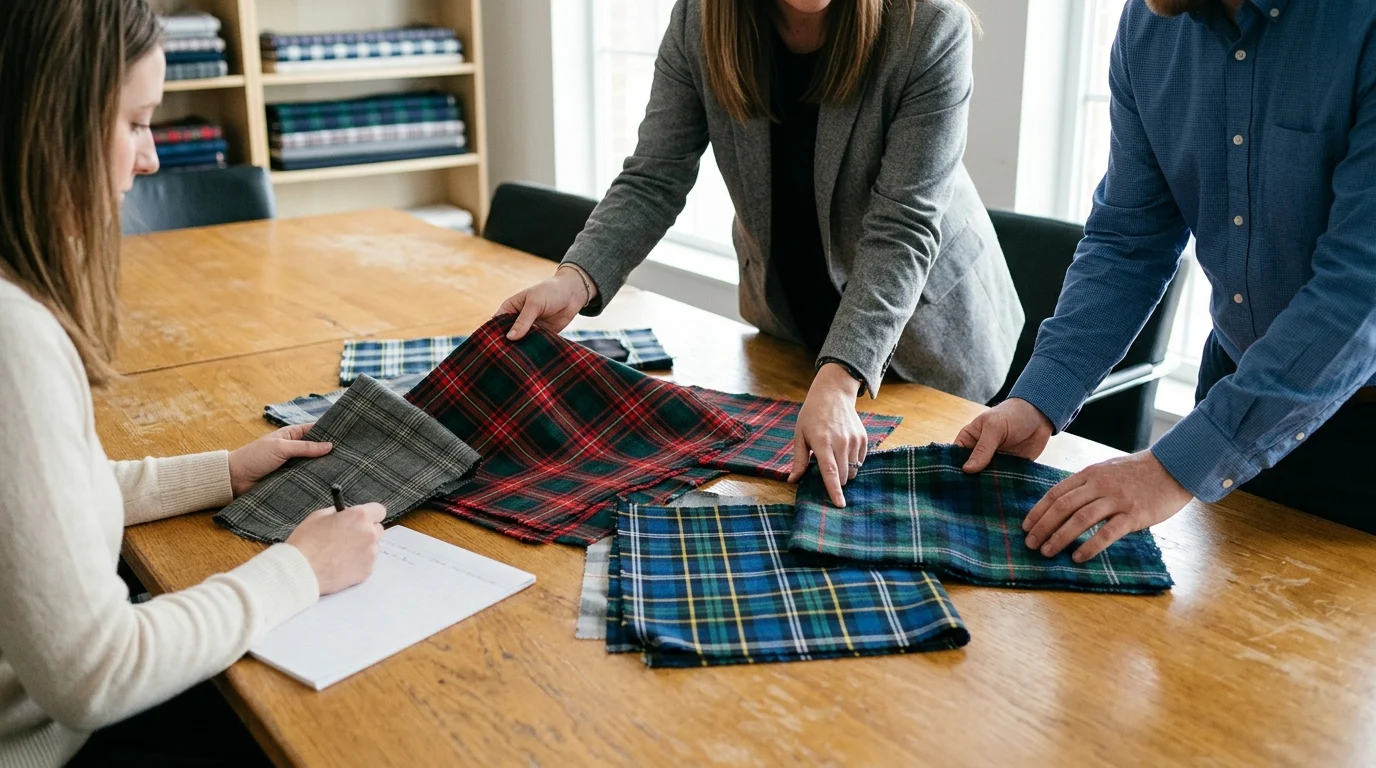
Evaluating plaid school uniform fabric requires moving beyond subjective aesthetics to measure empirical performance data. Because these garments must endure upwards of 180 days of active wear per academic year, institutional buyers demand strict quality control parameters and standardized laboratory testing.
Key specifications for comparison
Fabric weight, measured in grams per square meter (GSM), is a primary indicator of seasonal appropriateness, drape, and overall durability. A standard year-round plaid textile typically falls within the 220 to 260 GSM range, providing enough body for pleats without overheating the wearer. Heavyweight winter options designed for colder climates may push toward 300 GSM, while tropical summer variants drop to 180 GSM. Pilling resistance is another critical specification; premium uniform textiles must achieve a minimum Grade 4 on the ISO 12945-2 pilling test after 2,000 continuous rubs, ensuring the fabric surface remains smooth and professional.
| Feature | 65/35 Poly/Viscose (TR) | 65/35 Poly/Cotton (TC) | 100% Polyester |
|---|---|---|---|
| Typical Weight Range | 220 – 260 GSM | 180 – 220 GSM | 200 – 240 GSM |
| Pilling Resistance | Grade 4 | Grade 3-4 | Grade 3 |
| Tear Strength (Warp) | > 20 Newtons | > 15 Newtons | > 25 Newtons |
| Cost Profile | Premium | Moderate | Economical |
Testing, safety, and care requirements
Safety, toxicity, and care compliance are non-negotiable for children’s apparel. Textiles must undergo rigorous testing for colorfastness to washing (ISO 105-C06), with acceptable fabrics scoring a Grade 4 or higher to prevent the vibrant plaid colors—often deep reds, navies, and greens—from bleeding onto white collared shirts. Dimensional stability, or shrinkage, must be strictly controlled to under 3% in both the warp and weft directions after three standard wash cycles. Furthermore, the fabric must comply with stringent chemical safety standards, such as the Oeko-Tex Standard 100. This certification ensures that residual formaldehyde levels remain well below the strict 75 parts per million (ppm) threshold required for apparel in direct and prolonged skin contact.
How to Source the Right Plaid Fabric
Procuring the ideal material involves navigating a complex global textile supply chain. Institutional buyers, retail brands, and garment factories must establish clear communication channels and stringent technical requirements to guarantee batch-to-batch consistency across multi-year contracts.
Steps to control color matching
Maintaining exact institutional brand colors across multiple academic years requires rigid color control protocols. Buyers must work closely with school uniform fabric manufacturers to review physical lab dips under standardized D65 daylight simulators. To ensure visual uniformity when students stand side-by-side, the acceptable color variation, measured as Delta E (ΔE) using a digital spectrophotometer, must be kept strictly below 1.0. Because yarn-dyed patterns are mathematically plotted on the loom, CAD strike-offs must be approved to verify the exact millimeter spacing of the intersecting warp and weft stripes before bulk weaving begins.
Decision criteria for final selection
Final selection hinges on balancing technical specifications with logistical and financial realities. Custom yarn-dyed school uniform check fabric typically requires a Minimum Order Quantity (MOQ) of 1,500 to 3,000 linear meters per specific pattern to justify the extensive loom setup costs and yarn dyeing minimums. Depending on the exact fiber blend, yarn count, and finishing treatments, wholesale pricing generally fluctuates between $2.50 and $4.50 per linear meter. Procurement teams must also factor in production lead times, which average 30 to 45 days for custom weaving. When combined with rigorous Four-Point System quality inspections—aiming for fewer than 20 defect points per 100 linear yards—and international ocean freight, buyers must initiate orders months in advance to ensure garments are cut, sewn, and delivered before the back-to-school retail season.
Key Takeaways
- Choose 65/35 polyester/viscose plaid fabric when you need wrinkle resistance, soft hand-feel, breathable comfort, and stable pleat retention.
- Specify yarn-dyed plaid instead of printed plaid for stronger color durability and a more authentic woven pattern.
- Use 220–260 GSM plaid fabric for year-round school uniforms, with 180 GSM for summer and up to 300 GSM for colder climates.
- Look for 2/2 twill construction and plied yarns such as 32s/2 to 40s/2 to improve tear strength and reduce wear at stress points.
- Require a minimum Grade 4 pilling result after 2,000 rubs to keep school uniforms looking smooth through repeated daily use.
Frequently Asked Questions
What fibers are most common in school uniform plaid fabric?
The most common choice is a polyester/viscose blend, especially 65% polyester and 35% viscose rayon. Polyester adds wrinkle resistance and durability, while viscose improves breathability and softness.
Why is yarn-dyed plaid better than printed plaid?
Yarn-dyed plaid uses colored yarns woven into the fabric, so the pattern lasts longer and looks more dimensional. Printed plaid sits on the fabric surface and may fade faster with repeated washing.
What GSM is suitable for school uniform plaid?
A year-round school uniform plaid fabric is usually 220–260 GSM. Summer fabrics may be around 180 GSM, while winter-weight options can approach 300 GSM for added warmth and structure.
Is polyester/viscose better than polyester/cotton for uniforms?
Polyester/viscose generally holds pleats better, resists wrinkles, and keeps color well. Polyester/cotton can be useful for lightweight summer garments but may need more ironing.
What weave is commonly used for school plaid fabric?
A 2/2 twill weave is commonly used because it creates good drape, strength, and a subtle diagonal texture. This helps skirts, jumpers, and blazers maintain shape through daily wear.

Yunai Textile
Post time: Jul-20-2026