

Introduction
Choosing fabric for school uniforms affects far more than appearance. The right material must balance comfort, durability, easy care, and cost across months of daily wear, repeated washing, and active use in classrooms and playgrounds. This article explains how common school uniform fabrics compare, what performance factors matter most, and which blends tend to work best for shirts, trousers, skirts, and blazers. By the end, readers will have a clear basis for judging fabric quality and selecting options that hold color, resist damage, and stay comfortable throughout the school year.
Why school uniform fabric choice matters
As a textile industry professional, I have evaluated countless materials to determine the ideal school uniforms fabric. Children and young adults spend an average of 1,200 hours per academic year in these garments. Therefore, selecting the right material is not merely a matter of aesthetics; it directly impacts student comfort, daily focus, and long-term parental budgets.
The intersection of durability and cost-effectiveness forms the foundation of our sourcing strategy. When we analyze performance data across various educational institutions, the physical longevity of the textile consistently emerges as the primary driver of a uniform program’s success, outweighing initial aesthetic appeal.
Key performance criteria
When I assess a fabric’s viability, I look at specific quantitative metrics rather than subjective feel. Tear strength, seam slippage, and colorfastness are paramount. For instance, a standard school polo or button-down shirt must demonstrate a colorfastness to washing rating of at least 4.0 on the standardized grayscale.
Furthermore, optimal fabric weight plays a crucial role in both modesty and durability. We typically recommend 180 to 220 GSM (Grams per Square Meter) for shirting to prevent transparency, and a much heavier 240 to 300 GSM for trousers and skirts to ensure adequate wear resistance against daily friction.
Common fabric types
The market predominantly relies on three material families. First, traditional cotton offers unmatched breathability but requires significant upkeep and ironing. Second, synthetic fibers like polyester provide exceptional tensile strength and color retention, though they can trap moisture. Finally, engineered blends synthesize the best traits of both.
For example, TR fabric for school uniforms (a blend of Terylene and Rayon) has become an absolute staple for suiting and tailored trousers due to its exceptionally smooth drape, mechanical stretch, and anti-pilling properties. Working with a dedicated school uniform fabric manufacturer ensures that these common material types are woven with the exact yarn counts required to withstand the specific, high-impact rigors of daily student wear.
How to compare school uniform fabrics

To make an informed procurement decision, we must objectively compare how different textiles behave under physical stress and routine laundering. My approach involves analyzing lab results alongside real-world feedback from students and parents, ensuring our choices balance theoretical performance with practical utility.
A critical baseline for our comparison is dimensional stability over time. We strictly require that any viable school uniforms fabric exhibits a shrinkage rate of less than 3% after five standard industrial wash cycles. Materials exceeding this threshold inevitably lead to severe fit issues mid-semester, resulting in costly replacement cycles for families.
Cotton vs polyester vs blends
Pure cotton provides excellent moisture absorption but often fails our standard crease-recovery tests, making it a highly demanding, high-maintenance choice for parents. Conversely, 100% polyester boasts incredible abrasion resistance but traps heat, causing severe discomfort in warmer, humid climates.
This is why we favor strategic blends. A 65/35 polyester cotton uniform fabric strikes the perfect equilibrium, offering the breathability of natural fibers with the structural integrity of synthetics. Furthermore, applying specialized chemical finishes to these blends can yield a highly effective wrinkle free school uniform fabric, reducing ironing time while maintaining a crisp appearance throughout the school day.
What to include in a comparison table
When compiling data for school boards, I utilize a standardized comparison matrix isolating key variables like weight, shrinkage, pilling resistance (on a 1 to 5 scale), and wholesale cost.
| Fabric Type | Weight (GSM) | Shrinkage (%) | Pilling Resistance (1-5) | Est. Cost ($/yard) |
|---|---|---|---|---|
| 100% Cotton | 150 – 200 | 3.0 – 5.0 | 3 | 4.50 – 6.00 |
| 100% Polyester | 130 – 180 | < 1.0 | 4 | 2.00 – 3.50 |
| 65/35 Poly-Cotton | 180 – 240 | < 2.0 | 4 | 3.00 – 4.50 |
| 65/35 Poly-Viscose (TR) | 220 – 280 | < 2.0 | 4 | 3.50 – 5.00 |
By evaluating these specific, quantifiable metrics side-by-side, procurement teams can clearly articulate why synthetic blends often present the most economically and functionally viable solution over the lifespan of the garment.
How to choose fabric for climate and compliance
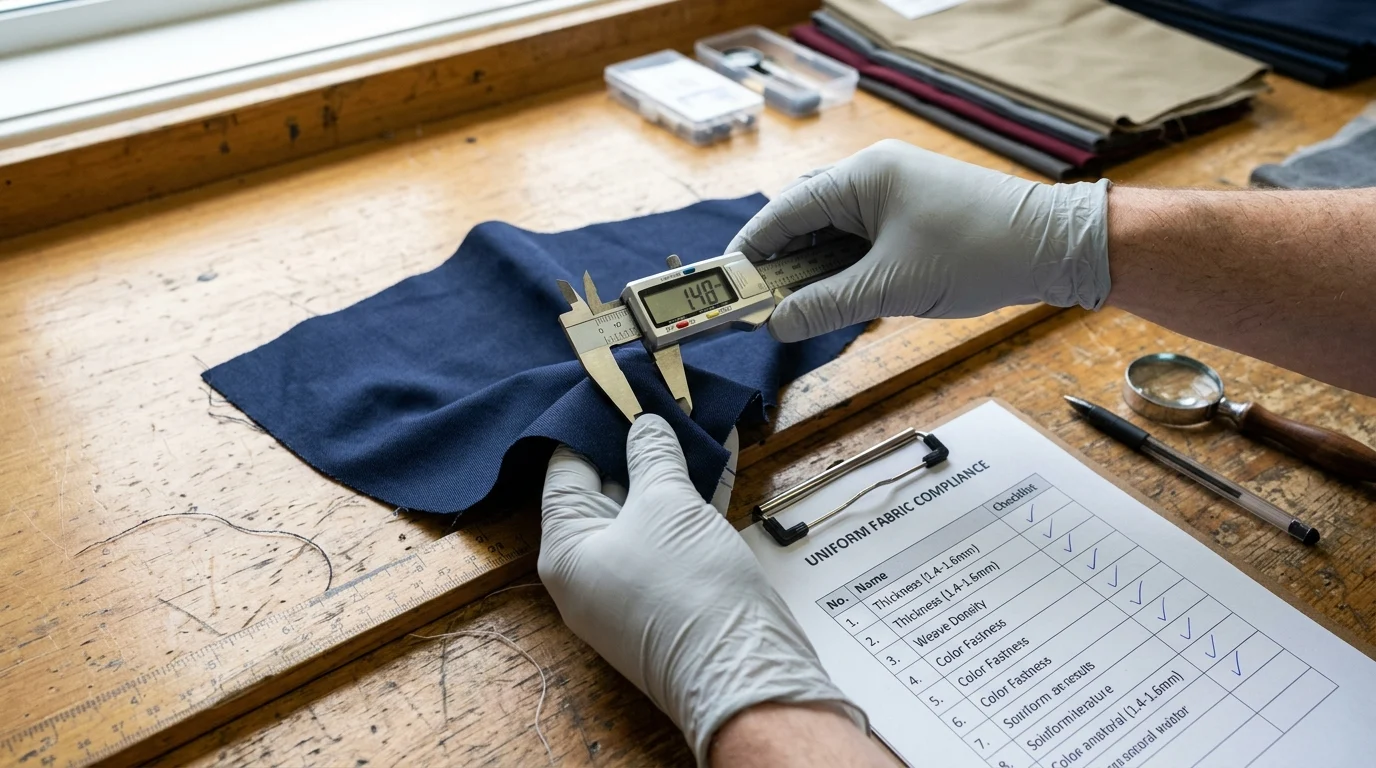
Beyond durability and cost, I advise institutions to weigh regional climate demands against strict regulatory compliance. A heavy, tightly woven twill that performs perfectly in a cold northern winter will cause severe thermal discomfort in a humid, tropical environment, where moisture-wicking properties become the highest priority. In sun-drenched regions, we also mandate fabrics with a UPF (Ultraviolet Protection Factor) rating of 50+ to protect students outdoors.
Chemical compliance is equally non-negotiable in our sourcing protocols. We rigorously screen our textiles to ensure they meet stringent international safety standards, such as the OEKO-TEX Standard 100. Because garments sit directly against the skin, it is legally and ethically imperative that formaldehyde levels remain below 75 ppm and that zero banned azo dyes are detected in the supply chain.
Practical fabric testing steps
Before finalizing bulk orders, I mandate comprehensive physical testing. First, we require a Martindale abrasion test threshold of 20,000 rubs to simulate a year of friction against desks and chairs.
Second, we execute a minimum of 50 industrial wash cycles to evaluate potential seam slippage, fabric pilling, and dye bleeding. Only materials that maintain their structural and visual integrity through these extreme simulated stressors are approved for mass production.
Best choice for your school
Ultimately, the optimal choice depends heavily on your specific institutional priorities, balancing upfront procurement costs against garment lifespan and student comfort. I strongly recommend establishing a clear, weighted matrix of your localized climate needs and parental maintenance expectations before ever approaching suppliers.
Securing your materials through reputable school uniform fabric wholesale channels ensures you receive consistent, certified batches that meet the rigorous technical specifications outlined in your testing phase. By prioritizing objective, data-driven textile selection, we can successfully deliver uniforms that look professional, feel comfortable, and effortlessly endure the grueling demands of the academic year.
Key Takeaways
- The most important conclusions and rationale for shcool uniforms fabric
- Specs, compliance, and risk checks worth validating before you commit
- Practical next steps and caveats readers can apply immediately
Frequently Asked Questions
What fabric is best for school uniforms?
Blended fabrics are usually best. A 65/35 poly-cotton works well for shirts, while TR (poly-viscose) is a strong choice for trousers, skirts, and blazers because it balances comfort, durability, and easy care.
Is cotton or polyester better for school uniforms?
Neither is ideal alone for most schools. Cotton breathes better but wrinkles and shrinks more; polyester lasts longer but can feel hotter. A blend gives a better balance for daily student wear.
What fabric weight is recommended for school uniforms?
Use about 180–220 GSM for shirts and 240–300 GSM for trousers or skirts. These weights help reduce transparency, improve durability, and hold shape better through frequent washing and wear.
How can I tell if a uniform fabric will last?
Check practical specs: shrinkage under 3% after washing, colorfastness at least grade 4, and pilling resistance around grade 4. These indicators usually mean better fit retention, cleaner appearance, and fewer replacements.
Where can I ask about school uniform fabric options and samples?
You can contact IYUNAI Textile through https://www.iyunaitextile.com/contact-us/ to discuss uniform fabric types, GSM, blend ratios, and sample requests for your school or uniform project.

Post time: May-07-2026