

White and light-colored medical uniforms are widely used by hospitals, clinics, healthcare brands, and medical professionals around the world. These colors can create a clean, professional, and recognizable appearance.
However, light-colored medical uniforms also create a specific fabric challenge:
How can a fabric remain lightweight and breathable while providing appropriate coverage?
For buyers sourcing medical uniform fabric for hot and humid climates, this question becomes even more important. A very lightweight fabric may help reduce garment weight, but if the fabric provides insufficient coverage, the final uniform may not deliver the desired appearance.
This is why fabric opacity should be considered together with GSM, breathability, fabric construction, color, moisture behavior, and garment design.
Opacity is not simply a question of whether a fabric is “thick enough.” It is a result of several factors working together.
What Does Fabric Opacity Mean?
Fabric opacity refers to how effectively a textile prevents what is underneath the fabric from being visually visible.
For medical uniforms, opacity can be particularly important for:
- · White scrubs
- · Light blue scrubs
- · Pale green uniforms
- · Light pink uniforms
- · Other pastel-colored healthcare garments
A fabric with appropriate coverage can help maintain a professional appearance under different lighting conditions and during normal movement.
However, opacity should not be treated as an isolated fabric characteristic.
The final appearance can change depending on:
- · Fabric construction
- · GSM
- · Color
- · Fabric density
- · Garment construction
- · Lighting
- · Moisture
- · What is worn underneath the garment
Therefore, a fabric should ideally be evaluated in the context of its intended application.
Why Lightweight Does Not Always Mean Better
In hot climates, buyers often want to reduce fabric weight.
This makes sense. A lighter fabric can reduce the overall weight of the finished garment.
But there is a potential trade-off.
If fabric weight is reduced too aggressively, the material may become more visually transparent, particularly in white or very light colors.
This can create a difficult balance:
Lower GSM → lighter garment
but potentially:
Lower GSM → greater challenge in achieving desired coverage
The solution is not necessarily to choose a much heavier fabric.
Instead, buyers and fabric manufacturers can optimize the combination of:
GSM + Fabric Construction + Density + Fiber Composition + Color
The objective is to achieve the required coverage without unnecessarily adding fabric weight.
GSM and Opacity Are Related, But Not Identical
One common assumption is:
Higher GSM automatically means better opacity.
This is not always the case.
GSM measures the mass of fabric per square meter. It does not directly measure how much visual coverage the fabric provides.
Two fabrics with similar GSM can have different opacity because of differences in:
- · Yarn characteristics
- · Fabric construction
- · Density
- · Thickness
- · Fiber properties
- · Finishing
Likewise, a lighter fabric may achieve suitable coverage if it has an appropriate construction.
Therefore, buyers should avoid using GSM as the only indicator of opacity.
A better approach is to evaluate GSM and actual coverage together.
How Fabric Construction Can Affect Coverage
The structure of a fabric determines how its yarns are arranged.
In woven medical uniform fabrics, factors such as warp density, weft density, yarn characteristics, and construction can influence the visual appearance of the material.
A tighter construction may provide greater coverage, although it can also affect air permeability.
This creates another important balance:
Coverage vs. Breathability
For hot and humid medical uniforms, buyers should not solve a coverage problem simply by making the fabric excessively dense.
The fabric still needs to provide a suitable wearing experience.
This is why the best development process considers multiple performance characteristics simultaneously.
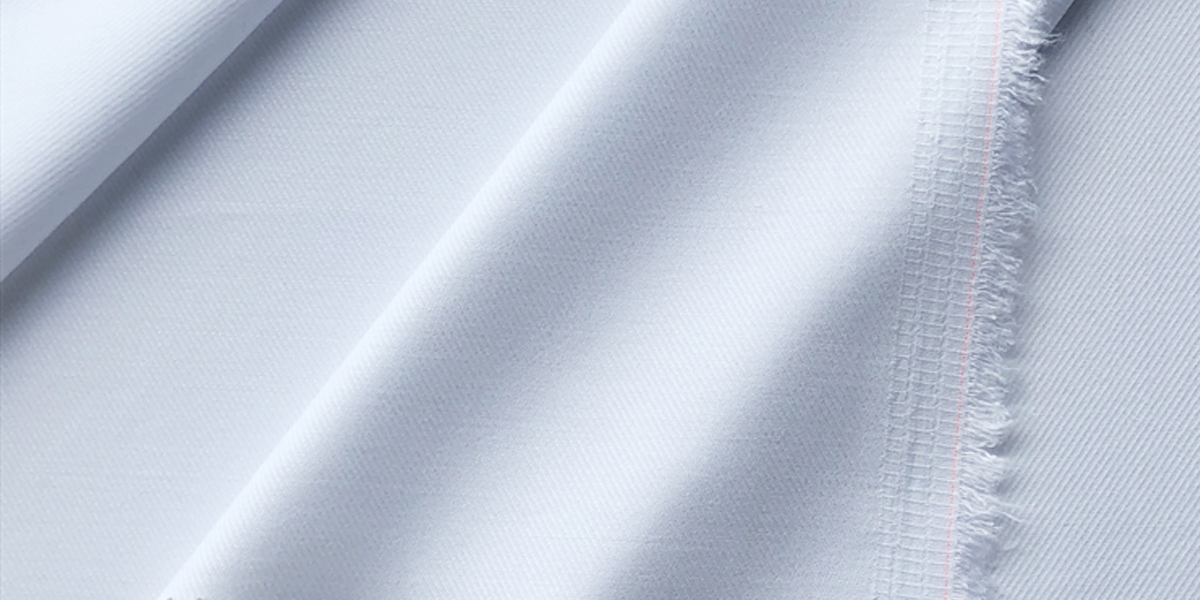
White Fabric Requires Extra Attention
White is one of the most demanding colors when it comes to fabric appearance.
Unlike darker colors, white and other pale shades can make the underlying layer more visually noticeable.
This means buyers should consider not only the fabric itself but also the finished garment.
For example, the appearance of a white scrub top can be influenced by:
- · Fabric GSM
- · Fabric construction
- · Garment fit
- · Pocket placement
- · Seams
- · Fabric tension
- · Lighting
- · Undergarment color
- · Moisture
A fabric that looks sufficiently opaque as a flat dry swatch may appear different when made into a fitted garment.
Therefore, evaluating only a small fabric swatch may not provide the complete picture.
Why Wet-State Appearance Matters
Moisture can change the visual appearance of many fabrics.
When a fabric becomes damp, the relationship between light, the fabric structure, and the material underneath can change.
This can be particularly noticeable with white and light-colored fabrics.
For medical uniforms used in warm environments, where perspiration or occasional moisture exposure may occur, buyers may want to evaluate the fabric in both:
Dry state
and
Wet or damp state
This does not mean that every medical uniform needs to be tested in exactly the same way.
The appropriate evaluation should reflect the actual garment application.
However, wet-state appearance can provide useful additional information during product development.
Opacity and Breathability Can Pull in Different Directions
One of the most important challenges in hot-climate medical uniform development is balancing coverage and airflow.
A fabric designed with greater density may provide improved coverage.
However, changes in density can also influence air permeability.
On the other hand, a very open construction may allow greater air movement but may require additional consideration for coverage.
Therefore, buyers should avoid optimizing only one characteristic.
A more complete development framework is:
Appropriate Coverage + Air Permeability + Suitable GSM + Moisture Management
The ideal balance depends on the target market and garment.
Does Stretch Affect Opacity?
Stretch is another factor worth considering.
Many modern medical uniforms use stretch woven fabrics because healthcare workers need freedom of movement.
However, when a fabric is stretched, the spacing and visual appearance of the fabric can change.
This is particularly relevant for fitted garments.
A fabric that appears sufficiently opaque when relaxed may have a different appearance when stretched across the body.
Therefore, when evaluating stretch medical uniform fabrics, buyers should consider the fabric in both:
Relaxed condition
and
Typical garment stretch condition
This is another reason why evaluating the finished garment can be more informative than looking at a small fabric swatch alone.
Fabric Color Can Influence the Final Appearance
Opacity is also connected to color.
Dark colors naturally tend to provide stronger visual coverage than very pale colors.
Medical uniform brands may therefore need different fabric-development strategies for:
- · Navy
- · Black
- · Royal blue
- · Burgundy
- · White
- · Light blue
- · Light green
- · Pastel shades
A fabric specification that works well for a dark scrub collection may not necessarily produce the same visual result in white.
For brands offering multiple colorways, it can therefore be useful to evaluate representative light and dark shades separately.
Why Garment Construction Matters
Fabric is only one component of a medical uniform.
The finished garment also includes:
- · Fit
- · Pattern
- · Seams
- · Pockets
- · Panels
- · Plackets
- · Waistbands
- · Layering
- · Garment tension
All of these can influence how the fabric looks when worn.
For example, a loose-fitting scrub top may create a different visual result from a fitted medical uniform made from the same fabric.
Therefore, opacity evaluation should ideally consider the final garment structure.
How Can Medical Uniform Buyers Evaluate Opacity?
A practical evaluation process can include several steps.
Step 1: Check the Dry Fabric
Place the fabric over a consistent background and examine its visual coverage.
Step 2: Compare Different GSM Options
If developing a new product, compare several fabric weights while keeping other specifications as consistent as possible.
Step 3: Check Under Different Lighting
Strong lighting can reveal differences that may not be obvious under normal indoor lighting.
Step 4: Evaluate Wet Appearance
For relevant applications, lightly dampen the fabric and compare its visual appearance with the dry state.
Step 5: Evaluate Stretch
For stretch fabrics, assess the material under realistic garment tension.
Step 6: Test the Finished Garment
Where possible, evaluate a prototype garment rather than relying only on loose fabric samples.
This approach gives buyers a more realistic understanding of the final product.
What Data Should Buyers Ask Their Fabric Supplier For?
For white and light-colored medical uniform fabrics, buyers can request:
- · GSM
- · Fabric construction
- · Fabric width
- · Fiber composition
- · Fabric thickness, where relevant
- · Air permeability
- · Moisture-management performance
- · Colorfastness
- · Dimensional stability
- · Pilling resistance
- · Stretch and recovery, where relevant
- · Wet-state appearance evaluation
There may not always be one universal numerical value that defines “good opacity” for every medical uniform.
The appropriate coverage depends on the garment design, color, market, and end use.
This is why physical evaluation remains important.
Building a Lightweight but Appropriately Covered Medical Uniform
For hot and humid climates, the goal should not be:
“Make the fabric as thick as possible.”
Nor should it be:
“Make the fabric as light as possible.”
Instead, the development target should be:
Lightweight + Breathable + Appropriate Coverage + Moisture Management + Durable
This allows healthcare brands to create uniforms that address both climate comfort and professional appearance.
For example, a buyer developing a white stretch scrub collection may specify:
- · Moderate lightweight GSM
- · Suitable woven construction
- · Four-way or mechanical stretch, depending on the fabric
- · Good air permeability
- · Appropriate moisture management
- · Suitable white coverage
- · Good colorfastness
- · Stable dimensions after washing
The final specification should then be confirmed through sampling and testing.
A Practical Buyer Checklist for White Scrub Fabric
Before confirming a white or light-colored medical uniform fabric, buyers can ask:
1. What is the GSM?
2. What is the fabric construction?
3. What is the fabric density?
4. Is air permeability available?
5. How does the fabric look when wet?
6. How does the fabric perform when stretched?
7. Has the fabric been evaluated in the final garment?
8. Are there different GSM options?
9. What are the colorfastness results?
10. Can the supplier provide physical samples for comparison?
These questions can help prevent a common sourcing problem: choosing a fabric that performs well on paper but does not achieve the desired appearance in the final uniform.
Conclusion
Opacity is an important but sometimes overlooked consideration when developing white and light-colored medical uniforms.
For hot and humid climates, the challenge is even greater because buyers often want lightweight and breathable fabrics while still requiring appropriate coverage and a professional appearance.
GSM can influence coverage, but it does not determine opacity by itself.
Fabric construction, density, color, stretch, moisture, lighting, and garment design can all affect the final result.
For healthcare uniform brands, the most practical approach is to evaluate:
GSM + Air Permeability + Fabric Construction + Moisture Behavior + Coverage + Finished Garment Appearance
The goal is not simply to make a medical uniform lighter.
The goal is to develop a fabric that remains comfortable in a hot climate while providing the coverage and professional appearance expected from a healthcare uniform.

Yunai Textile
Post time: Oct-08-2026