
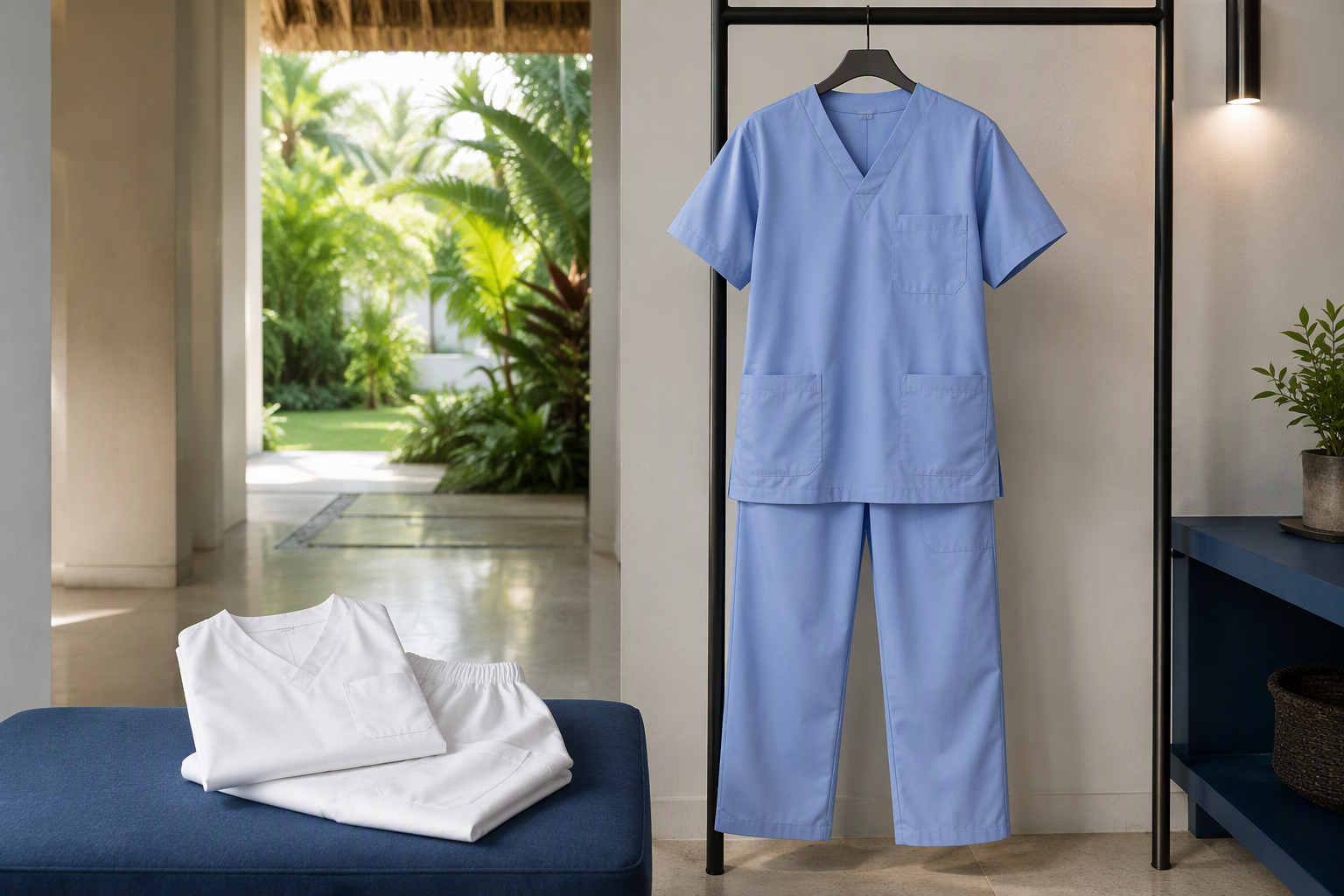
When choosing medical uniform fabric for hot and humid climates, many buyers naturally look for lightweight materials. A lower fabric weight can feel attractive because it may reduce the overall garment weight and provide a lighter wearing experience.
However, lightweight does not automatically mean more comfortable.
For medical scrubs and healthcare uniforms, fabric selection involves several factors beyond GSM. Breathability, moisture management, drying speed, opacity, fabric construction, hand feel, durability, and the working environment all influence how a uniform performs during long shifts.
For healthcare buyers in the Middle East, Southeast Asia, Latin America, and Africa, the better question is not simply, “How lightweight can the fabric be?” but rather:
“How can we balance lightness, breathability, moisture management, coverage, and professional appearance?”
Why Going Too Lightweight Can Create Problems
A very lightweight fabric may reduce garment weight, but reducing GSM alone does not guarantee a better wearing experience.
When fabric becomes extremely thin, several potential issues may appear.
1. Reduced Coverage
White, light blue, light green, and other pale colors are widely used in healthcare uniforms. When a fabric is too thin, the garment may provide insufficient visual coverage, particularly under strong lighting or when the fabric becomes damp.
For medical uniforms, this can affect more than comfort. Professional appearance and appropriate coverage are also important.
Therefore, buyers should evaluate opacity based on the intended garment color, construction, and end use instead of selecting fabric according to GSM alone.
2. A Fabric Can Feel Thin Without Being Highly Breathable
Fabric weight is only one part of the equation.
Air permeability can also be affected by:
- Fiber composition
- Yarn characteristics
- Fabric construction
- Fabric density
- Finishing processes
- Fabric thickness and structure
Two fabrics with similar GSM can therefore provide different levels of air circulation.
This is why professional fabric evaluation should combine GSM with air permeability and fabric construction, rather than treating GSM as a direct measurement of comfort.
3. Moisture May Still Remain on the Fabric
Hot and humid environments create another challenge.
A fabric may absorb moisture but still take time to spread and release that moisture. For healthcare workers wearing uniforms through long shifts, the ability to manage moisture can be just as important as the initial feeling of lightness.
A more complete evaluation should consider:
Moisture absorption → moisture spreading → evaporation → drying speed
This is particularly relevant in tropical and subtropical markets where high temperature and humidity can occur at the same time.
Lightweight vs. Lightweight and Functional
There is an important difference between simply reducing fabric weight and developing a lightweight fabric for a specific working environment.
A functional lightweight medical uniform fabric should ideally balance several properties:
Lightweight + Breathable + Moisture Management + Appropriate Coverage + Durability
The exact balance depends on the market and application.
For example, a medical uniform designed for outdoor healthcare workers in a hot climate may prioritize breathability and drying speed. A uniform mainly worn inside an air-conditioned hospital may require a different balance between lightness, coverage, and thermal comfort.
Therefore, there is no universal “best GSM” for all hot-climate medical uniforms.
Why Fabric Construction Matters
When evaluating a scrub fabric, buyers should look beyond fiber content.
Fiber composition can influence moisture behavior, hand feel, durability, and stretch. However, the final fabric performance also depends on how the yarns are constructed and how the fabric is woven and finished.
For example, a polyester-rayon-spandex blend can be developed into different fabric structures and weights for different applications.
A stretch medical uniform fabric may be designed to provide:
- Comfortable movement during long shifts
- Appropriate fabric recovery
- A soft hand feel
- Professional appearance
- Controlled fabric weight
- Suitable breathability
This is why comparing two fabrics only by composition—for example, “polyester/rayon/spandex”—does not provide enough information for a professional purchasing decision.
Breathability and Moisture Management Should Be Evaluated Together
In hot and humid climates, breathability and moisture management are closely related but should not be treated as the same property.
Breathability is related to how easily air can pass through the fabric.
Moisture management considers how moisture interacts with the fabric, including spreading and drying behavior.
A fabric can therefore be breathable without necessarily offering the moisture-management performance a buyer expects.
For this reason, healthcare uniform buyers can request relevant test data rather than relying only on marketing descriptions.
Useful information may include:
- Fabric GSM
- Air permeability
- Moisture management performance
- Drying performance
- Dimensional stability
- Colorfastness
- Pilling resistance
- Fabric composition
These measurements provide a more complete picture of how the fabric may perform in real-world use.
Don’t Forget About Light-Colored Scrubs
Light-colored medical uniforms deserve special attention.
White and pastel-colored scrubs can create a clean and professional visual appearance, but fabric selection becomes more challenging because insufficient coverage can become more noticeable.
For these colors, buyers should consider:
- Fabric construction
- GSM
- Fabric density
- Wet appearance
- Garment construction
- Intended undergarment color
- Lighting conditions
Importantly, fabric opacity should ideally be evaluated in the finished garment or under conditions close to the actual application.
A fabric that appears sufficiently opaque as a small dry swatch may look different after becoming damp or when used in a particular garment construction.
The Indoor–Outdoor Challenge
Hot-climate medical uniforms also need to consider the environments healthcare workers move between.
In many regions, healthcare workers may move from a hot outdoor environment into a strongly air-conditioned hospital or clinic.
This creates a different requirement from simply designing a fabric for maximum outdoor heat.
For these applications, buyers may need to balance:
Outdoor heat → breathability → moisture management → indoor air conditioning → appropriate coverage
A very thin fabric may perform well in one environment but may not provide the desired coverage or comfort in another.
This is why understanding the actual working environment should come before deciding the final fabric specification.
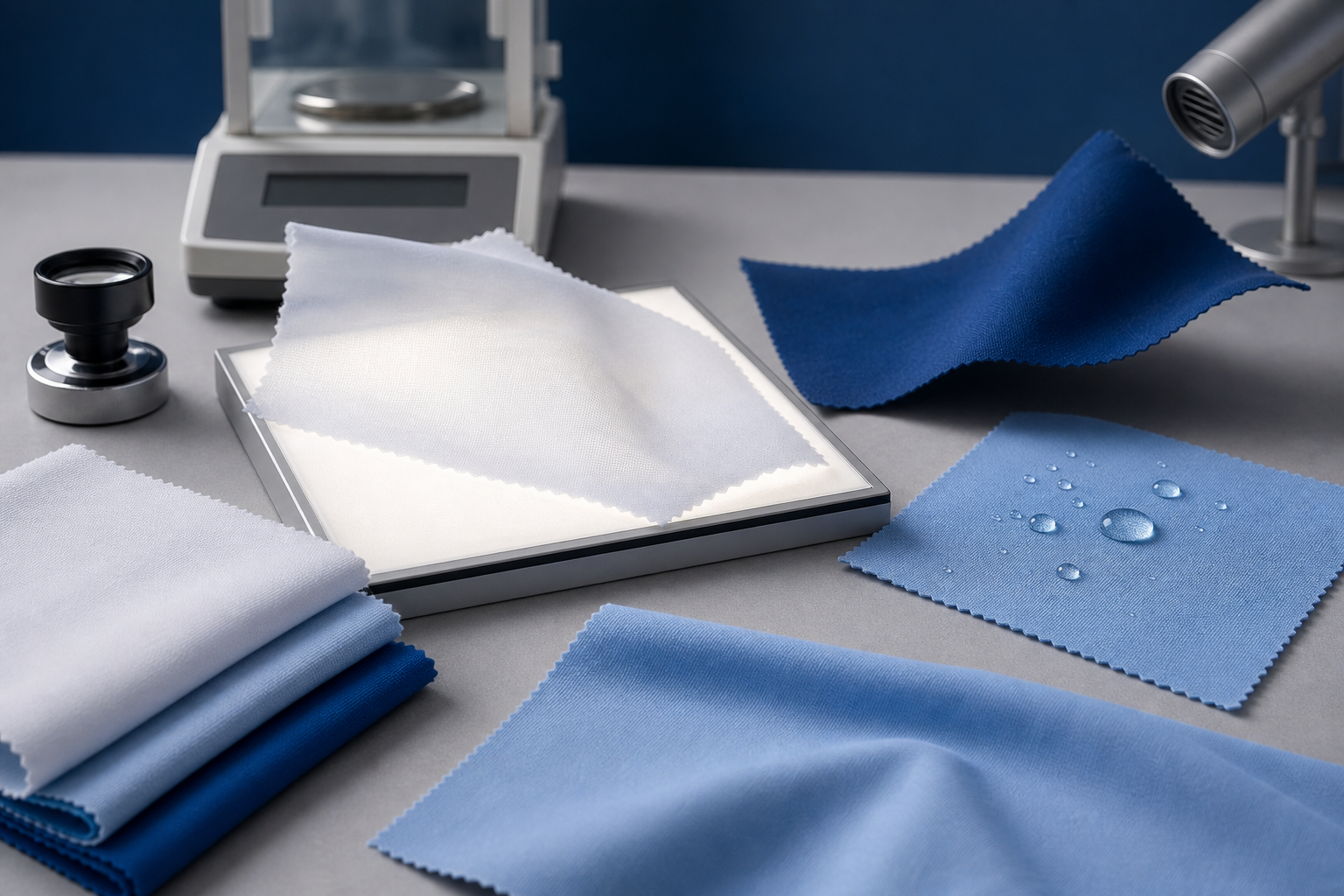
How Should Buyers Choose Lightweight Scrub Fabric?
Instead of asking a supplier only for the lightest available fabric, buyers can provide a more complete application brief.
For example:
Target market: Southeast Asia
Working environment: Hospital + outdoor movement
Uniform color: White / light blue
Priority: Breathability + quick drying + coverage
Fabric requirement: Lightweight stretch woven fabric
Testing: GSM + air permeability + moisture management + colorfastness
This gives the fabric manufacturer a much clearer starting point for development.
For different customers, the final fabric specification may be different even when the target climate is similar.
A Better Way to Define “Lightweight”
For medical uniform fabrics, lightweight should not mean “the lowest possible GSM.”
Instead, it should mean:
The right fabric weight for the required balance of comfort, breathability, moisture management, coverage, durability, and working environment.
This approach is particularly important for healthcare uniforms because medical professionals may wear the same garments for many hours, move frequently, and work under changing environmental conditions.
A fabric that is slightly heavier but provides better coverage, moisture management, durability, and comfort may ultimately be more suitable than an ultra-light fabric.
What Should Medical Uniform Buyers Ask Their Fabric Supplier?
Before placing an order, buyers can consider asking suppliers:
- What is the actual GSM and fabric width?
- What is the fabric construction?
- Is air permeability available?
- Is moisture-management or quick-drying performance tested?
- How does the fabric perform in light colors?
- Has the fabric been evaluated under wet conditions?
- What are the colorfastness results?
- What is the pilling performance?
- What is the dimensional stability after washing?
- Can different GSM or finishing options be developed?
These questions can help buyers move from “Which fabric is cheapest or lightest?” toward a more complete performance-based purchasing decision.
Conclusion
For hot and humid climates, lightweight medical uniform fabric can provide valuable comfort—but lighter is not automatically better.
A successful scrub fabric needs to balance multiple properties, including breathability, moisture management, drying speed, coverage, durability, stretch, hand feel, and professional appearance.
For healthcare uniform brands and fabric buyers in the Middle East, Southeast Asia, Latin America, and Africa, the most effective approach is to select fabric according to the actual climate, working environment, garment color, job requirements, and performance testing, rather than choosing based on GSM alone.
The goal is not to make the lightest possible scrub fabric.
The goal is to develop the right lightweight fabric for the right healthcare environment.

Yunai Textile
Post time: Sep-29-2026