

Why OEKO-TEX 100 Matters for Healthcare Scrubs
In the highly regulated field of medical procurement, institutional buyers face increasingly stringent demands for material safety, transparency, and performance. When sourcing textiles for clinical environments, basic quality control measures and visual inspections are no longer sufficient.
OEKO-TEX Standard 100 certification has evolved from a niche sustainability badge into an increasingly common contractual requirement for many major hospital networks across Europe and North America. Navigating this requirement properly ensures that medical apparel meets high international safety thresholds while mitigating long-term liability risks.
What the Certification Verifies
The OEKO-TEX Standard 100 certification serves as a rigorous, globally standardized, independent testing framework that screens raw, semi-finished, and finished textile products for over 100 harmful substances. For medical apparel, fabrics are evaluated under Product Class II, which governs textiles intended for direct and prolonged contact with human skin.
Under this classification, the fabric must meet highly restrictive quantitative thresholds. For example, it must maintain formaldehyde levels below 75 parts per million (ppm), adhere to strict limits on heavy metals in the dye process, and verify that the fabric’s pH value aligns with the natural acidity of human skin. Testing also covers auxiliary components, including threads and elastic bands, leaving no blind spots in the garment’s chemical safety profile.
However, it is critical to note that OEKO-TEX Standard 100 Class II certifies chemical safety only. It does not satisfy regional clinical-performance regulations—such as U.S. FDA or AAMI standards for barrier apparel—nor does it guarantee clinical garment performance or replace physical testing, such as tensile strength, seam slippage, or abrasion resistance. It also does not cover supply-chain audits for social compliance. To prevent buyer confusion, it must be distinguished from related labels like OEKO-TEX STeP or MADE IN GREEN, which evaluate manufacturing conditions alongside chemical limits. Furthermore, while OEKO-TEX testing overlaps with some REACH Substances of Very High Concern (SVHC) limits, it does not constitute automatic REACH compliance for articles imported into the European Union; additional regulatory obligations may still apply for cross-border distribution.
Why Chemical Safety Matters in Clinical Use
Healthcare professionals frequently endure demanding 12- to 16-hour shifts, during which their skin remains in continuous, friction-heavy contact with their uniforms. In high-stress clinical settings, prolonged skin contact combined with friction and active perspiration presents a potential dermal absorption risk for residual manufacturing chemicals, such as allergenic disperse dyes, azo colorants, or phthalates.
By explicitly specifying certified scrub fabrics, procurement teams can proactively mitigate these hidden chemical risks as a precautionary measure. This ensures that the garments support rather than compromise the wearer’s health, helping to minimize the likelihood of contact dermatitis and long-term chemical sensitization among critical staff.
How to Compare Certified Scrub Fabrics
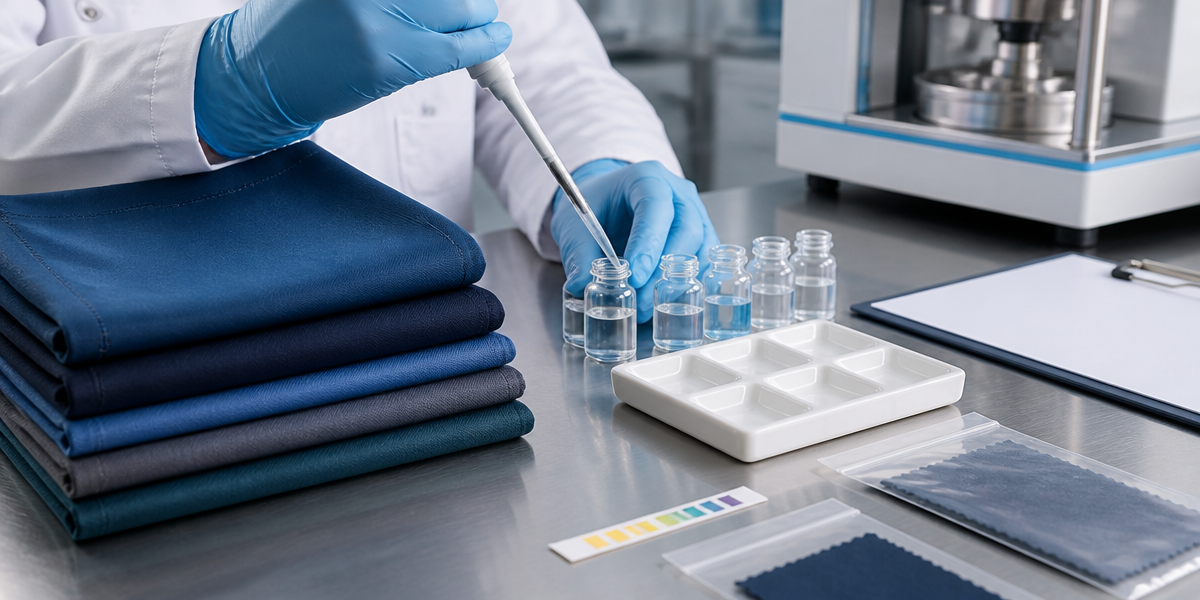
While OEKO-TEX 100 serves as a non-negotiable baseline filter for chemical safety, it is not a competitive quality rank for physical durability. Securing a chemically safe, certified textile is only the foundational step in a comprehensive procurement strategy. Buyers must also rigorously evaluate the physical performance of the fabric to ensure it withstands the extreme wear, tear, and sanitation protocols typical of medical environments.
Comparing different certified fabric options allows organizations to strike the optimal balance between ergonomic comfort, structural durability, and overall lifecycle costs. Mapping physical requirements against certified supply chains builds highly reliable product lines.
Key Sourcing Criteria
When evaluating prospective suppliers, specific functional metrics should be prioritized alongside chemical safety certifications. Modern clinical garments rely heavily on engineered synthetic compositions—such as poly-rayon-spandex blends—which provide an optimal mix of durability and flexibility.
Sourcing high-quality performance stretch fabrics ensures that garments move fluidly with medical staff during physically demanding tasks. In emergency rooms and intensive care units, restricted movement can hinder critical patient care, making advanced elasticity an increasingly prioritized specification.
Additionally, because hospital sanitization protocols often require harsh industrial laundering at temperatures exceeding 60°C, verifying color retention by selecting color-fast textiles designed for healthcare is essential.
The following table provides illustrative examples of typical fabric blends and their estimated performance benchmarks:
| Fabric Blend Type | Typical Composition | Stretch Capacity | Durability / Wash Cycles | Primary Cost Drivers |
|---|---|---|---|---|
| Standard Poly-Cotton | 65% Poly / 35% Cotton | Low | High | Baseline production |
| Performance TR Spandex | 72% Poly / 21% Rayon / 7% Spandex | High | Very High | Segregated line fees & testing amortization |
| Lightweight Synthetic | 95% Poly / 5% Spandex | Maximum | Moderate | Specialty yarn & certification premiums |
Note: The ratings above represent generalized industry estimates. Actual stretch capacity, durability, and cost premiums vary significantly based on specific weave structures, finishing treatments, and regional market conditions.
Common Trade-Offs to Evaluate
In textile sourcing, buyers frequently navigate complex trade-offs between softness and longevity. While a higher rayon content significantly improves the drape, moisture-wicking capability, and breathability of the garment, it can sometimes reduce the fabric’s resistance to surface abrasion.
It is important to note that pilling and abrasion resistance are heavily influenced by the fabric’s weave structure and specific finishing treatments, not solely by fiber content or by paying a premium for a “certified” material. To counteract vulnerability, procurement standards often mandate a minimum pilling resistance of Grade 4 (based on test standards like ASTM D3512). Utilizing properly engineered, certified pilling-resistant materials generally carries an upfront cost premium at the factory level. However, this investment dramatically extends the garment’s usable lifecycle, reducing replacement frequency and ultimately lowering the total cost of ownership across a multi-year hospital contract.
How to Make a Sourcing Decision
Finalizing a supplier contract requires a highly systematic approach to document verification and supply chain risk management. Buyers cannot rely solely on a manufacturer’s verbal assurance or outdated marketing materials regarding safety and compliance.
Instead, strict, repeatable validation protocols should be implemented before authorizing any mass production runs or issuing purchase orders. This systematic diligence protects buyers from financial and reputational risk.
Key Takeaways
- Specify OEKO-TEX Standard 100 Product Class II for scrub fabrics because healthcare uniforms involve direct and prolonged skin contact.
- Require current certificate verification because OEKO-TEX 100 tests textile components against more than 100 harmful substances.
- Do not treat OEKO-TEX 100 as a substitute for FDA, AAMI, barrier, tensile, abrasion, seam-slippage, or wash-durability testing.
- Use certified scrub fabrics to help reduce potential exposure to residual chemicals during 12- to 16-hour clinical shifts.
- Compare suppliers on both chemical safety and physical performance data before approving any healthcare apparel fabric for bulk procurement.
Frequently Asked Questions
What does OEKO-TEX Standard 100 verify for healthcare scrub fabric?
It verifies that raw, semi-finished, or finished textile components have been independently tested against limits for harmful substances, including formaldehyde, heavy metals, certain dyes, phthalates, and skin-related pH requirements.
Is OEKO-TEX 100 enough to prove a scrub fabric is clinically compliant?
No. OEKO-TEX 100 confirms chemical safety, but it does not replace FDA, AAMI, barrier-performance, durability, abrasion, tensile, or seam-slippage testing required for specific clinical applications.
Why is Product Class II important for medical apparel?
Product Class II applies to textiles with direct, prolonged skin contact, making it relevant for scrubs worn during long healthcare shifts. It sets restrictive chemical thresholds suited to everyday professional wear.
Can OEKO-TEX 100 reduce skin irritation risks for healthcare workers?
It can help reduce exposure to residual chemicals linked to irritation or sensitization, such as allergenic dyes or formaldehyde, especially when staff wear scrubs for 12 to 16 hours in warm, high-friction conditions.
Does OEKO-TEX 100 certification guarantee fabric durability?
No. Certification is a chemical safety baseline, not a durability ranking. Buyers should still request test data for colorfastness, pilling, abrasion resistance, stretch recovery, tensile strength, and wash performance.

Yunai Textile
Post time: Aug-25-2026