
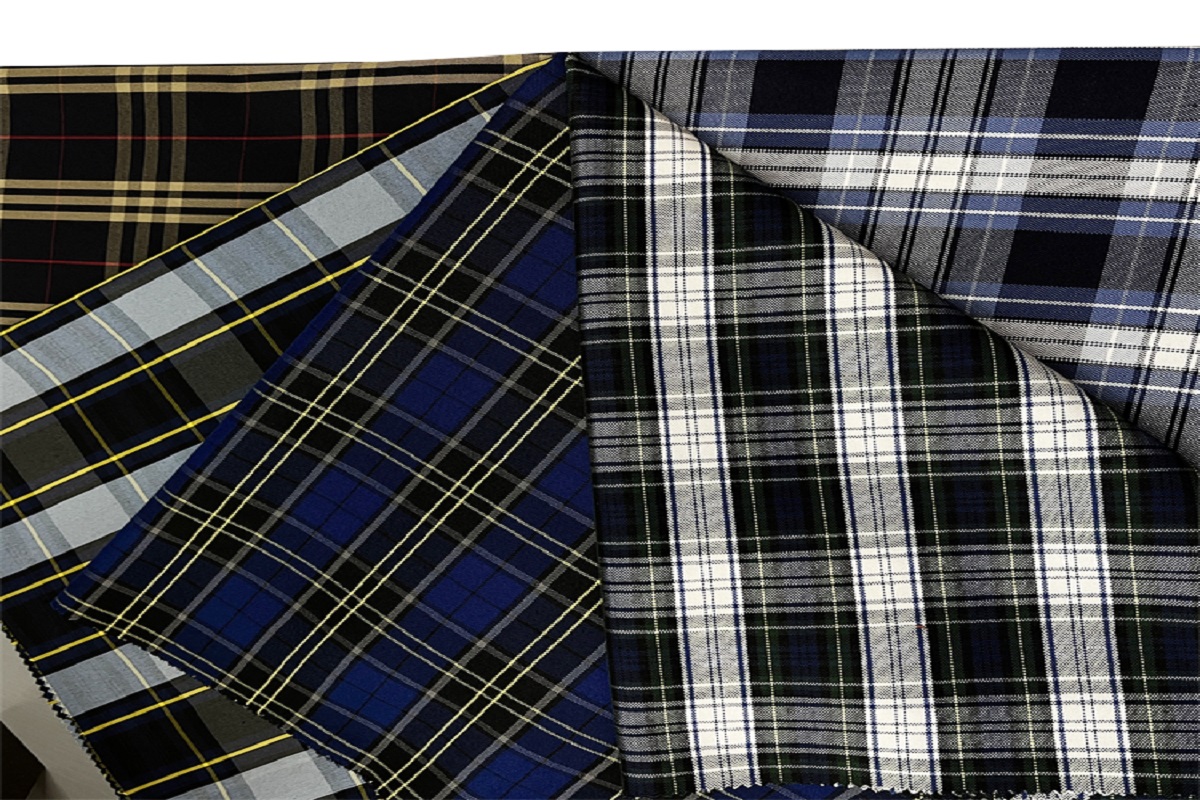
Define Polyester Rayon Plaid Fabric Requirements
Selecting the best fabric for school uniform manufacturing requires a precise balance of durability, comfort, and structural integrity. Polyester rayon (TR) blends have emerged as a leading choice for institutional apparel, consistently outperforming single-fiber textiles. This combination leverages the high tensile strength, abrasion resistance, and wrinkle recovery of synthetic polyester alongside the breathability and softer hand feel of semi-synthetic rayon. By blending these fibers, textile engineers create a fabric optimized for daily wear, frequent laundering, and long-term lifecycle value.
Understanding the specific requirements of TR plaid fabrics is the critical first step in the procurement cycle. Buyers must evaluate the intended garment type and the demographic of the end-user to determine the optimal construction. Because uniform programs often run for multiple consecutive years, establishing a rigid baseline for the material’s composition ensures that future production lots remain visually and structurally identical to the initial rollout.
Key Uses in School Uniforms
Institutional garments demand specialized textiles that can hold sharp creases while resisting daily abrasion. When sourcing plaid fabric for school uniforms—whether through specialized suppliers or general textile mills—buyers must prioritize materials that maintain structural pleats through high-temperature heat setting. This thermal memory is particularly critical for plaid skirts and skorts, where permanent press capabilities directly dictate the garment’s functional lifecycle and aesthetic appeal.
Similarly, plaid jumpers require excellent drape and anti-static properties to ensure comfort throughout the academic year. The inclusion of rayon in the blend mitigates the static cling commonly associated with 100% polyester garments, while the woven structure provides enough rigidity to support hardware like side zippers, buckles, and adjustable waistbands without sagging.
Blend, Weave, Yarn Count, and Plaid Design
The foundational architecture of TR plaid relies on precise blend ratios. While 65% polyester and 35% rayon (65/35) is a common configuration, optimal specifications vary by garment type, climate, and budget. For instance, 70/30 or 80/20 variations exist for budget-conscious programs. For maximum density and structural stability, a 2/2 twill weave is frequently chosen as an illustrative standard over plain weaves, as the diagonal ribbing of the twill enhances tear strength and creates a superior drape.
Yarn count directly impacts the fabric’s refinement and burst strength. A 32s/2 or 40s/2 two-ply yarn configuration serves as a typical example of the smooth surface required for intricate, multi-colored designs. Furthermore, the fabric must utilize a yarn-dyed process rather than surface printing. Yarn-dyeing ensures the tartan pattern is woven directly into the textile, guaranteeing long-term pattern fidelity and preventing the design from fading or rubbing off at high-friction points like hemlines and pockets.
A critical caveat for TR blends involves laundering. Because rayon exhibits reduced wet strength, these fabrics are highly vulnerable to high-heat washing and aggressive mechanical action. This limitation is especially critical for institutional laundry contracts, requiring clear care instructions and careful handling to prevent premature degradation.
Compare Fabric Specifications Before Buying
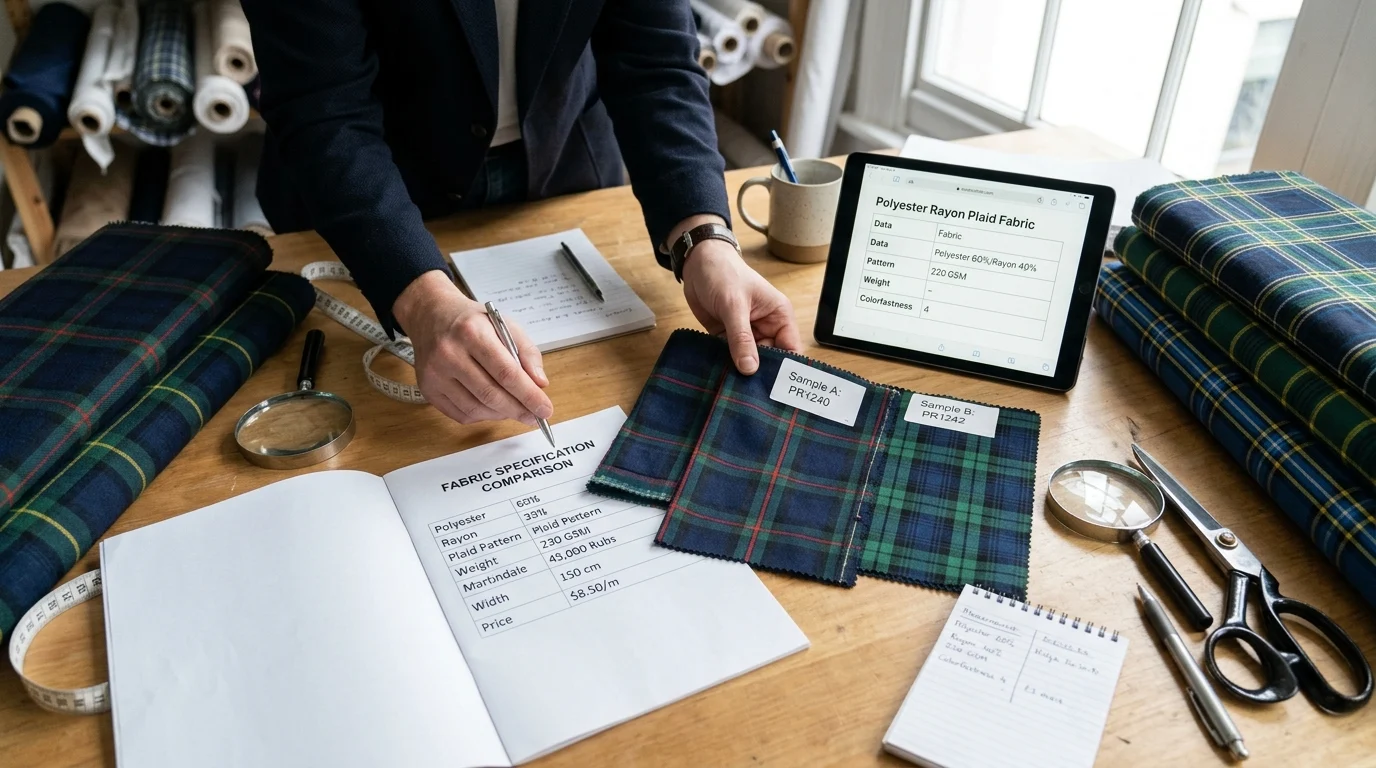
Moving from general compositional requirements to strict technical specifications is essential for minimizing defect rates and ensuring consistency across bulk production runs. Procurement teams must evaluate physical performance metrics against standardized testing protocols before committing to a purchase order. Without a comprehensive specification sheet, buyers risk receiving fabrics that look correct but fail prematurely under the stress of daily student wear.
Establishing these parameters upfront also allows buyers to compare different suppliers on a level playing field. When manufacturers quote prices based on identical, highly detailed technical data sheets, the procurement team can accurately assess which mill offers the best value without compromising on the garment’s end-use performance. Buyers must carefully weigh trade-offs between standard and premium specifications based on their specific needs. For instance, investing in premium pilling resistance and heavier weights may increase upfront costs but will significantly extend the garment’s lifespan, making it a better choice for multi-year uniform programs. Conversely, standard specifications might suffice for budget-conscious programs in milder climates.
Weight, Hand Feel, Durability, and Colorfastness
The physical characteristics of the textile determine its viability for academic environments across different climates. A common weight of 220 to 280 grams per square meter (GSM) provides adequate opacity and seasonal versatility without becoming overly heavy or restrictive. Hand feel can be further engineered through mechanical finishing processes, such as light brushing or singeing, to eliminate harsh synthetic textures.
Durability is objectively measured via pilling resistance, which should achieve a minimum Grade 4 under standard ISO 12945-2 pilling protocols (typically evaluated at 2,000 to 7,000 cycles for apparel, rather than high-cycle upholstery abrasion standards) to prevent the formation of unsightly fuzz balls. Colorfastness is equally critical for yarn-dyed plaids. The fabric must rate at least Grade 4-5 for colorfastness to washing (ISO 105-C06) and Grade 4 for both dry and wet rubbing. This prevents dye migration between the intersecting light and dark yarns, ensuring that white or yellow accent threads do not become tinted by adjacent navy or red yarns during domestic laundering.
Specification Checklist for Buyers
To streamline supplier evaluations and enforce quality control, procurement managers should utilize a standardized matrix. Establishing strict technical tolerances prevents unacceptable variations in bulk shipments and provides a clear framework for third-party quality inspections. It is important to note that the “Standard” and “Premium” thresholds in the table below are illustrative benchmarks rather than universal industry definitions. For example, lighter weights (220 GSM) may map to shirts or blouses, while heavier weights (280 GSM) are better suited for skirts and trousers.
| Specification Metric | Standard Requirement | Premium Grade Requirement | Standard Test Method |
|---|---|---|---|
| Fabric Weight (GSM) | 220 – 240 GSM | 250 – 280 GSM | ASTM D3776 |
| Pilling Resistance | Grade 3.5 | Grade 4.0 or higher | ISO 12945-2 |
| Colorfastness (Wash) | Grade 4 | Grade 4-5 | ISO 105-C06 |
| Dimensional Stability | ±5% Shrinkage | ±3% Shrinkage | AATCC 135 |
| Tear Strength | >20 Newtons | >30 Newtons | ASTM D1424 |
Approve Suppliers and Final Orders
Testing, Compliance, Lab Dips, and Bulk Approval
Before committing to a large-scale order of polyester rayon plaid fabric, buyers must validate the material through rigorous testing and approval protocols. Because this blend is widely considered the best fabric for school uniform applications, the textile must meet strict durability and safety standards. Suppliers should provide testing reports from accredited third-party organizations—such as SGS or Intertek—confirming compliance with international standards, including ISO 12945 for pilling resistance and ISO 105 for colorfastness to washing and rubbing.
Next, buyers must evaluate lab dips and strike-offs. A lab dip ensures the exact yarn-dyed colors match the institution’s specific Pantone requirements. Because school uniform plaid fabric relies on precise color consistency across multiple academic years, approving the physical color swatch is non-negotiable. Once the lab dip is approved, requesting a pre-production sample (PPS) is necessary to verify the plaid pattern’s scale, repeat dimensions, and fabric hand-feel before authorizing bulk manufacturing.
Price, Lead Time, and Final Supplier Selection
Selecting the final supplier requires balancing cost efficiency with production reliability. Buyers should compare quotes based on exact structural specifications—including the fabric weight (GSM), weave structure, and yarn count—rather than baseline pricing alone.
Lead times serve as a critical decision factor in supplier selection. Yarn-dyed polyester rayon plaid fabric typically requires longer production windows than piece-dyed alternatives, often ranging from 30 to 45 days. Buyers must synchronize these manufacturing lead times with the academic calendar, factoring in ocean freight transit (which can add 20 to 40 days depending on the routing) and garment assembly schedules.
Finally, assess the supplier’s Minimum Order Quantity (MOQ) and commercial terms. A highly qualified textile manufacturer will offer transparent Incoterms, structured payment schedules (such as a 30% deposit and 70% against the Bill of Lading), and a proven track record of delivering uniform-grade textiles without delays.
Key Takeaways
- Choose a polyester-rayon blend such as 65/35 when you need a practical balance of durability, wrinkle recovery, softness, and breathability for daily schoolwear.
- Specify yarn-dyed plaid instead of printed plaid to improve pattern durability and reduce fading at high-friction areas like pockets, hems, and pleats.
- Use a stable construction such as 2/2 twill when the garment requires better drape, tear strength, and long-lasting pleat definition.
- Match the blend ratio, yarn count, and fabric weight to the garment type, climate, budget, and expected laundering method before confirming bulk production.
- Request approved lab dips, strike-offs, and production samples to keep plaid color, repeat, and hand feel consistent across multi-year uniform programs.
- Avoid high-heat washing and harsh mechanical laundering because rayon’s reduced wet strength can cause premature wear in TR school uniform fabrics.
Frequently Asked Questions
What is polyester rayon plaid fabric?
It is a woven TR blend that combines polyester strength and wrinkle resistance with rayon softness and breathability, commonly used for school skirts, skorts, jumpers, and other uniform garments.
What blend ratio is best for school uniform plaid fabric?
A 65/35 polyester-rayon blend is a common balanced choice, while 70/30 or 80/20 may suit tighter budgets or higher durability needs. The best ratio depends on garment type, climate, and care requirements.
Why is yarn-dyed plaid better than printed plaid?
Yarn-dyed plaid is woven from pre-dyed yarns, so the pattern lasts longer and resists rubbing or fading at stress points such as hems, pockets, and pleats.
Which weave works well for plaid school uniforms?
A 2/2 twill weave is often preferred because it improves drape, tear strength, and crease retention compared with many plain weaves, making it suitable for pleated skirts and structured uniforms.
Can polyester rayon plaid fabric hold permanent pleats?
Yes, when the fabric is properly constructed and heat-set, TR plaid can hold sharp pleats well. This is especially important for school skirts and skorts that must keep their shape after repeated wear.
Post time: Sep-07-2026