
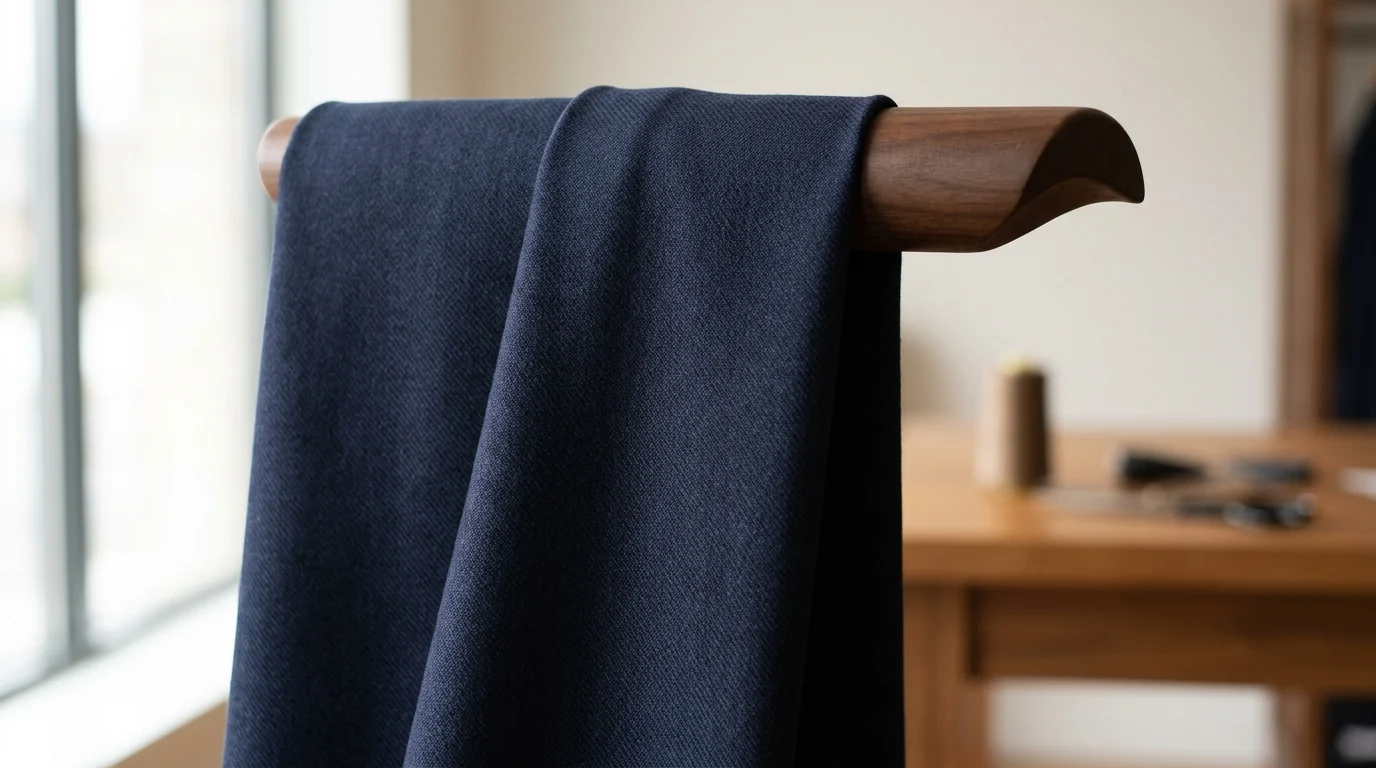
Why Choose 10% Wool Fabric for Suits
Balancing material costs with garment performance is a constant challenge in volume tailoring. When specifying materials for large-scale production, evaluating blended textiles is essential. Integrating a precise fraction of wool staple with polyester and rayon meets rigorous commercial demands without inflating costs. The modern textile industry has refined the blending of protein fibers (wool), cellulosic fibers (viscose), and synthetics (polyester) to create composite materials that offer longevity and appealing aesthetics.
Key Benefits for Suiting
The primary advantage of a 10% wool blend lies in its synergistic physical properties. These benefits largely apply to the popular 65% polyester, 25% viscose, and 10% wool (TRW) variant. This exact 10% proportion represents a cost-performance sweet spot: a 5% wool blend offers negligible hand-feel improvement, while 15–20% wool increases raw material costs, often pushing the garment out of the target budget for entry-level programs. The 10% wool component modifies the hand-feel, introducing a natural crimp and subtle luster. Other architectures, such as a 90/10 polyester-wool blend, differ noticeably; they offer higher abrasion resistance and tensile strength for heavy-duty use but lack the softer drape and moisture absorbency provided by viscose.
While the dominant polyester matrix ensures exceptional tensile strength and abrasion resistance, it also introduces caveats like static electricity accumulation and limited breathability in warm climates. Depending on weave architecture, TRW blends can be engineered to target warp tear strengths of 300 Newtons (N) (ISO 13937)—an illustrative benchmark subject to yarn count and regional mill standards—ensuring structural integrity during automated cutting and daily wear. Furthermore, the viscose in TRW blends mimics the drape of premium worsted wool. This allows the finished garment to hang cleanly while maintaining high crease recovery angles, keeping suits looking freshly pressed even after a long commute.
Best Use Cases for Low-Wool Blends
These blends are highly recommended for high-turnover corporate wear, institutional uniforms, airline crew apparel, and entry-level retail tailoring. In commercial uniform procurement, garments must withstand aggressive laundering and wear cycles that would degrade pure natural fibers. A well-engineered 10% wool blend can reliably survive rigorous laundering—sometimes targeting upwards of 50 industrial wash cycles—provided the wash chemistry and mechanical action are properly managed to account for viscose’s reduced wet-strength. For specialized applications like airline uniforms, buyers must also ensure the fabric meets specific safety and flammability compliance standards (such as FAR 25.853) and static-dissipation requirements.
For fast-fashion and mid-market suiting brands, this fabric composition allows manufacturers to hit aggressive retail price points. It enables brands to market the garment as containing genuine wool, elevating the perceived value of the final product on the rack. Procurement teams must carefully verify that the exact composition meets specific FTC or EU labeling mandates, which require mandatory disclosure formats (e.g., explicitly listing “10% Wool” rather than using a generic “wool blend” tag). Additionally, buyers should weigh sustainability and recyclability concerns, as polyester-dominant blends are increasingly scrutinized in modern corporate uniform tenders.
Technical and Sourcing Specifications
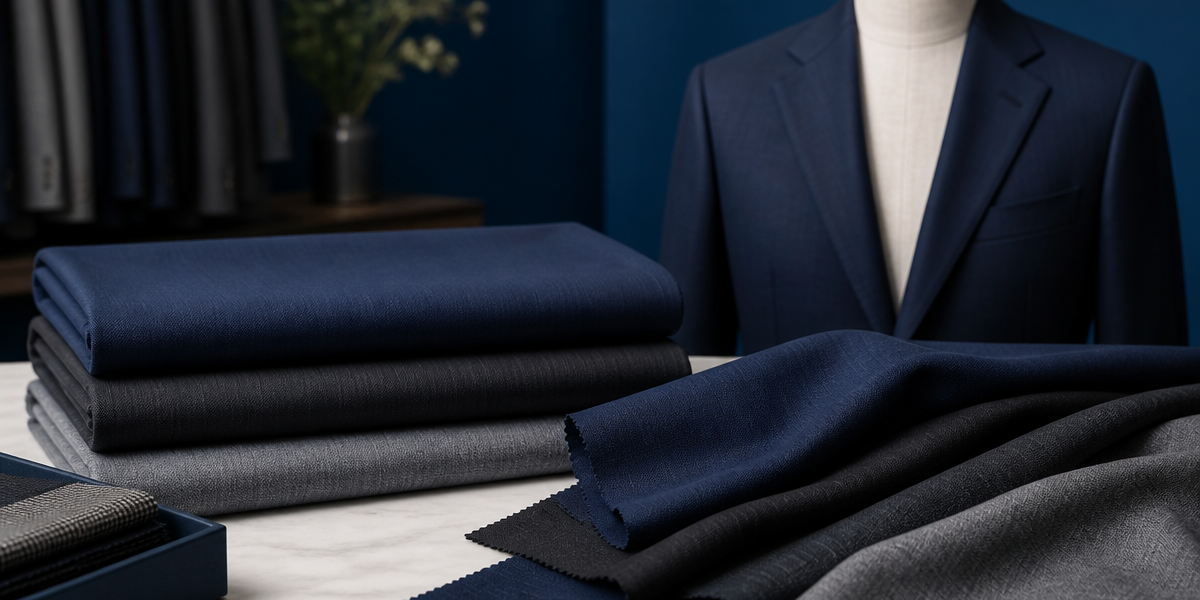
Transitioning from the conceptual design phase to actual procurement requires rigid adherence to technical specifications. When sourcing TRW suiting fabric, it is best practice to mandate comprehensive technical data sheets from partner mills to guarantee batch-to-batch consistency across thousands of meters of production. It is also important to note that bulk composition tolerances (e.g., ±2–3%) are standard in mill contracts and must be accounted for in quality assurance protocols.
Construction, Weight, Finish, and Colors
The architecture of the weave dictates both the aesthetic appeal and the functional lifespan of the finished suit. For standard year-round suiting programs, a common target weight band is 240 to 280 grams per square meter (gsm). Lighter weights risk structural failure at the seams and poor drape, while heavier weights compromise the breathability of the polyester-viscose matrix. The specifications below serve as a baseline for standard programs and should be adjusted for specific end-uses, weave types, and climates.
| Specification Parameter | Optimal Target Range / Standard |
|---|---|
| Composition Target | 65% Poly / 25% Viscose / 10% Wool (Fixed) |
| Weight (Year-Round) | 240 gsm – 280 gsm |
| Yarn Count | 32s/2 × 32s/2 (Worsted spun) |
| Anti-Pilling Grade | Grade 3.5 to 4.0 (ISO 12945-2) |
| Usable Width | 58/60 inches (147-150 cm) |
Beyond the basic construction, yarn engineering and finishing processes are absolutely critical. Specifying worsted-spun, two-ply yarns (such as 32s/2) helps ensure a smooth, refined surface that resists snagging. Because polyester-dominant blends can be susceptible to pilling, anti-pilling treatments must be rigorously applied. Thorough singeing and a high-temperature heat-set finish are required to lock the synthetic fibers in place, which is essential for achieving a standard Grade 3.5 anti-pilling baseline (ISO 12945-2). Color application also demands scrutiny. Wool and polyester require different dye classes; therefore, 10% wool blends—especially for piece-dyed or heathered effects—need verified union-dye or cross-dye processes. Otherwise, shade variation and barré become significant procurement risks.
Ready Goods, Low MOQ, and Price Factors
Sourcing logistics and lead times heavily influence the final landed cost per garment. In today’s highly competitive market, purchasing ready goods from available mill inventory can drop the Minimum Order Quantity (MOQ) to as low as 1,000 meters per colorway, though this is an illustrative target that varies by supplier. This is ideal for capsule collections or testing new styles. However, if a brand requires custom lab dips to match specific seasonal Pantone references, mills typically enforce MOQs of 3,000 to 5,000 meters and require lead times of 45 to 60 days. Pricing is highly responsive to these variables. Standard bulk orders typically sit in a competitive price band of $3.50 to $5.50 per meter (FOB)—an estimate subject to region, yarn count, and market conditions. This benchmark fluctuates further with the inclusion of secondary chemical finishes like mechanical stretch or durable water repellent (DWR) coatings.
How to Make the Final Buying Decision
Approaching the final procurement stage, the focus must shift entirely to risk mitigation, compliance, and quality
Key Takeaways
- Specify a 65% polyester, 25% viscose, and 10% wool TRW blend when you need a practical balance of cost, drape, durability, and perceived value.
- Use 10% wool as a cost-performance benchmark because 5% may deliver limited hand-feel improvement while 15–20% can raise costs beyond entry-level targets.
- Evaluate tear strength, abrasion resistance, crease recovery, and laundering performance before committing fabric to automated cutting or uniform production.
- Select low-wool blends for corporate wear, institutional uniforms, airline apparel, and entry-level suits that must withstand frequent use and cleaning.
- Confirm fiber labeling requirements, such as clearly declaring “10% Wool,” to comply with FTC or EU disclosure rules.
Frequently Asked Questions
What is the main advantage of a 10% wool suit fabric?
A 10% wool blend improves hand-feel, subtle luster, and perceived garment value while keeping material costs controlled for volume suiting programs.
What is a common composition for 10% wool suiting fabric?
A common TRW blend is 65% polyester, 25% viscose, and 10% wool, balancing durability, drape, crease recovery, and cost.
Is 10% wool enough to affect suit performance?
Yes. At 10%, wool can noticeably improve feel and appearance, while lower levels such as 5% may offer minimal practical improvement.
Where is 10% wool fabric best used?
It is well suited for corporate uniforms, airline crew apparel, institutional wear, entry-level retail suits, and other high-turnover garment programs.
How durable is a 10% wool blend suit fabric?
Durability depends on yarn, weave, and finishing, but polyester-rich TRW blends can deliver strong abrasion resistance and support demanding laundering programs.

Yunai Textile
Post time: Aug-04-2026