

I see how medical scrub fabric changes daily work for healthcare teams. I notice that hospitals use antimicrobial textiles in medical scrub uniform and patient linens to lower infection risks. When I look for the best scrub uniform fabric or search for a top 10 medical uniform brand, I consider how to choose best medical scrub apparel for safety and comfort.
Key Takeaways
- Antimicrobial fabrics in medical uniforms help stop the growth of harmful germs, reducing infection risks and supporting safer healthcare environments.
- These fabrics keep uniforms fresher by controlling odor and moisture, making long shifts more comfortable for healthcare workers.
- Durable antimicrobial uniforms last through many washes, saving money and reducing waste while maintaining protection and comfort.
How Antimicrobial Fabrics Enhance Medical Scrub Fabric

Defining Antimicrobial Fabrics in Healthcare Uniforms
When I select uniforms for healthcare settings, I look for fabrics that do more than just cover the body. Antimicrobial fabrics in healthcare uniforms are textiles that either contain built-in properties or have been treated to stop the growth and spread of microorganisms. These include bacteria, viruses, fungi, and mold. I see that these fabrics play a vital role in keeping uniforms clean and safe, especially since medical scrub fabric faces daily exposure to pathogens. Industry standards require that antimicrobial fabrics prevent microbial growth on the surface, which helps maintain hygiene and reduce cross-contamination. For example, some brands use controlled-release systems to provide long-lasting protection. This approach extends the life of the fabric and supports a safer environment for both patients and staff.
I notice several characteristics that set antimicrobial fabrics apart from traditional medical uniform fabrics:
- They fight microbial growth by using special agents and moisture-wicking technology.
- Medical uniforms made from these fabrics resist odors, wick away moisture, and allow the skin to breathe.
- These fabrics undergo strict FDA testing and regulation to ensure safety and effectiveness.
- Antimicrobial fabrics help lower contamination risks, supporting healthcare workers during long shifts.
- While they improve hygiene, they do not create a sterile environment and must be part of a broader infection control plan.
Mechanisms of Action in Scrub Fabric
I often ask how antimicrobial agents in medical scrub fabric actually work. These agents must kill or stop the growth of microbes. They need to keep working even after many washes and exposure to different environments. Safety for both the manufacturer and the wearer is crucial. The agents must also meet government regulations and have a low impact on the environment.
Some agents, like quaternary ammonium compounds (QACs), work by attaching to the negatively charged membranes of microbes. This disrupts the membrane and stops proteins from working, which can even affect the DNA of bacteria and prevent them from multiplying. Silver ions, another common agent, bind to proteins inside microbes and inactivate them. When silver particles are woven into the fabric, they release ions slowly when exposed to moisture, giving long-lasting protection. These mechanisms make medical scrub fabric more effective at stopping the spread of harmful germs.
Note: Antimicrobial textiles have a long history of reducing both transient and resident skin microbes. However, I know that antimicrobial fabrics alone may not remove all contamination. Other features, like fluid repellency, also matter. Industrial laundering removes most microbes, but uniforms can regain about half their microbial load within three hours of wear. Home laundering works only if guidelines are followed closely. Some antimicrobial agents may affect helpful skin microbes, and the long-term effects are still being studied. For best results, I always combine antimicrobial uniforms with proper laundering and infection control practices.
Common Antimicrobial Agents in Medical Wear
I see a range of antimicrobial agents used in medical scrub fabric. Each agent works in a unique way and pairs with different types of fibers. Here is a table that summarizes the most common agents, their modes of action, and the fibers they are used with:
| Antimicrobial Agent | Mode of Action | Common Fibers Used |
|---|---|---|
| Quaternary Ammonium Compounds (QACs) | Damage cell membranes, denature proteins, inhibit DNA synthesis | Cotton, Polyester, Nylon, Wool |
| Triclosan | Blocks lipid biosynthesis, disrupts cell membrane integrity | Polyester, Nylon, Polypropylene, Cellulose acetate, Acrylic |
| Metals and Metallic Salts (e.g., TiO2, ZnO) | Generate reactive oxygen species that damage proteins, lipids, and DNA | Cotton, Wool, Polyester, Nylon |
| Chitosan | Inhibits mRNA synthesis or causes leakage of cell contents | Cotton, Polyester, Wool |
I also find that silver, copper, and PHMB are popular choices. Silver kills microbes by binding to their proteins, while copper disrupts cell membranes. PHMB and chlorhexidine are antiseptics that kill or stop microbes with a low risk of resistance. These agents help reduce biofilm formation and support wound healing.
Comparative studies show that these agents are generally effective in reducing microbial load on healthcare uniforms. Some, like silver and QACs, can cause mild skin irritation in rare cases. The chart below compares the efficacy of different antimicrobial agents used in healthcare uniforms:
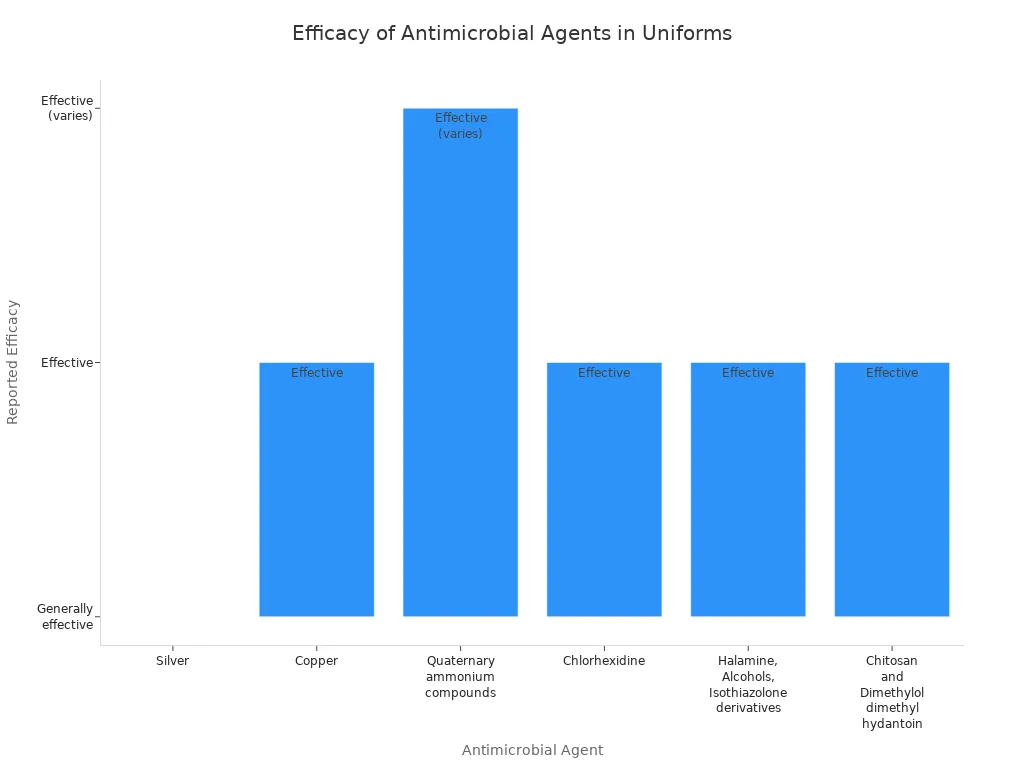
I always consider the balance between effectiveness, safety, and comfort when choosing medical scrub fabric. The right combination of antimicrobial agents and fabric technology helps create uniforms that protect both healthcare workers and patients.
Benefits and Considerations for Medical Apparel
Infection Control in Scrubs and Hospital Uniforms
I see infection control as the most important benefit of antimicrobial uniforms. When I wear medical apparel, I know that my scrubs can pick up bacteria like MRSA and VRE. These germs can survive on hospital fabrics for a long time. I often touch patient belongings or wipe my hands on my uniform, which increases the risk of spreading germs. I have learned that uniforms in long-term care facilities can carry even more bacteria than those in hospitals, likely because of differences in training and infection control.
- Healthcare uniforms can carry multidrug-resistant bacteria.
- Pathogens survive for long periods on scrubs and lab coats.
- Contamination rates are higher in some settings, like long-term care facilities.
- Wearing uniforms to and from work can spread germs between the hospital and the community.
- Proper laundering and strict infection control protocols are essential.
Although research does not directly prove that antimicrobial scrubs stop all infections, I know that reducing bacteria on uniforms helps lower the risk. Hospitals need clear guidelines for laundering and handling uniforms to keep everyone safe. When I choose medical scrub fabric with antimicrobial properties, I support a safer environment for patients and staff.
Tip: I always follow hospital rules for laundering uniforms and avoid wearing scrubs outside the workplace to reduce the risk of spreading germs.
Odor Reduction and Comfort in Clinic Uniforms
Comfort matters during long shifts. I notice that antimicrobial clinic uniforms help control odor. When I work, sweat and bacteria can make uniforms smell bad. Studies show that bacteria growing on fabric cause most of the odor. Antimicrobial uniforms limit this growth, so my clothes stay fresher longer.
I read about a study where researchers found that polyester and cotton clothes develop odors after activity because of bacteria. Antimicrobial uniforms slow down this process. I also see that brands highlight how their scrubs resist bacterial growth, which keeps uniforms smelling clean even after many hours.
- Antimicrobial fabrics reduce bacterial growth, controlling odor.
- These uniforms stay fresh longer, even after repeated washes.
- Lightweight, breathable, and moisture-wicking materials add to my comfort.
- Compared to traditional scrubs, antimicrobial uniforms feel fresher and more pleasant to wear.
When I choose clinic uniforms with antimicrobial properties, I feel more confident and comfortable throughout my shift.
Durability and Lifespan of Healthcare Uniforms
Durability is another key benefit I look for in medical apparel. Antimicrobial fabrics help uniforms last longer. They resist bacteria and odor, so I do not need to replace them as often. I read that uniforms made with antimicrobial finishes, like PHMB, keep their antibacterial power even after 25 washes. This means the uniforms stay effective and hygienic for a longer time.
Antimicrobial uniforms also save money for hospitals. I found that zinc nanocomposite textiles keep their antimicrobial strength after 50 to 100 laundry cycles. This reduces the need for frequent replacements and lowers waste. Here is a table that shows how durability impacts costs:
| Aspect | Evidence Summary | Implication for Healthcare Costs |
|---|---|---|
| Durability of antimicrobial textiles | Zinc nanocomposites retain >99.999% bacterial reduction after 50-100 washes | Sustained protection reduces infection transmission over time |
| Longevity compared to other textiles | Superior durability; other textiles lose efficacy after fewer washes | Less frequent replacement, lowering procurement and waste costs |
| Impact on HAIs | Durable apparel maintains microbial reduction | Potentially lowers costs for treatment and extended hospital stays |
| Safety and usability | Non-irritating and hypoallergenic | Supports continuous use and cost-effectiveness |
I see that antimicrobial uniforms not only last longer but also help hospitals save money by reducing replacement and infection-related costs.
Safety, Regulations, and Environmental Impact
Safety always comes first when I select medical apparel. I know that some antimicrobial agents, like triclosan and quaternary ammonium compounds, can cause skin irritation or allergic reactions. Prolonged exposure may lead to contact dermatitis or even systemic effects. I pay attention to how my skin reacts and report any irritation to my supervisor.
- Prolonged exposure to certain agents can cause skin irritation or allergies.
- Triclosan may disrupt hormones and increase health risks.
- Quaternary ammonium compounds can trigger asthma or skin sensitization.
- Frequent glove use and wet work increase the risk of skin problems.
I also consider the environment when choosing uniforms. Many traditional uniforms use polyester or conventional cotton, which can harm the planet. Polyester production uses a lot of energy and creates microplastic pollution. Cotton farming uses water and pesticides. Disposing of these uniforms adds to landfill waste.
Sustainable options help reduce these impacts:
- Recycled polyester (rPET) lowers energy use and diverts plastic from landfills.
- Organic cotton uses less water and no synthetic pesticides.
- Bamboo textiles grow quickly and need no pesticides or irrigation.
- Tencel™ and Modal come from wood pulp in closed-loop systems, recycling water and solvents.
- These materials are biodegradable or have a smaller environmental footprint.
Hospitals in the European Union now prefer reusable textiles to cut down on waste. Some hospitals use antimicrobial fabrics that are fully recyclable and require less water and energy to produce. These choices support hospital sustainability goals and help protect the environment.
Note: Even though antimicrobial uniforms reduce bacteria, I still wash my scrubs daily. Experts recommend laundering at accredited facilities to ensure proper cleaning. Home washing does not always remove all germs.
When I choose medical scrub fabric with antimicrobial and sustainable features, I help create a safer, cleaner, and greener healthcare environment.
I see antimicrobial fabrics as essential for modern medical scrub fabric. These textiles protect against bacteria and last through many washes. New technologies, like embedded silver and copper, improve safety and comfort. The market for these fabrics keeps growing, driven by infection control needs.

FAQ
What makes antimicrobial fabrics different from regular medical uniforms?
I choose antimicrobial fabrics because they stop bacteria from growing. Regular uniforms do not have this protection. Antimicrobial uniforms help keep me and my patients safer.
How often should I wash my antimicrobial scrubs?
I wash my antimicrobial scrubs after every shift. This keeps them clean and effective.
Tip: Always follow your hospital’s laundering guidelines.
Can antimicrobial uniforms cause skin irritation?
Some agents, like triclosan, may irritate sensitive skin.
- I check for redness or itching.
- I report any reaction to my supervisor.
Post time: Jul-18-2025