
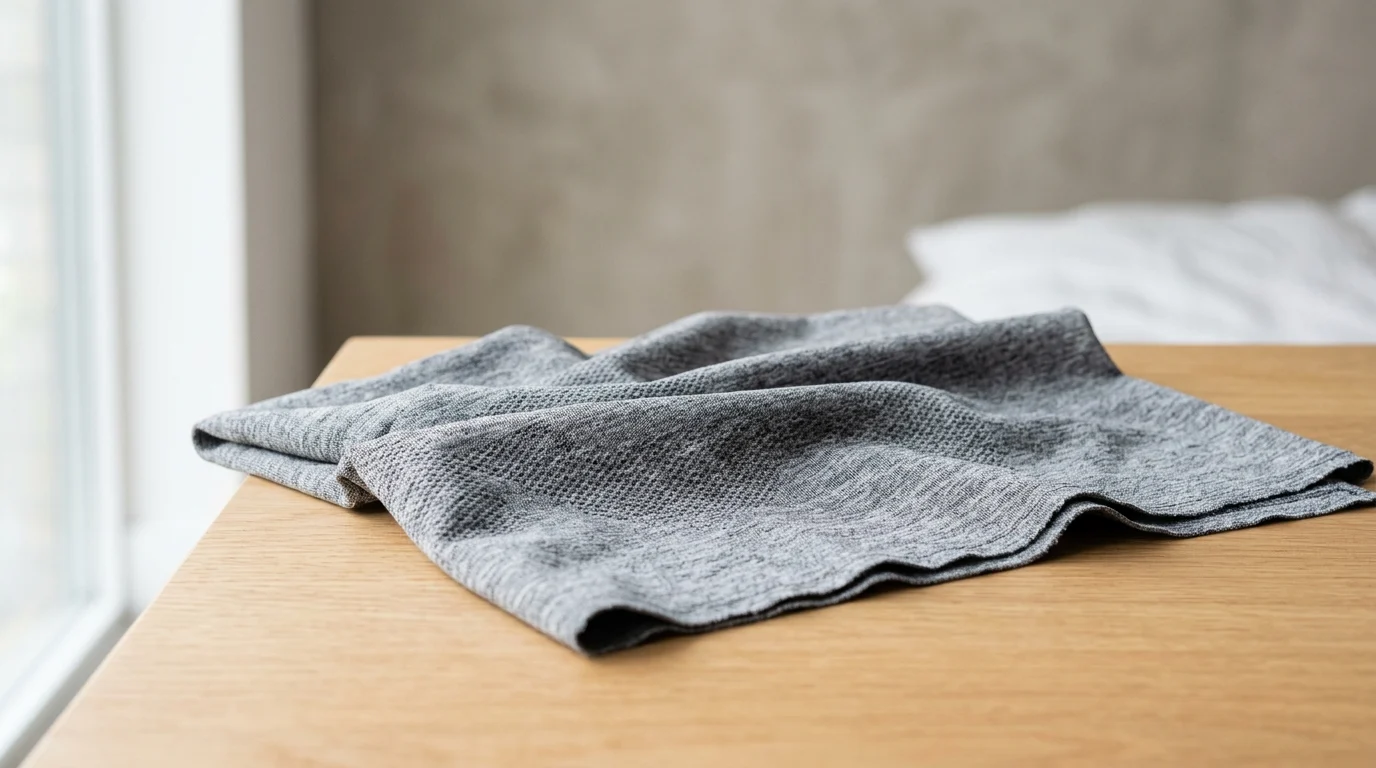
Why 2-Way vs 4-Way Stretch Matters
Engineering performance apparel requires balancing mobility, structural stability, and production costs. Choosing the right stretch mechanism in woven textiles is a critical material decision. Knits inherently stretch due to their looped structure. Woven fabrics, however, are chosen specifically for their superior structure, durability, and weather resistance. To make wovens elastic, mills must strategically integrate elastomeric yarns like spandex (elastane). Choosing between a two-way and a four-way stretch profile is vital. This choice dictates how the garment moves with the athlete and how well it holds its shape over hundreds of wash cycles.
It is also important to note that terminology is not standardized globally. In some regions, “2-way” refers to stretch-and-recovery rather than a single direction, while “4-way” claims sometimes rely on mechanical bias stretch rather than true multi-axis elastane. Buyers should always verify from mill spec sheets that elastomeric yarns are genuinely present in both the warp and weft for true 4-way performance.
What Is 2-Way Stretch Fabric?
Despite its industry nomenclature, true 2-way stretch fabric expands in only one direction across the textile plane—typically horizontally across the weft (from selvedge to selvedge). In standard applications, or specialized waterproof outdoor wear fabrics, the textile relies on a modest elastane content to provide mechanical elongation. This horizontal give allows a garment to expand around the wearer’s body during movement, such as breathing or torso rotation, while maintaining strict vertical stability so the garment does not elongate over time.
What Is 4-Way Stretch Fabric?
Conversely, 4-way stretch textiles expand both horizontally (weft) and vertically (warp). To achieve this cross-directional elasticity, mills must weave elastomeric yarns into both axes. A high-performance four-way stretch variant demands a higher elastane content to achieve comprehensive elongation. This creates a textile that acts like a second skin, moving seamlessly with complex multi-axis biomechanical movements.
How 2-Way and 4-Way Stretch Fabrics Compare
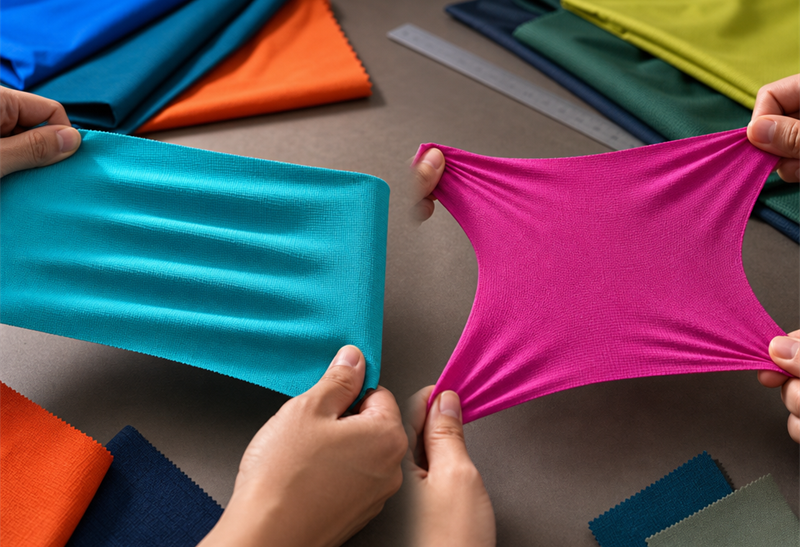
To make an informed sourcing decision, designers must analyze how these textiles behave under dynamic loads. The differences extend far beyond mere elasticity; they impact the modulus, recovery rate, and overall bill of materials (BOM) costs. Below is a comparative breakdown based on realistic industry tendencies for woven sportswear textiles, excluding high-performance knit outliers.
| Feature | 2-Way Stretch Woven | 4-Way Stretch Woven |
|---|---|---|
| Stretch Axes | 1 (Horizontal/Weft) | 2 (Horizontal & Vertical) |
| Typical Elastane % | ~2% – 5% (varies by denier/weave) | ~3% – 10% (varies by denier/weave) |
| Max Elongation | ~10% – 20% | ~15% – 35% |
| Recovery Rate | High (varies by construction) | Very High (requires proper finishing) |
| Cost Index | Baseline | Premium (varies by mill) |
Stretch Direction, Percentage, and Recovery
When evaluating performance, the modulus of elasticity (the force required to stretch the fabric) and its recovery rate (the ability to snap back to its original dimensions) are paramount. A reliable outdoor wear fabric must maintain its structural integrity over time. Rather than just looking at maximum elongation, it is crucial to understand the underlying mechanics. For instance, warp tensioning during the weaving process directly affects how well a 4-way stretch fabric snaps back. Under standard test methods like ASTM D3107, premium 4-way stretch wovens are engineered to maintain high recovery even after extensive flex cycles. However, the higher elastane content required for this multi-directional stretch makes the fabric inherently more vulnerable. Elastane degrades faster than polyester or nylon, meaning 4-way stretch fabrics are more susceptible to breakdown from UV exposure, chlorine, and high-heat laundering if not properly treated with specialized finishes. To preserve this recovery and prevent premature degradation, high-elastane wovens require strict care protocols, including cold washing, avoiding fabric softeners, and utilizing low-heat or air drying.
Fiber Content and Construction
The structural difference lies entirely in the weaving architecture. In a 2-way stretch woven, rigid polyester or nylon yarns (often 50D to 75D) are used for the warp, providing a stable vertical backbone, while core-spun elastane yarns are integrated into the weft. When comparing standard 100% polyester fabrics with elastane blends, the latter requires complex loom setups to handle elastomeric yarns in both directions. This dual-axis tensioning during the weaving and finishing processes significantly increases manufacturing difficulty. Handling stretch in both the warp and weft can reduce warp tensile strength and increase the risk of seam slippage under dynamic loads. These construction risks lead to higher defect rates in lower-tier mills and drive up the final per-yard cost.
How to Choose the Right Stretch Fabric
Selecting the optimal textile requires matching the fabric’s mechanical properties to the garment’s end-use biomechanics and the production budget. Because 4-way stretch wovens typically carry a cost premium over their 2-way counterparts, over-specifying a fabric can unnecessarily inflate the BOM. It is highly advisable to map the strain zones of the specific garment before committing to a fabric yardage. Additionally, practical manufacturing caveats must be considered: 4-way stretch wovens require stricter sewing protocols—such as precise tension control and specific needle types—to prevent pattern distortion and seam failure. Often, strategic paneling or gussets using 2-way stretch fabrics can achieve comparable mobility at a lower cost.
Best Applications for 2-Way Stretch
2-way stretch is frequently specified for garments requiring lateral expansion but vertical stability. It is the ideal choice for running shorts, track jackets, and hiking trousers. In a pair of running shorts, for example, the athlete needs horizontal give across the quads and glutes during a stride, but vertical stretch is unnecessary. The rigid warp in 2-way stretch wovens provides superior seam slippage resistance compared to 4-way alternatives, making it highly durable under repetitive linear motion. Furthermore, in many bulk-production markets, 2-way stretch fabrics are more frequently available as stock items. This regional availability can result in lower Minimum Order Quantities (MOQs) for buyers, making them highly accessible for mid-tier production runs where budget and structural durability are the primary drivers.
Best Applications for 4-Way Stretch
For high-articulation
Key Takeaways
- Choose 2-way stretch woven fabric when the garment needs horizontal comfort, vertical stability, and a lower baseline cost.
- Use 4-way stretch woven fabric for performance apparel that must support multi-axis movement, such as fitted training wear or high-mobility sportswear.
- Verify true 4-way stretch by checking that elastomeric yarns are present in both warp and weft directions, not just claimed through bias stretch.
- Expect typical elastane ranges of about 2% to 5% for 2-way stretch and about 3% to 10% for 4-way stretch woven fabrics.
- Evaluate modulus, elongation, recovery rate, and wash performance before selecting a stretch woven fabric for bulk sportswear production.
Frequently Asked Questions
Is 4-way stretch always better for sportswear?
Not always. 4-way stretch is better for high-mobility garments like leggings, training shorts, and fitted performance pieces, but 2-way stretch can be more stable, cost-effective, and durable for jackets, uniforms, and structured outdoor wear.
What is the main difference between 2-way and 4-way stretch woven fabric?
2-way stretch usually stretches in one direction, typically across the weft. 4-way stretch stretches in both the warp and weft directions, giving better freedom of movement for multi-directional athletic activity.
How much elastane is typically used in stretch woven sportswear fabric?
2-way stretch woven fabrics commonly use about 2% to 5% elastane, while 4-way stretch versions often use around 3% to 10%, depending on yarn, weave, target elongation, and finishing requirements.
How can buyers verify true 4-way stretch performance?
Ask the mill for a spec sheet confirming elastomeric yarns in both warp and weft directions. Buyers should also review elongation, recovery, and wash-test data before bulk ordering.
Which fabric is better for outdoor sportswear?
It depends on the garment. 2-way stretch works well for structured outerwear that needs stability and weather resistance, while 4-way stretch is better for active outdoor apparel requiring full-range movement.

Yunai Textile
Post time: Aug-27-2026