
Why Sportswear Fabric Costs More Than the Purchase Price
In my years of managing textile supply chains, I have consistently seen brands make the same critical error: equating the ex-factory price per yard with the actual cost of the fabric. The reality is that the true cost of performance textiles is heavily weighted by hidden logistical and operational factors.
Understanding sportswear fabric cost requires us to look beyond the initial supplier quote. While this guide focuses primarily on knit fabrics—which dominate the activewear market—many of these total cost principles also apply to woven sportswear, such as nylon ripstop shells. When we evaluate margins, we must account for the entire lifecycle of the material, from raw yarn procurement to the cutting room floor.
How to Calculate Total Cost of Ownership
To calculate the Total Cost of Ownership (TCO), I always factor in yield loss, inbound freight, import duties, and defect rates. A baseline price of $3.50 per yard might seem attractive, but if that fabric has a 10% defect rate requiring extensive splicing in the cutting room, the effective cost quickly exceeds $4.00 per yard.
I recommend budgeting a standard defect allowance of 3% to 5% for high-quality knits. Anything higher indicates poor quality control at the mill. By tracking these hidden penalties, we can accurately compare suppliers not just on their quoted price, but on the usable yield they actually deliver into our finished garments.
Key Sportswear Fabric Cost Drivers to Compare
Several primary drivers dictate the baseline price before shipping. Raw material fluctuations in petroleum directly impact synthetic yarn prices, while specialized dyeing techniques and functional finishes—such as Durable Water Repellent (DWR) or silver-ion anti-microbial treatments—add significant premiums.
Note: The table below is an illustrative scenario. Freight and duty are variable costs, not fixed per-yard amounts.
| Cost Component | Base Fabric ($/yd) | Yield Loss (5%) | Freight & Duty ($/yd) | True Landed Cost ($/yd) |
|---|---|---|---|---|
| Standard Poly-Spandex | $3.20 | $0.16 | $0.45 | $3.81 |
| Premium Nylon-Spandex | $5.50 | $0.28 | $0.50 | $6.28 |
As shown in the illustrative comparison above, standardizing your evaluation method reveals the true financial impact of your sourcing decisions. It is important to reiterate that freight and duty are variable costs dependent on shipment volume, Incoterms, and specific trade agreements, rather than fixed per-yard add-ons. Piece dyeing might be cheaper for small runs, but dope dyeing (solution dyeing) offers better color consistency and lower water usage, which can effectively offset costs on larger volume programs.
How Specifications Affect Cost and Performance
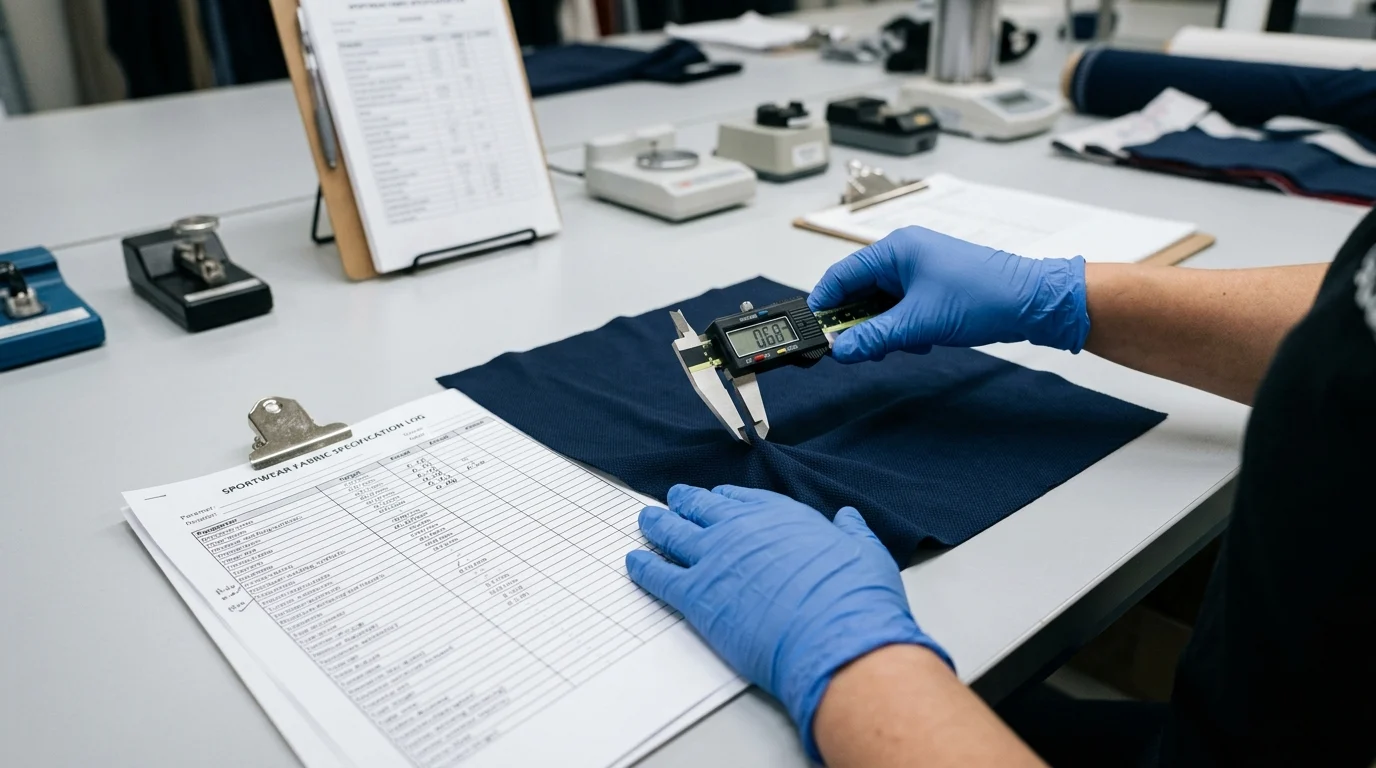
Engineering the fabric specification is where I see the most margin saved or lost. Over-specifying a fabric drains profitability, while aggressive cost-cutting and under-specifying lead to catastrophic field failures, higher return rates, and severe brand damage. The key is finding the exact intersection where performance metrics meet target costs without compromising the garment’s integrity.
Balancing Fabric Composition and Spandex Content
Elastane is one of the most expensive components in athletic wear. The polyester spandex fabric price is highly sensitive to the percentage of stretch fiber used. For standard activewear, an 8% to 12% spandex blend provides ample mobility and recovery.
However, when designing high-compression gear, brands often push spandex content to 20% or even 25%. This jump can increase the per-yard cost by 15% to 20% and complicate the dyeing process. I always advise my teams to rigorously test whether that extra 5% of elastane genuinely improves the garment’s functional performance or if a smarter knit structure could achieve the same mechanical stretch for less.
Optimizing GSM, Width, and Cutting Efficiency
Fabric weight, measured in Grams per Square Meter (GSM), directly impacts your yield. Since many mills sell knits by the kilogram (unlike wovens, which are typically sold by the yard), a 250 GSM fabric will yield fewer yards per kilo than a 200 GSM fabric. If the garment doesn’t strictly require the heavier weight, dropping the GSM slightly is an immediate cost-saving lever. However, this must be balanced carefully; a lower GSM can reduce the fabric’s opacity, durability, and printability, risking customer dissatisfaction.
Equally critical is the fabric’s usable width. Rather than just looking at the cutting table, specifying a cost effective sportswear fabric requires selecting the optimal width during the sourcing phase to subsequently improve cutting-room yield. Increasing a fabric’s usable width from 58 inches to 62 inches can improve marker efficiency by 4% to 6%. This reduction in scrap fabric directly lowers the consumption required per garment. Keep in mind that wider fabrics are not a universally risk-free lever; they may carry higher Minimum Order Quantities (MOQs) or face limited supplier availability depending on the mill’s knitting machinery.
How to Source, Test, and Plan Fabric Orders
Sourcing performance textiles is not just about identifying a capable activewear fabric manufacturer. It requires a highly disciplined approach to testing, validation, and production scheduling to prevent expensive delays and quality failures late in the manufacturing cycle.
Sample Testing, Shrinkage, and Colorfastness Checks
Before committing to bulk production, I mandate rigorous third-party lab testing on all pre-production yardage. Shrinkage is a primary concern for knit sportswear (wovens generally have much lower shrinkage profiles); a tolerance of 5% to 7% is standard for knits, but if a fabric shrinks by 8% or more after washing, it will completely ruin your pattern grading and fit.
Colorfastness is another non-negotiable metric. Activewear faces harsh conditions, including heavy perspiration and frequent laundering. I require fabrics to meet at least a Grade 4 on the ISO 105-C06 colorfastness to washing standard. Failing to verify this beforehand leads to dye bleeding, ruined garments, and severe brand damage that costs far more than the initial lab tests.
Managing MOQ, Lead Time, and Production Planning
Managing Minimum Order Quantities (MOQ) and lead times is the final hurdle in controlling costs. Standard MOQs for custom dye lots typically range from 1,000 to 3,000 kilograms per color.
Key Takeaways
- Calculate sportswear fabric cost using total cost of ownership, including yield loss, freight, duties, and defect rates.
- Budget a 3% to 5% defect allowance for quality knit fabrics and investigate suppliers that exceed this range.
- A fabric quoted at $3.50 per yard can exceed $4.00 per usable yard if defects reach 10%.
- Compare cost drivers such as yarn type, spandex content, dyeing method, and functional finishes before approving a specification.
- Use dope dyeing for larger-volume programs when color consistency and reduced water usage can offset higher upfront planning costs.
- Avoid over-specifying performance features that do not directly support the garment’s intended use or target customer.
Frequently Asked Questions
What is the biggest mistake brands make when evaluating sportswear fabric cost?
They often compare only the ex-factory price per yard. A more accurate view includes yield loss, freight, duties, defect rates, finishing costs, and cutting-room efficiency.
What defect allowance is reasonable for high-quality knit sportswear fabric?
A 3% to 5% defect allowance is generally reasonable for quality knits. If defects reach 10%, the usable fabric cost can rise sharply and hurt margins.
How can a lower fabric quote become more expensive in production?
A low quote can become costly if the fabric has high defects, poor consistency, added freight costs, import duties, or cutting waste that reduces usable yield.
Do performance finishes always justify their added cost?
Not always. Finishes such as DWR or antimicrobial treatments should match the garment’s use case, target price, and customer expectations rather than being added by default.
Is dope dyeing more cost-effective than piece dyeing?
Dope dyeing can be more cost-effective for larger programs because it improves color consistency and lowers water usage, while piece dyeing may suit smaller runs better.
Post time: Sep-14-2026