
Introduction
When sourcing fabric for tailored suits, choosing the right fiber composition and fabric quality is only part of the decision. Fabric weight is equally important because it influences how a suit drapes, feels, retains warmth, and performs in different climates.
A fabric suitable for winter business suits in Northern Europe may feel too heavy in Southeast Asian humidity. Similarly, an ultra-lightweight tropical suiting fabric may not provide the structure and warmth required for colder seasons.
For apparel brands, suit manufacturers, and international textile buyers, understanding fabric weight is essential when developing collections for different geographical markets.
Fabric weight is commonly measured in grams per square meter (GSM) or ounces (Oz). However, these measurements are not always directly interchangeable because ounce measurements can refer to either square-yard weight or linear-yard weight.
In this guide, we explain how to understand GSM and Oz, compare common worsted wool weight categories, and select suitable fabric weights for tropical, all-season, and winter collections.
Quick Answer: What GSM Is Best for Suiting Fabric?
The ideal fabric weight depends on the climate, garment construction, and intended application.
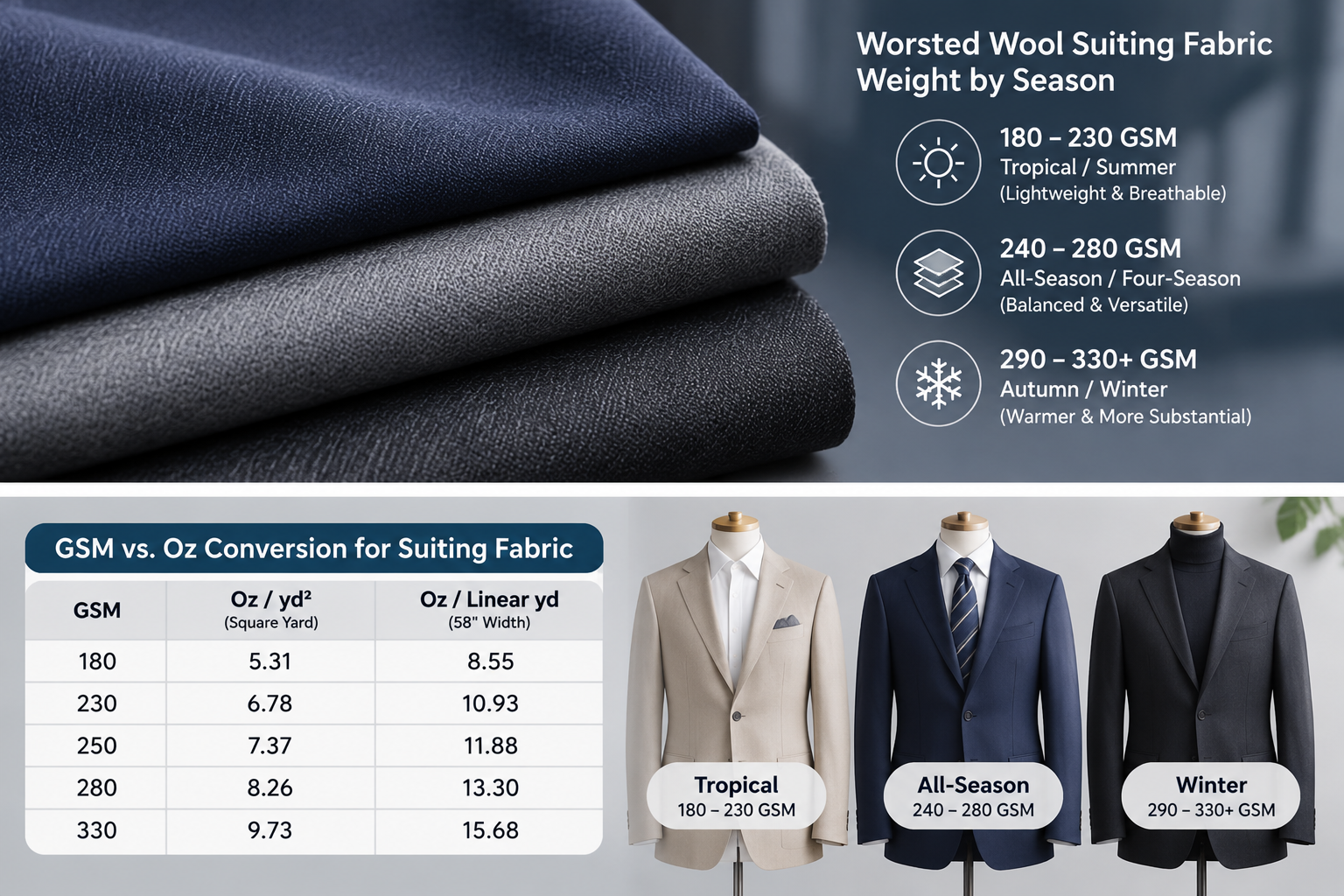
The following ranges provide a practical starting point for worsted wool suiting:
| Application | Suggested Fabric Weight | Typical Characteristics |
|---|---|---|
| Tropical / Summer Suits | 180–230 GSM | Lightweight, suitable for warm-weather tailoring |
| All-Season Business Suits | 240–280 GSM | Balanced weight, versatility, and structure |
| Autumn / Winter Suits | 290–330 GSM | More substantial handle and warmth |
| Heavy Winter Suiting | 340 GSM and above | Heavier construction for colder conditions |
These ranges are general sourcing guidelines, not universal industry standards. Actual suitability depends on fiber composition, weave structure, yarn construction, finishing, garment lining, and local climate.
1. Understanding GSM vs. Oz: How Is Fabric Weight Measured?
Before comparing seasonal fabric weights, buyers should understand the two main measurement systems used in textile sourcing.
What Is GSM?
GSM stands for grams per square meter.
It measures the weight of one square meter of fabric and is widely used in international textile manufacturing, technical specifications, and laboratory testing.
For example:
- 180 GSM means one square meter of fabric weighs 180 grams.
- 250 GSM means one square meter of fabric weighs 250 grams.
- 320 GSM means one square meter of fabric weighs 320 grams.
GSM provides a standardized way to compare fabric weight regardless of fabric width.
What Does Oz Mean in Fabric Weight?
Ounce measurements can refer to two different units.
1. Oz per Square Yard (oz/yd²)
This measures the weight of one square yard of fabric.
The conversion formulas are:
GSM = Oz/yd² × 33.906
Oz/yd² = GSM ÷ 33.906
2. Oz per Linear Yard (oz/linear yd)
This measures the weight of one linear yard of fabric at a specified width.
Unlike GSM, the result changes according to fabric width.
For a 58-inch-wide fabric, the approximate conversion is:
Oz/Linear Yard = GSM × 0.04751
For example, 250 GSM fabric at 58 inches wide weighs approximately 11.88 oz per linear yard.
GSM to Oz Conversion Reference Table
| Fabric Weight | Oz/Square Yard | Oz/Linear Yard (58″ Width) |
|---|---|---|
| 180 GSM | 5.31 oz | 8.55 oz |
| 200 GSM | 5.90 oz | 9.50 oz |
| 230 GSM | 6.78 oz | 10.93 oz |
| 250 GSM | 7.37 oz | 11.88 oz |
| 270 GSM | 7.96 oz | 12.83 oz |
| 300 GSM | 8.85 oz | 14.25 oz |
| 330 GSM | 9.73 oz | 15.68 oz |
| 350 GSM | 10.32 oz | 16.63 oz |
Note: Linear-yard conversions assume a fabric width of 58 inches. Actual values should be recalculated using the specified fabric width.
Why Does This Difference Matter for Fabric Buyers?
Suppose two suppliers quote a fabric weight of 250 GSM and 12 Oz.
Before comparing the specifications, buyers should confirm whether the 12 Oz refers to square-yard weight or linear-yard weight, and what fabric width is being used.
Different measurement conventions can lead to incorrect purchasing comparisons.
Buyer Tip: Always request fabric weight in GSM and confirm usable width. If ounces are used, ask whether the measurement refers to oz/yd² or oz/linear yard.
2. Tropical and Summer Suiting: 180–230 GSM
Lightweight worsted wool is commonly selected for summer suits and warm-weather tailoring.
For buyers serving tropical markets, the objective is to balance a lightweight fabric structure with sufficient stability and a clean garment appearance.
Recommended Fabric Construction
- Plain weave and open-weave constructions.
- Tropical worsted structures.
- Suitable high-twist yarn constructions.
- Lightweight finishing treatments.
Key Performance Characteristics
Lightweight Wearing Comfort
Lower fabric weight can reduce the amount of material used in a garment, helping create a lighter overall wearing experience.
Air Permeability
Open-weave constructions may allow greater airflow through the fabric, supporting comfort in warm and humid conditions.
Flexible Garment Drape
Lightweight suiting can create a softer and less bulky silhouette.
Warm-Weather Suitability
These fabrics are worth considering for summer business suits, lightweight trousers, and tropical formalwear.
Recommended Applications
- Summer business suits.
- Tropical formalwear.
- Lightweight office trousers.
- Unlined or partially lined jackets.
- Warm-weather business collections.
Potential Target Markets
- Southeast Asia.
- Middle Eastern markets.
- Southern United States.
- Other regions with extended warm seasons.
Buyer Insight: When sourcing lightweight worsted wool fabric, do not evaluate GSM alone. Air permeability, weave openness, fabric construction, lining, and finishing all influence the final garment’s comfort.
3. All-Season Business Suiting: 240–280 GSM
For many international apparel brands, midweight worsted wool is a versatile option for business suiting.
This category offers a balance between fabric substance, drape, and wearing comfort, making it suitable for a wide range of business apparel collections.
Recommended Fabric Construction
- 2/2 Twill.
- Serge.
- Birdseye.
- Sharkskin.
- Other balanced worsted constructions.
Key Performance Characteristics
Balanced Fabric Structure
Midweight fabrics generally provide more substance than lightweight tropical constructions, helping maintain clean garment lines.
Versatile Tailoring Performance
They can be used in different jacket and trouser constructions depending on the fabric’s structure and finishing.
Suitable for Different Seasons
In temperate climates and controlled indoor environments, midweight fabrics can be a practical option for year-round business wear.
Commercial Versatility
For brands supplying multiple markets, midweight fabric can simplify collection planning when one fabric construction needs to serve several applications.
Recommended Applications
- Executive business suits.
- Everyday office wear.
- Corporate formalwear.
- Business trousers.
- Four-season suiting collections.
Potential Target Markets
- Europe.
- North America.
- East Asia.
- Other temperate markets.
Buyer Insight: When sourcing midweight worsted wool fabric, compare fabric drape, crease recovery, weave consistency, and intended garment construction. A 260 GSM open-weave fabric may behave differently from a tightly constructed 260 GSM twill.
4. Autumn and Winter Suiting: 290–330 GSM
For colder climates, heavier worsted wool fabrics can provide greater substance and warmth.
Compared with lightweight summer fabrics, this category generally offers a fuller handle and a more substantial garment structure.
Recommended Fabric Construction
- Heavy twill.
- Dense worsted constructions.
- Suitable structured suiting weaves.
- Selected brushed or finished constructions where appropriate.
Key Performance Characteristics
Greater Fabric Substance
Higher fabric weight can contribute to a fuller garment appearance and more substantial drape.
Thermal Comfort
Heavier fabrics can provide additional warmth, although insulation also depends on weave density, fiber characteristics, garment lining, and construction.
Structured Appearance
A heavier fabric may help create a more substantial silhouette in jackets and trousers.
Cold-Season Suitability
These fabrics are commonly considered for autumn and winter tailoring collections.
Recommended Applications
- Winter business suits.
- Structured jackets.
- Cold-weather trousers.
- Premium autumn collections.
- Formalwear for colder climates.
Potential Target Markets
- Northern Europe.
- Canada.
- Northern United States.
- Northern Japan.
- Other regions with colder seasonal conditions.
Buyer Insight: Higher GSM does not automatically mean better winter performance. Buyers should consider thermal insulation, air permeability, fabric density, garment lining, and the actual temperature conditions of the target market.
5. Seasonal Suiting Fabric Weight Comparison for Global Buyers
The following matrix provides a practical reference for apparel procurement managers developing collections for different climates.
| Target Climate | Recommended Weight | Suggested Construction | Common Applications |
|---|---|---|---|
| Hot and Humid | 180–230 GSM | Tropical weave, open plain weave | Summer suits, lightweight trousers |
| Temperate / Year-Round | 240–280 GSM | Twill, Birdseye, Sharkskin | Business suits, corporate apparel |
| Cool Autumn | 290–320 GSM | Medium-heavy twill | Autumn suits, structured jackets |
| Cold Winter | 320–350+ GSM | Dense and heavier constructions | Winter suits, heavy jackets |
These are starting points for product development, not fixed regional requirements. Buyers should also consider local dress codes, indoor air conditioning, seasonal temperature changes, and end-user preferences.
6. How Should Buyers Select the Right Fabric Weight?
Before confirming bulk fabric production, procurement teams should consider the following factors.
Step 1: Identify the Target Market
Determine where the finished garments will be sold or worn.
A summer collection for Southeast Asia will generally require different fabric characteristics from a winter business collection for Canada.
Step 2: Define the Garment Application
Consider whether the fabric will be used for:
- Tailored jackets.
- Formal trousers.
- Full business suits.
- Unlined summer jackets.
- Corporate uniforms.
- Winter formalwear.
Different garment constructions may require different fabric weights, even within the same collection.
Step 3: Confirm Fabric Specifications
Request a complete technical specification sheet.
| Specification | What Buyers Should Check |
|---|---|
| Fiber Composition | Wool percentage and blend composition |
| Fabric Weight | GSM and agreed tolerance |
| Fabric Width | Total and usable width |
| Weave Structure | Plain, twill, and other constructions |
| Yarn Construction | Yarn count and twist |
| Finishing | Relevant finishing treatments |
| Colorfastness | Applicable test results |
| Dimensional Stability | Shrinkage and dimensional changes |
| Fabric Handle | Approved reference sample |
Step 4: Request Physical Samples
Always evaluate actual fabric samples before bulk production.
Check:
- Fabric drape and handle.
- Surface consistency.
- Thickness and flexibility.
- Air permeability where relevant.
- Color and shade consistency.
- Performance after applicable garment-care treatments.
Step 5: Establish Weight Tolerances
Agree on the fabric weight specification and acceptable production tolerance before placing the order.
For example, a buyer may specify a target weight of 260 GSM with an agreed tolerance of ±5%, depending on product requirements and the commercial agreement.
The actual tolerance should be mutually confirmed and checked using an agreed sampling and testing procedure.
7. Frequently Asked Questions About Suiting Fabric Weight
Q1. What GSM is best for a business suit?
For many general-purpose business suits, 240–280 GSM is a useful starting range. However, the best choice depends on climate, weave construction, lining, and intended use.
Q2. Is 250 GSM suitable for summer suits?
It may be suitable for some mild-weather or transitional-season suits, but it may feel heavy in very hot and humid climates. Lightweight open-weave constructions around 180–230 GSM are also worth considering.
Q3. What is the difference between 250 GSM and 300 GSM wool fabric?
A 300 GSM fabric weighs more per square meter and generally offers a more substantial handle than a 250 GSM fabric. However, the difference in warmth and drape also depends on weave structure, fiber composition, and finishing.
Q4. Is higher GSM always better quality?
No. Fabric weight is not a direct measurement of quality. A lightweight tropical wool fabric and a heavyweight winter wool fabric serve different purposes. Both can be high-quality when designed and manufactured appropriately.
Q5. How do I convert GSM to Oz for suiting fabric?
For square-yard measurements, divide GSM by approximately 33.906.
For linear-yard measurements, you must also consider the fabric width. For example, 250 GSM at 58 inches wide is approximately 11.88 oz per linear yard.
Q6. What GSM is suitable for tropical climates?
For lightweight tropical worsted wool suiting, approximately 180–230 GSM is a useful starting range. Open-weave construction and air permeability are also important considerations.
Q7. Should buyers specify GSM or Oz when ordering fabric?
GSM is generally easier for international specification and comparison because it does not depend on fabric width. If ounces are used, buyers should clearly specify whether the measurement is per square yard or per linear yard and state the fabric width.
Final Thoughts: Match Fabric Weight to the Intended Market
Selecting the right suiting fabric weight requires more than choosing a number on a specification sheet.
Tropical, all-season, and winter collections each have different requirements for fabric weight, construction, comfort, and garment structure.
For professional fabric sourcing, buyers should evaluate GSM together with weave construction, fiber composition, fabric width, finishing, and the intended wearing environment.
At Yun Ai Textile, our main product focus includes polyester woven fabrics, polyester-spandex stretch woven fabrics, and functional laminated fabrics for apparel applications.
For buyers developing customized woven fabric collections, our team can discuss technical specifications, fabric weight requirements, and suitable fabric solutions for different garment applications.

Yunai Textile
Post time: Nov-26-2026